Florida to participate in federal education tax-credit scholarships starting January 2027, DeSantis says
January 29, 2026 | Governor's Cabinet: Rep. DeSantis, Executive , Florida
This article was created by AI summarizing key points discussed. AI makes mistakes, so for full details and context, please refer to the video of the full meeting. Please report any errors so we can fix them. Report an error »
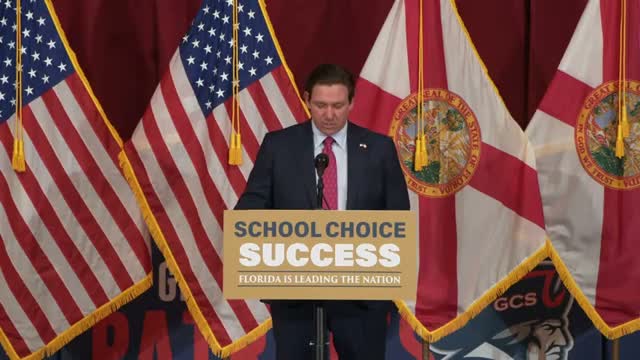
Governor DeSantis announced at Grace Christian School that Florida will participate in the federal tax-credit scholarship created by recent reconciliation legislation and said the program should begin in January 2027 if Treasury rules align with state practice. "We have registered now the highest graduation rate in the history of the state of Florida, 92.2 percent," he said, linking the federal program to the state's broader school-choice agenda.
The governor said the federal tax-credit mechanism allows taxpayers to direct a portion of their tax liability to scholarship-granting organizations rather than to the Treasury, and that states must opt into the program. "This will allow students to get..." DeSantis said, describing the federal credits as a supplement to Florida's existing ESAs and private scholarship programs.
Commissioner of Education Stasi Kamutsis, who spoke after the governor, presented data the administration uses to defend the state's approach: in a state of roughly 2.8 million students, about 1.4 million have access to a school-choice option, more than 400,000 attend charter schools and more than 530,000 participate in private-school scholarships, he said. Kamutsis also said homeschool participation has grown from around 77,000 a decade ago to more than 150,000 today.
DeSantis described state budget actions intended to raise teacher pay, saying the administration placed $1.35 billion in the current-year budget for teacher salary increases that took effect July 1 and is seeking $1.5 billion in his proposed budget to continue that effort. He said statewide policy requires that the designated funding be used only for increased teacher pay and that the state will monitor local implementation. "Out of 67 counties, we have 11 school districts that have not implemented any of the teacher salary increases," he said, blaming some local actors and unions for delaying pay increases.
DeSantis and Kamutsis framed the federal tax-credit scholarship as a potential resource to expand options for low-income families and to complement existing state resources, while the governor cautioned the state will watch for unintended consequences such as private schools that refuse scholarships or raise tuition in response to available funds. "What we don't want is the schools to just simply see this money's there and then raise the tuition," he said.
The governor previewed the state's "Schools of Hope" initiative, expected to begin in the 2027–28 school year, to place high-performing operators in struggling communities. He also recounted legal and policy steps taken at the state level to enable broader scholarship access.
The announcement did not include specific allocation figures for federal credits to Florida residents (program funding will depend on taxpayer participation), and officials said Treasury is still finalizing regulations. DeSantis said the administration will review rules as they are published and "let them know" if changes would conflict with Florida's approach.
No formal vote or legislative action occurred at the event; the governor said he expects legislative support for administrative fixes to program implementation and that further details will depend on forthcoming federal regulations.
The governor said the federal tax-credit mechanism allows taxpayers to direct a portion of their tax liability to scholarship-granting organizations rather than to the Treasury, and that states must opt into the program. "This will allow students to get..." DeSantis said, describing the federal credits as a supplement to Florida's existing ESAs and private scholarship programs.
Commissioner of Education Stasi Kamutsis, who spoke after the governor, presented data the administration uses to defend the state's approach: in a state of roughly 2.8 million students, about 1.4 million have access to a school-choice option, more than 400,000 attend charter schools and more than 530,000 participate in private-school scholarships, he said. Kamutsis also said homeschool participation has grown from around 77,000 a decade ago to more than 150,000 today.
DeSantis described state budget actions intended to raise teacher pay, saying the administration placed $1.35 billion in the current-year budget for teacher salary increases that took effect July 1 and is seeking $1.5 billion in his proposed budget to continue that effort. He said statewide policy requires that the designated funding be used only for increased teacher pay and that the state will monitor local implementation. "Out of 67 counties, we have 11 school districts that have not implemented any of the teacher salary increases," he said, blaming some local actors and unions for delaying pay increases.
DeSantis and Kamutsis framed the federal tax-credit scholarship as a potential resource to expand options for low-income families and to complement existing state resources, while the governor cautioned the state will watch for unintended consequences such as private schools that refuse scholarships or raise tuition in response to available funds. "What we don't want is the schools to just simply see this money's there and then raise the tuition," he said.
The governor previewed the state's "Schools of Hope" initiative, expected to begin in the 2027–28 school year, to place high-performing operators in struggling communities. He also recounted legal and policy steps taken at the state level to enable broader scholarship access.
The announcement did not include specific allocation figures for federal credits to Florida residents (program funding will depend on taxpayer participation), and officials said Treasury is still finalizing regulations. DeSantis said the administration will review rules as they are published and "let them know" if changes would conflict with Florida's approach.
No formal vote or legislative action occurred at the event; the governor said he expects legislative support for administrative fixes to program implementation and that further details will depend on forthcoming federal regulations.
View the Full Meeting & All Its Details
This article offers just a summary. Unlock complete video, transcripts, and insights as a Founder Member.
✓
Watch full, unedited meeting videos
✓
Search every word spoken in unlimited transcripts
✓
AI summaries & real-time alerts (all government levels)
✓
Permanent access to expanding government content
30-day money-back guarantee
