San Bernardino council advances ADU ordinance amid concerns about parking, enforcement and sizes
January 22, 2026 | San Bernardino, San Bernardino County, California
This article was created by AI summarizing key points discussed. AI makes mistakes, so for full details and context, please refer to the video of the full meeting. Please report any errors so we can fix them. Report an error »
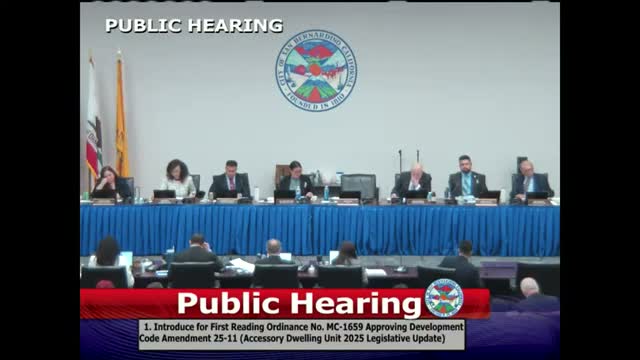
The San Bernardino City Council on Jan. 20 introduced for first reading an update to the city’s accessory dwelling unit (ADU) regulations — Ordinance MC 16‑59 (Development Code Amendment 25‑11) — to align with recent state laws AB 1154 and SB 543. Staff described the changes as largely technical but said updating local code was necessary to avoid having the city’s ADU ordinance invalidated by state law.
Staff explained AB 1154 narrows owner-occupancy requirements for junior ADUs (JADUs) by limiting owner-occupancy to units that share a bathroom with the primary dwelling and prohibiting short‑term rentals under 30 days. SB 543 requires jurisdictions to file compliance information with the California Department of Housing and Community Development within 60 days of adoption and clarifies interior livable‑space definitions and certain fee exemptions for small ADUs.
Council discussion focused less on the text of the ordinance and more on local impacts. Councilmember Ortiz and others said the city is seeing conversions and unpermitted ADU construction across neighborhoods — garages removed and structures added without inspection — and asked what the city is doing to enforce permits and manage parking. Staff and the city attorney said permits remain ministerial under state law and that many enforcement options (including parking regulation) would require separate code amendments and additional enforcement resources.
On maximum sizes, staff said the city had already set local size limits at the smallest legally allowed levels: maximum interior livable space of 850 square feet for a studio/one‑bedroom ADU and 1,000 square feet for units with two or more bedrooms; state law otherwise allows up to 1,200 square feet for detached ADUs. Several councilmembers asked staff to return with options — for example, targeted permitting, parking permit programs and enforcement strategies — and asked for memos showing how many ADUs applied for in 2021 were completed (staff said they received over 2,000 ADU applications initially and that more than 25% had been completed based on earlier internal figures).
Councilmember Sherritt said he opposed the ordinance in principle as “an unfunded state mandate,” but the council approved the procedural motion to introduce the ordinance and waive further reading so the city’s ordinance aligns with state law. The council recorded a motion and vote to proceed. Staff will prepare follow‑up materials per several members’ requests, including enforcement options, parking strategies and answers about permit completion counts.
Councilmembers and staff repeatedly distinguished discussion items from formal direction: the ordinance introduction is a procedural step to keep the city’s ADU rules in force while staff prepares any separate code or enforcement changes the council may later consider.
Staff explained AB 1154 narrows owner-occupancy requirements for junior ADUs (JADUs) by limiting owner-occupancy to units that share a bathroom with the primary dwelling and prohibiting short‑term rentals under 30 days. SB 543 requires jurisdictions to file compliance information with the California Department of Housing and Community Development within 60 days of adoption and clarifies interior livable‑space definitions and certain fee exemptions for small ADUs.
Council discussion focused less on the text of the ordinance and more on local impacts. Councilmember Ortiz and others said the city is seeing conversions and unpermitted ADU construction across neighborhoods — garages removed and structures added without inspection — and asked what the city is doing to enforce permits and manage parking. Staff and the city attorney said permits remain ministerial under state law and that many enforcement options (including parking regulation) would require separate code amendments and additional enforcement resources.
On maximum sizes, staff said the city had already set local size limits at the smallest legally allowed levels: maximum interior livable space of 850 square feet for a studio/one‑bedroom ADU and 1,000 square feet for units with two or more bedrooms; state law otherwise allows up to 1,200 square feet for detached ADUs. Several councilmembers asked staff to return with options — for example, targeted permitting, parking permit programs and enforcement strategies — and asked for memos showing how many ADUs applied for in 2021 were completed (staff said they received over 2,000 ADU applications initially and that more than 25% had been completed based on earlier internal figures).
Councilmember Sherritt said he opposed the ordinance in principle as “an unfunded state mandate,” but the council approved the procedural motion to introduce the ordinance and waive further reading so the city’s ordinance aligns with state law. The council recorded a motion and vote to proceed. Staff will prepare follow‑up materials per several members’ requests, including enforcement options, parking strategies and answers about permit completion counts.
Councilmembers and staff repeatedly distinguished discussion items from formal direction: the ordinance introduction is a procedural step to keep the city’s ADU rules in force while staff prepares any separate code or enforcement changes the council may later consider.
View the Full Meeting & All Its Details
This article offers just a summary. Unlock complete video, transcripts, and insights as a Founder Member.
✓
Watch full, unedited meeting videos
✓
Search every word spoken in unlimited transcripts
✓
AI summaries & real-time alerts (all government levels)
✓
Permanent access to expanding government content
30-day money-back guarantee
