San Jose staff proposes higher housing capacity, points to SB 79 as a major driver
January 22, 2026 | San Jose , Santa Clara County, California
This article was created by AI summarizing key points discussed. AI makes mistakes, so for full details and context, please refer to the video of the full meeting. Please report any errors so we can fix them. Report an error »
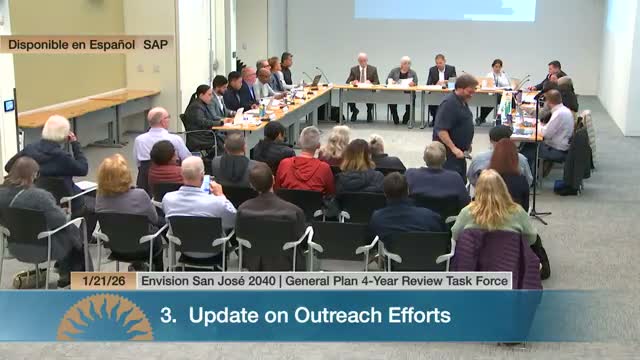
San Jose planning staff recommended increasing the city’s residential capacity during a task force meeting, citing state housing mandates and recent population forecasts.
“Since 2011, approximately 57,000 units have either been constructed, or they are under construction, or are entitled,” planner Sunita Ghoshal summarized, noting an additional 44,800 units were earmarked for the housing element site inventory and that this “has left the city with a remaining capacity of 18,000 units out of the 120,000 units that was originally planned in the general plan.” Staff said they are preparing to raise that capacity and indicated they are “recommending increasing the capacity to between 30,060 units.”
Why it matters: staff framed the proposal as a preparatory step for the next RHNA cycle and related housing element work. San Jose must demonstrate sufficient zoning capacity to match state and regional targets; it is not being required to build housing itself, staff said, but to show the land use tools are available.
Four strategies presented
1) New growth areas: Staff identified six candidate corridors near higher‑quality transit (examples included portions of the 66, 73 and 77 bus corridors and Winchester Boulevard) and proposed a starting rule of roughly two blocks from transit corridors as an initial boundary for expanded growth. Staff said corridors were chosen to connect existing growth areas and take advantage of higher frequency service.
2) Missing middle and state law alignment: Staff said work on missing‑middle housing (townhomes, multiplexes) will continue on a parallel track and will incorporate recent state laws (SB 9 and related statutes). The presentation highlighted SB 79 — the Abundant and Affordable Homes Near Transit Act — as particularly consequential: “The law will become effective 07/01/2026,” staff said, and SB 79 could allow development within a half‑mile of qualifying transit and raise allowed densities substantially.
3) Residential Neighborhood (RN) adjustments: Staff proposed to change the RN land‑use language to allow up to 16 dwelling units per acre citywide by removing the prevailing‑density requirement, aligning local policy with what state law already allows in some circumstances.
4) Targeted general plan amendments: Staff outlined three parcel buckets — commercial parcels with longstanding residential uses (about 80 parcels, staff estimated could yield roughly 500 units), mixed‑use commercial parcels where commercial requirements have weakened, and select public/quasi‑public (PQP) sites such as schools and churches that communities or districts have indicated might be candidates for conversion with negotiated community benefits.
State law and constraints: Staff repeatedly cautioned that SB 79 remains under analysis and that some SB 79 effects (for example, parcels within 200 feet of station pedestrian access points being eligible for up to 160 dwelling units per acre) could change capacity estimates once final local maps are prepared and state rules are applied.
Questions and requested analyses: Commissioners pressed staff for more granular parcel‑level estimates, equity overlays (for legacy redlining areas), VMT (vehicle miles traveled) and traffic mitigation analysis, and water and school‑capacity projections tied to proposed PQP conversions. Staff committed to returning in April with parcel‑specific analysis and said it could run both a two‑block and a six‑block scenario for expanded growth areas.
Quotes from stakeholders and agencies: Robert Swirk, principal planner at VTA, said the agency appreciated staff collaboration and encouraged streamlining transit‑oriented development near stations and high‑quality bus corridors. Staff also noted that environmental review and project‑level analysis will include required transportation demand management measures and water‑supply assessment.
Next steps: Staff will refine the numbers, prepare parcel‑level capacity estimates, run layered (2‑block and 6‑block) scenarios and report back to the task force in April. City staff also said they would present a staff report to the City Council on SB 79 prior to the council’s consideration.
“Since 2011, approximately 57,000 units have either been constructed, or they are under construction, or are entitled,” planner Sunita Ghoshal summarized, noting an additional 44,800 units were earmarked for the housing element site inventory and that this “has left the city with a remaining capacity of 18,000 units out of the 120,000 units that was originally planned in the general plan.” Staff said they are preparing to raise that capacity and indicated they are “recommending increasing the capacity to between 30,060 units.”
Why it matters: staff framed the proposal as a preparatory step for the next RHNA cycle and related housing element work. San Jose must demonstrate sufficient zoning capacity to match state and regional targets; it is not being required to build housing itself, staff said, but to show the land use tools are available.
Four strategies presented
1) New growth areas: Staff identified six candidate corridors near higher‑quality transit (examples included portions of the 66, 73 and 77 bus corridors and Winchester Boulevard) and proposed a starting rule of roughly two blocks from transit corridors as an initial boundary for expanded growth. Staff said corridors were chosen to connect existing growth areas and take advantage of higher frequency service.
2) Missing middle and state law alignment: Staff said work on missing‑middle housing (townhomes, multiplexes) will continue on a parallel track and will incorporate recent state laws (SB 9 and related statutes). The presentation highlighted SB 79 — the Abundant and Affordable Homes Near Transit Act — as particularly consequential: “The law will become effective 07/01/2026,” staff said, and SB 79 could allow development within a half‑mile of qualifying transit and raise allowed densities substantially.
3) Residential Neighborhood (RN) adjustments: Staff proposed to change the RN land‑use language to allow up to 16 dwelling units per acre citywide by removing the prevailing‑density requirement, aligning local policy with what state law already allows in some circumstances.
4) Targeted general plan amendments: Staff outlined three parcel buckets — commercial parcels with longstanding residential uses (about 80 parcels, staff estimated could yield roughly 500 units), mixed‑use commercial parcels where commercial requirements have weakened, and select public/quasi‑public (PQP) sites such as schools and churches that communities or districts have indicated might be candidates for conversion with negotiated community benefits.
State law and constraints: Staff repeatedly cautioned that SB 79 remains under analysis and that some SB 79 effects (for example, parcels within 200 feet of station pedestrian access points being eligible for up to 160 dwelling units per acre) could change capacity estimates once final local maps are prepared and state rules are applied.
Questions and requested analyses: Commissioners pressed staff for more granular parcel‑level estimates, equity overlays (for legacy redlining areas), VMT (vehicle miles traveled) and traffic mitigation analysis, and water and school‑capacity projections tied to proposed PQP conversions. Staff committed to returning in April with parcel‑specific analysis and said it could run both a two‑block and a six‑block scenario for expanded growth areas.
Quotes from stakeholders and agencies: Robert Swirk, principal planner at VTA, said the agency appreciated staff collaboration and encouraged streamlining transit‑oriented development near stations and high‑quality bus corridors. Staff also noted that environmental review and project‑level analysis will include required transportation demand management measures and water‑supply assessment.
Next steps: Staff will refine the numbers, prepare parcel‑level capacity estimates, run layered (2‑block and 6‑block) scenarios and report back to the task force in April. City staff also said they would present a staff report to the City Council on SB 79 prior to the council’s consideration.
View the Full Meeting & All Its Details
This article offers just a summary. Unlock complete video, transcripts, and insights as a Founder Member.
✓
Watch full, unedited meeting videos
✓
Search every word spoken in unlimited transcripts
✓
AI summaries & real-time alerts (all government levels)
✓
Permanent access to expanding government content
30-day money-back guarantee
