City attorney reviews Brown Act, agenda rules and conflict rules with Animal Well‑being Commission
January 22, 2026 | Sacramento , Sacramento County, California
This article was created by AI summarizing key points discussed. AI makes mistakes, so for full details and context, please refer to the video of the full meeting. Please report any errors so we can fix them. Report an error »
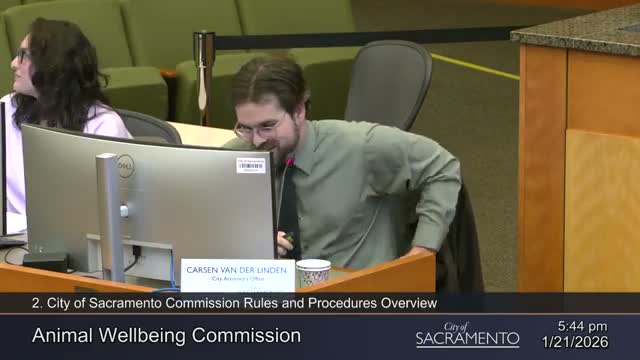
Deputy City Attorney Carson Vanderlinden told the City of Sacramento Animal Well‑being Commission it is an advisory body that provides recommendations to the City Council on animal care services, while staff controls what appears on future agendas. "The commission is established for the purpose of providing advice and recommendations to the city council on strategies, policies, and programs designed to ensure and enhance animal care services," Vanderlinden said during his presentation.
Vanderlinden reviewed the Brown Act’s core requirement that public business must be conducted in public, warned against "serial meetings" (including daisy‑chain email or spoken hubs that could involve a quorum outside a public meeting) and described acceptable exceptions such as purely social events or public conferences. He said regular meeting agendas must be posted at least 72 hours ahead, and noted a City Sunshine Ordinance that requires a 120‑hour posting in Sacramento.
He also reviewed Rosenberg’s rules of order (used by Sacramento commissions), clarifying that motions require a mover and a second to be discussed, and a simple majority of the quorum is needed to pass an item. On ethics, he summarized the Political Reform Act’s disclosure and recusal rules, advising commissioners to file conflict forms and to consult staff before meetings if they believe a financial or material interest may present a conflict.
City Clerk Mindy Kuppi followed with a practical overview of the follow‑up log: a running list of commissioner requests that staff tracks and uses to set future agendas. Kuppi said commissioners can add items under the meeting’s "ideas, comments and questions" section; staff then determines timing and feasibility and may mark items "not applicable" if they fall outside the commission’s statutory scope.
Why it matters: The briefing clarified limits on commissioner‑to‑commissioner communications, how off‑agenda requests should be handled, and the division of responsibility between the commission (advisory) and staff (agenda and implementation). Vanderlinden and Kuppi advised commissioners to route time‑sensitive requests through council members or staff and to use written follow‑up requests to avoid inadvertent Brown Act violations.
What’s next: Commissioners asked for citations and for staff to share ordinance text and resources; Vanderlinden offered to provide specific citations and Kuppi said the ordinance text is included in the meeting packet.
Vanderlinden reviewed the Brown Act’s core requirement that public business must be conducted in public, warned against "serial meetings" (including daisy‑chain email or spoken hubs that could involve a quorum outside a public meeting) and described acceptable exceptions such as purely social events or public conferences. He said regular meeting agendas must be posted at least 72 hours ahead, and noted a City Sunshine Ordinance that requires a 120‑hour posting in Sacramento.
He also reviewed Rosenberg’s rules of order (used by Sacramento commissions), clarifying that motions require a mover and a second to be discussed, and a simple majority of the quorum is needed to pass an item. On ethics, he summarized the Political Reform Act’s disclosure and recusal rules, advising commissioners to file conflict forms and to consult staff before meetings if they believe a financial or material interest may present a conflict.
City Clerk Mindy Kuppi followed with a practical overview of the follow‑up log: a running list of commissioner requests that staff tracks and uses to set future agendas. Kuppi said commissioners can add items under the meeting’s "ideas, comments and questions" section; staff then determines timing and feasibility and may mark items "not applicable" if they fall outside the commission’s statutory scope.
Why it matters: The briefing clarified limits on commissioner‑to‑commissioner communications, how off‑agenda requests should be handled, and the division of responsibility between the commission (advisory) and staff (agenda and implementation). Vanderlinden and Kuppi advised commissioners to route time‑sensitive requests through council members or staff and to use written follow‑up requests to avoid inadvertent Brown Act violations.
What’s next: Commissioners asked for citations and for staff to share ordinance text and resources; Vanderlinden offered to provide specific citations and Kuppi said the ordinance text is included in the meeting packet.
View the Full Meeting & All Its Details
This article offers just a summary. Unlock complete video, transcripts, and insights as a Founder Member.
✓
Watch full, unedited meeting videos
✓
Search every word spoken in unlimited transcripts
✓
AI summaries & real-time alerts (all government levels)
✓
Permanent access to expanding government content
30-day money-back guarantee
