Locust Valley board hears 2026–27 budget details, hears $92.7 million tax‑levy ceiling
January 29, 2026 | LOCUST VALLEY CENTRAL SCHOOL DISTRICT, School Districts, New York
This article was created by AI summarizing key points discussed. AI makes mistakes, so for full details and context, please refer to the video of the full meeting. Please report any errors so we can fix them. Report an error »
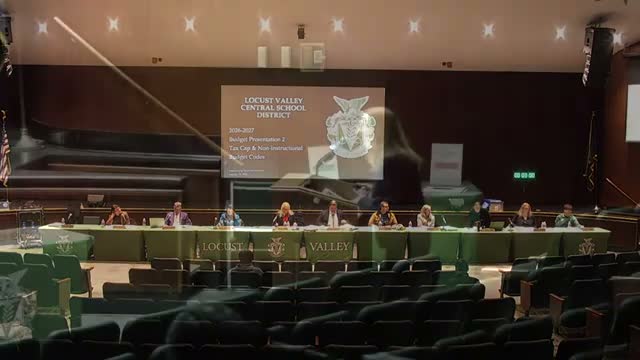
Administrators presented the second portion of the Locust Valley Central School District’s proposed 2026–27 operating budget and walked trustees through the state tax‑cap calculation and reserve strategy.
The budget presenter said the district’s current operating budget for 2025–26 is $98,289,000 and that the state formula produced a maximum tax‑levy ceiling for next year of $92,722,000. "So the current year's tax levy maximum is 92,722,000," the presenter told the board while emphasizing that the figure is a ceiling and not necessarily the levy the district will propose to voters.
The presentation reviewed the district’s fund‑balance classifications — non‑spendable, restricted (reserves), assigned (encumbrances) and unassigned — and noted the unassigned fund balance stands at $3,900,000, which the presenter said represents the 4% rainy‑day fund allowed by New York State. The presenter described the recent decrease in total reserves as a planned utilization of capital and repair reserves rather than a revenue shortfall.
On specific lines, the presenter said contractual salary increases account for modest percentage increases in several non‑instructional codes (for example, a 2.62% rise in business administration and a 4.27% rise under personnel tied to contractual costs). The presentation also flagged a roughly $102,000 equipment purchase for a tractor to support maintenance and snow removal; trustees were told that some maintenance projects would be deferred and contractual lines reduced to offset that purchase.
Other highlights included a 13% estimated increase in property and casualty insurance driven by carrier estimates, a 24% increase in a "contractual and other" line tied to Medicaid cost‑filing reimbursements, and a transportation budget showing a small net decrease (about 2.4%) while the district reviews vendor proposals under a new RFP for contract transportation.
During Q&A, a board member asked how often the district draws on the 4% unassigned fund. The presenter replied the district has not exceeded the 4% cap and described the reserve as an emergency fund to preserve classroom programs during downturns.
The administration said the next public review will cover athletics, technology and a potential transfer to capital at the Feb. 25 board meeting.
Provincial note: the presentation materials and figures were presented on screen to the board and are available through the district’s business office page.
The budget presenter said the district’s current operating budget for 2025–26 is $98,289,000 and that the state formula produced a maximum tax‑levy ceiling for next year of $92,722,000. "So the current year's tax levy maximum is 92,722,000," the presenter told the board while emphasizing that the figure is a ceiling and not necessarily the levy the district will propose to voters.
The presentation reviewed the district’s fund‑balance classifications — non‑spendable, restricted (reserves), assigned (encumbrances) and unassigned — and noted the unassigned fund balance stands at $3,900,000, which the presenter said represents the 4% rainy‑day fund allowed by New York State. The presenter described the recent decrease in total reserves as a planned utilization of capital and repair reserves rather than a revenue shortfall.
On specific lines, the presenter said contractual salary increases account for modest percentage increases in several non‑instructional codes (for example, a 2.62% rise in business administration and a 4.27% rise under personnel tied to contractual costs). The presentation also flagged a roughly $102,000 equipment purchase for a tractor to support maintenance and snow removal; trustees were told that some maintenance projects would be deferred and contractual lines reduced to offset that purchase.
Other highlights included a 13% estimated increase in property and casualty insurance driven by carrier estimates, a 24% increase in a "contractual and other" line tied to Medicaid cost‑filing reimbursements, and a transportation budget showing a small net decrease (about 2.4%) while the district reviews vendor proposals under a new RFP for contract transportation.
During Q&A, a board member asked how often the district draws on the 4% unassigned fund. The presenter replied the district has not exceeded the 4% cap and described the reserve as an emergency fund to preserve classroom programs during downturns.
The administration said the next public review will cover athletics, technology and a potential transfer to capital at the Feb. 25 board meeting.
Provincial note: the presentation materials and figures were presented on screen to the board and are available through the district’s business office page.
View the Full Meeting & All Its Details
This article offers just a summary. Unlock complete video, transcripts, and insights as a Founder Member.
✓
Watch full, unedited meeting videos
✓
Search every word spoken in unlimited transcripts
✓
AI summaries & real-time alerts (all government levels)
✓
Permanent access to expanding government content
30-day money-back guarantee
