Education funding panel weighs tiered thresholds, documentation and quarterly payments for special education
January 29, 2026 | Education, House of Representatives, Committees , Legislative, New Hampshire
This article was created by AI summarizing key points discussed. AI makes mistakes, so for full details and context, please refer to the video of the full meeting. Please report any errors so we can fix them. Report an error »
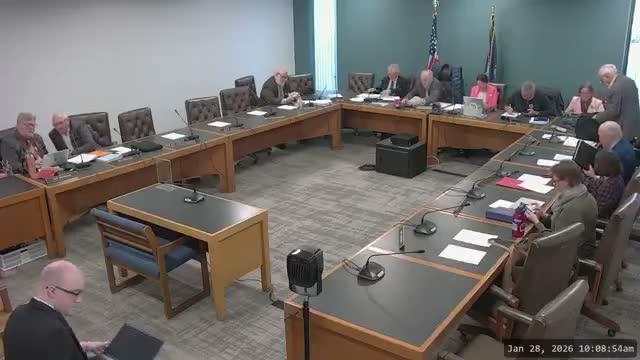
CONCORD — The House Education Funding Committee met in a work session to consider three related bills aimed at reshaping how the state helps school districts pay for costly special-education services.
Representative Ladd, chair of the Education Funding Committee, opened the meeting by saying the committee would examine HB 1557, HB 1563 and HB 1835 together because they contain overlapping language addressing special-education funding. "All these bills have to do with special education and the funding of special education and the design of the formulas that support that funding of special education," he said.
Why it matters: Committee members said rising catastrophic special-education costs are straining district budgets. Current estimates discussed at the hearing put roughly 85% of many special-education costs on local districts, with the state and federal grants covering the remainder. Lawmakers said they want to preserve services while limiting the unplanned, unbudgeted burdens that fall on small districts.
What the draft would do: Ladd walked members through a draft that removes an absolute state cap and replaces it with a tiered, dollar-based structure. Under the chair’s draft, districts would be liable for a first band (example figure used in the draft: $50,000 per pupil), pay 90% of the difference up to $60,000, while the Department of Education (DOE) would cover 10% in that band. The draft then gives the state larger shares for higher-cost bands — for example, 80% of costs between $60,000 and $200,000, and 90% of costs above $200,000, eliminating the earlier $160,000 per-pupil cap proposed in one bill.
Department guidance and documentation: Rebecca, a department special-education official, told the committee the department’s current practice is ‘‘inclusionary’’ — it lists what will be paid rather than enumerating what is excluded. "If it's not there, we won't pay for it," she said, explaining that reimbursements must be tied to services documented in a student's individualized education program (IEP) and supported with documentation such as schedules, payroll records and invoices. The draft would codify tighter documentation standards and allow the DOE to disqualify undocumented claims.
Audits, staffing and quarterly payments: Members pressed the department about administrative burden and audit strategy. Some members urged moving from an end‑of‑year reimbursement to a quarterly payment cycle to ease cash‑flow pressure on districts. The department warned that quarterly payments would require year‑round processing and alter proration mechanics if appropriations are insufficient; it said billing timing varies by provider and that current staff include seasonal clerks hired July–December.
Data and cost estimates: Brian, a DOE staffer, offered data used in discussion: dividing total special-education expenditures by special-education ADM produced an average special-education cost per student of roughly $33,262 for FY 2025. Committee members said the state is currently "flying blind" below the present multiplier trigger and urged better data collection before major structural changes.
Emergency assistance and transition challenges: Lawmakers also discussed a modest emergency-assistance appropriation (statute currently references $250,000 and an additional $250,000 for very small districts) that staff said has rarely been tapped and that funds are not generally available at the start of the year without reducing other special-education aid. Several members cautioned that any move to shift payment timing or eligibility will require careful transition language to avoid creating cash-flow or coverage gaps for districts.
Next steps: The chair said he will circulate a revised draft to the committee, asked the department for additional costing data and signaled the committee will continue work in follow-up executive sessions. No motions or votes were taken in the work session.
Quotes that mattered
"We do have both the director of special education here today, and we have Brian Eaton who's working within special education," Representative Ladd said as he introduced departmental staff and the day's agenda.
"Currently, we don't have language exactly like this. Ours is more of an inclusionary language where it says this is what is allowed," Rebecca said when the committee asked whether the draft's exclusions matched current DOE rule language.
"For FY '25, it was $33,262," Brian said when asked for an average special-education cost per pupil used to model changes.
What was not decided: The committee did not vote on the bills. Members debated whether to use one bill as a vehicle and graft provisions from the others, whether to retain multipliers (e.g., 3.5 times the state average) or switch to fixed-dollar triggers (e.g., $50,000, $60,000), and how to ensure adequate state funding without imposing excessive administrative burden on districts.
The committee scheduled follow-up work, asked the DOE for more detailed costing and implementation information, and the chair said he would circulate a revised draft for members to review before taking formal action.
Representative Ladd, chair of the Education Funding Committee, opened the meeting by saying the committee would examine HB 1557, HB 1563 and HB 1835 together because they contain overlapping language addressing special-education funding. "All these bills have to do with special education and the funding of special education and the design of the formulas that support that funding of special education," he said.
Why it matters: Committee members said rising catastrophic special-education costs are straining district budgets. Current estimates discussed at the hearing put roughly 85% of many special-education costs on local districts, with the state and federal grants covering the remainder. Lawmakers said they want to preserve services while limiting the unplanned, unbudgeted burdens that fall on small districts.
What the draft would do: Ladd walked members through a draft that removes an absolute state cap and replaces it with a tiered, dollar-based structure. Under the chair’s draft, districts would be liable for a first band (example figure used in the draft: $50,000 per pupil), pay 90% of the difference up to $60,000, while the Department of Education (DOE) would cover 10% in that band. The draft then gives the state larger shares for higher-cost bands — for example, 80% of costs between $60,000 and $200,000, and 90% of costs above $200,000, eliminating the earlier $160,000 per-pupil cap proposed in one bill.
Department guidance and documentation: Rebecca, a department special-education official, told the committee the department’s current practice is ‘‘inclusionary’’ — it lists what will be paid rather than enumerating what is excluded. "If it's not there, we won't pay for it," she said, explaining that reimbursements must be tied to services documented in a student's individualized education program (IEP) and supported with documentation such as schedules, payroll records and invoices. The draft would codify tighter documentation standards and allow the DOE to disqualify undocumented claims.
Audits, staffing and quarterly payments: Members pressed the department about administrative burden and audit strategy. Some members urged moving from an end‑of‑year reimbursement to a quarterly payment cycle to ease cash‑flow pressure on districts. The department warned that quarterly payments would require year‑round processing and alter proration mechanics if appropriations are insufficient; it said billing timing varies by provider and that current staff include seasonal clerks hired July–December.
Data and cost estimates: Brian, a DOE staffer, offered data used in discussion: dividing total special-education expenditures by special-education ADM produced an average special-education cost per student of roughly $33,262 for FY 2025. Committee members said the state is currently "flying blind" below the present multiplier trigger and urged better data collection before major structural changes.
Emergency assistance and transition challenges: Lawmakers also discussed a modest emergency-assistance appropriation (statute currently references $250,000 and an additional $250,000 for very small districts) that staff said has rarely been tapped and that funds are not generally available at the start of the year without reducing other special-education aid. Several members cautioned that any move to shift payment timing or eligibility will require careful transition language to avoid creating cash-flow or coverage gaps for districts.
Next steps: The chair said he will circulate a revised draft to the committee, asked the department for additional costing data and signaled the committee will continue work in follow-up executive sessions. No motions or votes were taken in the work session.
Quotes that mattered
"We do have both the director of special education here today, and we have Brian Eaton who's working within special education," Representative Ladd said as he introduced departmental staff and the day's agenda.
"Currently, we don't have language exactly like this. Ours is more of an inclusionary language where it says this is what is allowed," Rebecca said when the committee asked whether the draft's exclusions matched current DOE rule language.
"For FY '25, it was $33,262," Brian said when asked for an average special-education cost per pupil used to model changes.
What was not decided: The committee did not vote on the bills. Members debated whether to use one bill as a vehicle and graft provisions from the others, whether to retain multipliers (e.g., 3.5 times the state average) or switch to fixed-dollar triggers (e.g., $50,000, $60,000), and how to ensure adequate state funding without imposing excessive administrative burden on districts.
The committee scheduled follow-up work, asked the DOE for more detailed costing and implementation information, and the chair said he would circulate a revised draft for members to review before taking formal action.
View the Full Meeting & All Its Details
This article offers just a summary. Unlock complete video, transcripts, and insights as a Founder Member.
✓
Watch full, unedited meeting videos
✓
Search every word spoken in unlimited transcripts
✓
AI summaries & real-time alerts (all government levels)
✓
Permanent access to expanding government content
30-day money-back guarantee
