Public Advocate urges law to stop low‑income households from overpaying to competitive electricity providers
January 29, 2026 | 2026 Legislature ME, Maine
This article was created by AI summarizing key points discussed. AI makes mistakes, so for full details and context, please refer to the video of the full meeting. Please report any errors so we can fix them. Report an error »
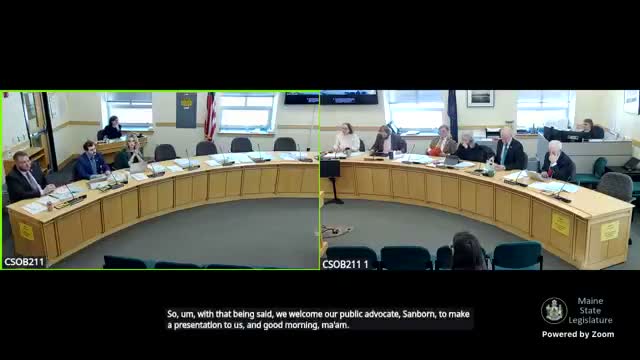
Public Advocate Heather Sanborn told the Energy, Utilities and Technology Committee on Jan. 29 that analysis of confidential utility billing records shows customers enrolled with competitive electricity providers (CEPs) have paid a total of $156,000,000 in premiums above the standard-offer supply price across the nine years covered by the study.
The report, prepared by the Office of the Public Advocate (OPA) with consultant Tim Howington and reviewed by the Electric Ratepayer Advisory Council (ERAC), used ZIP‑code‑level slices of CMP and Versant billing data for May and December snapshots since 2021. Sanborn said those snapshots reveal systematic patterns: in the most recent month presented, about 51,000 customers paid more than they would have under the standard offer, while roughly 8,400 paid less — a roughly 6:1 ratio.
Why it matters: the OPA and ERAC recommended legislation to prevent LIHAP‑enrolled utility customers (those receiving statutorily authorized low‑income assistance) from being charged a CEP supply rate that, at any time, exceeds the standard-offer rate. Sanborn told the committee that LIHAP is changing this year from a lump‑sum benefit to a percent‑off‑bill discount, which increases the risk that CEP enrollment will reduce the public assistance program’s real value and drain program funds.
Details and limitations: Sanborn emphasized the study’s limits. The granular dataset came from utilities under a PUC protective order, but CEP companies did not provide contract‑level documents, length-of-contract data, or redemption statistics for discounts and gift cards. “No data for this study was provided to us by the CEPs themselves,” she said, and that prevented the office from quantifying non‑price benefits (for example, an affiliated oil discount or a $100 signup gift card) and how long any premium might be offset by those benefits.
Committee response and next steps: Committee staff drafted draft language based on the OPA/ERAC recommendation that would bar CEPs from entering or renewing contracts with residential LIHAP customers if the contract can result in a rate higher than the standard offer. After discussion about implementation options — a simple rule that LIHAP recipients must take standard offer versus a PUC‑administered cap that preserves consumer choice when a CEP demonstrably offers a lower supply rate — the committee took a procedural show‑of‑hands to have the language printed as a committee bill for a public hearing. The chair reported the procedural poll unanimous in favor of printing the bill for public comment and a formal hearing.
What was not decided: The committee did not adopt final statutory text at the session and acknowledged data gaps that CEPs declined to fill. Sanborn urged the committee that the proposed protection is modest and implementable while leaving room for CEPs that can document below‑standard rates to continue operating.
The committee scheduled the bill for further review and a public hearing so members can receive testimony and finer drafting guidance before a final vote.
The report, prepared by the Office of the Public Advocate (OPA) with consultant Tim Howington and reviewed by the Electric Ratepayer Advisory Council (ERAC), used ZIP‑code‑level slices of CMP and Versant billing data for May and December snapshots since 2021. Sanborn said those snapshots reveal systematic patterns: in the most recent month presented, about 51,000 customers paid more than they would have under the standard offer, while roughly 8,400 paid less — a roughly 6:1 ratio.
Why it matters: the OPA and ERAC recommended legislation to prevent LIHAP‑enrolled utility customers (those receiving statutorily authorized low‑income assistance) from being charged a CEP supply rate that, at any time, exceeds the standard-offer rate. Sanborn told the committee that LIHAP is changing this year from a lump‑sum benefit to a percent‑off‑bill discount, which increases the risk that CEP enrollment will reduce the public assistance program’s real value and drain program funds.
Details and limitations: Sanborn emphasized the study’s limits. The granular dataset came from utilities under a PUC protective order, but CEP companies did not provide contract‑level documents, length-of-contract data, or redemption statistics for discounts and gift cards. “No data for this study was provided to us by the CEPs themselves,” she said, and that prevented the office from quantifying non‑price benefits (for example, an affiliated oil discount or a $100 signup gift card) and how long any premium might be offset by those benefits.
Committee response and next steps: Committee staff drafted draft language based on the OPA/ERAC recommendation that would bar CEPs from entering or renewing contracts with residential LIHAP customers if the contract can result in a rate higher than the standard offer. After discussion about implementation options — a simple rule that LIHAP recipients must take standard offer versus a PUC‑administered cap that preserves consumer choice when a CEP demonstrably offers a lower supply rate — the committee took a procedural show‑of‑hands to have the language printed as a committee bill for a public hearing. The chair reported the procedural poll unanimous in favor of printing the bill for public comment and a formal hearing.
What was not decided: The committee did not adopt final statutory text at the session and acknowledged data gaps that CEPs declined to fill. Sanborn urged the committee that the proposed protection is modest and implementable while leaving room for CEPs that can document below‑standard rates to continue operating.
The committee scheduled the bill for further review and a public hearing so members can receive testimony and finer drafting guidance before a final vote.
View the Full Meeting & All Its Details
This article offers just a summary. Unlock complete video, transcripts, and insights as a Founder Member.
✓
Watch full, unedited meeting videos
✓
Search every word spoken in unlimited transcripts
✓
AI summaries & real-time alerts (all government levels)
✓
Permanent access to expanding government content
30-day money-back guarantee
