Committee backs bill to require Maine transmission utilities to join regional RTO after debate over FERC impacts
January 29, 2026 | 2026 Legislature ME, Maine
This article was created by AI summarizing key points discussed. AI makes mistakes, so for full details and context, please refer to the video of the full meeting. Please report any errors so we can fix them. Report an error »
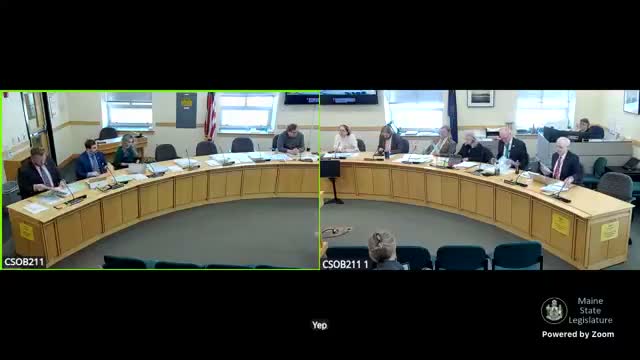
The Energy, Utilities and Technology Committee voted in work session on Jan. 29 to report LD 2038 — a bill that would require Maine transmission and distribution utilities to participate in a regional transmission organization (RTO) — as a majority 'ought to pass as amended' report after a detailed work session and debate over FERC incentives and rate impacts.
Committee staff described LD 2038 as emergency legislation that would make participation mandatory for transmission and distribution utilities, with exceptions for consumer-owned utilities and utilities in areas administered by the independent system operator for northern Maine. Staff noted definitional and statutory placement questions that the committee might resolve before final drafting.
Why it mattered in committee: Central Maine Power and Avangrid counsel argued the bill raises issues that FERC will need to resolve. Amber Martin Stone of Avangrid said the 50‑basis‑point RTO participation incentive is a long‑standing FERC policy tied to risk assumed when transmission owners ceded operational control to ISO‑NE and that eliminating the incentive would face FERC review. "We think that the bill faces some challenges when it gets to FERC because FERC will have to determine that the existing, rate and the award of the RTO incentive for Maine utilities is unjust and unreasonable," she said.
Disputed savings numbers: CMP/Avangrid provided alternative calculations that produced much smaller projected customer savings than those estimated by the OPA. CMP representatives explained that some project‑level incentives and FERC caps on authorized returns limit the extent to which removing the RTO adder would reduce customers’ bills for specific transmission projects. Committee members asked for additional detail about which parts of the rate base would be affected.
Motions and outcome: Representative Sacks moved that the committee report the bill 'ought to pass as amended' with two technical amendments (use the existing statutory definition of RTO and place the provision in Part 3 of Title 35‑A). Representative Geiger seconded. The committee’s recorded roll calls showed an initial majority favorable outcome and, after a motion to reconsider and removal of emergency language, a final majority report in favor; the committee also registered a minority 'ought not to pass' report.
What comes next: The majority and minority reports will accompany the printed LD and be available for a public hearing and further committee deliberations. The Public Advocate indicated her office can pursue any necessary FERC work within existing resources and consultant relationships if the state pursues the statutory change.
The committee did not resolve all technical questions about the statutory placement of the provision and asked staff to coordinate with the PUC and stakeholders for additional drafting refinements prior to the public hearing.
Committee staff described LD 2038 as emergency legislation that would make participation mandatory for transmission and distribution utilities, with exceptions for consumer-owned utilities and utilities in areas administered by the independent system operator for northern Maine. Staff noted definitional and statutory placement questions that the committee might resolve before final drafting.
Why it mattered in committee: Central Maine Power and Avangrid counsel argued the bill raises issues that FERC will need to resolve. Amber Martin Stone of Avangrid said the 50‑basis‑point RTO participation incentive is a long‑standing FERC policy tied to risk assumed when transmission owners ceded operational control to ISO‑NE and that eliminating the incentive would face FERC review. "We think that the bill faces some challenges when it gets to FERC because FERC will have to determine that the existing, rate and the award of the RTO incentive for Maine utilities is unjust and unreasonable," she said.
Disputed savings numbers: CMP/Avangrid provided alternative calculations that produced much smaller projected customer savings than those estimated by the OPA. CMP representatives explained that some project‑level incentives and FERC caps on authorized returns limit the extent to which removing the RTO adder would reduce customers’ bills for specific transmission projects. Committee members asked for additional detail about which parts of the rate base would be affected.
Motions and outcome: Representative Sacks moved that the committee report the bill 'ought to pass as amended' with two technical amendments (use the existing statutory definition of RTO and place the provision in Part 3 of Title 35‑A). Representative Geiger seconded. The committee’s recorded roll calls showed an initial majority favorable outcome and, after a motion to reconsider and removal of emergency language, a final majority report in favor; the committee also registered a minority 'ought not to pass' report.
What comes next: The majority and minority reports will accompany the printed LD and be available for a public hearing and further committee deliberations. The Public Advocate indicated her office can pursue any necessary FERC work within existing resources and consultant relationships if the state pursues the statutory change.
The committee did not resolve all technical questions about the statutory placement of the provision and asked staff to coordinate with the PUC and stakeholders for additional drafting refinements prior to the public hearing.
Don't Miss a Word: See the Full Meeting!
Go beyond summaries. Unlock every video, transcript, and key insight with a Founder Membership.
✓
Get instant access to full meeting videos
✓
Search and clip any phrase from complete transcripts
✓
Receive AI-powered summaries & custom alerts
✓
Enjoy lifetime, unrestricted access to government data
30-day money-back guarantee
