Committee advances bill to make small plug‑in solar and battery systems more accessible while setting safety and notification rules
January 29, 2026 | 2026 Legislature ME, Maine
This article was created by AI summarizing key points discussed. AI makes mistakes, so for full details and context, please refer to the video of the full meeting. Please report any errors so we can fix them. Report an error »
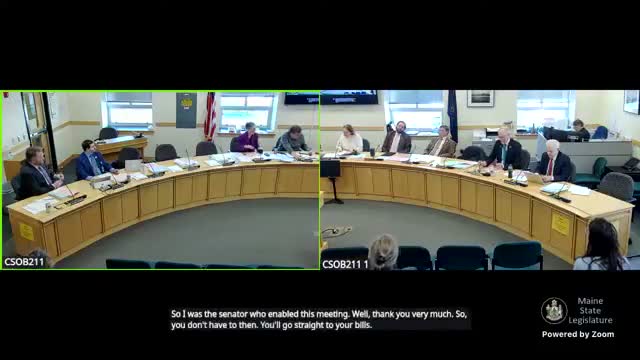
Senator Grochowski presented amendments to LD 1730 on Jan. 29 designed to broaden access to small plug‑in photovoltaic and battery systems while addressing safety and grid concerns. The amended draft removes a building‑code change and focuses on standards and thresholds for small devices.
Key points of the amendment: Eligible systems must meet applicable safety standards (the amendment references Underwriters Laboratories UL 3700 and NEC standards) and be configured to shut off within 0.2 seconds if line power is disrupted. The amendment establishes a two‑tier capacity approach: systems with combined inverter output up to 420 watts may be installed without electrician involvement and without mandatory utility notification; combined output above 420 watts and up to 1,200 watts requires installation by a state‑licensed electrician, a dedicated circuit with a single outlet, and notification to the customer’s utility through a standardized PUC form.
Why sponsors made the change: Senator Grochowski said the lower 420W threshold balances safety and affordability and that adopting UL 3700 into the definition keeps the law aligned with evolving standards. Utilities raised concerns about export controls and grid impacts, but sponsor and staff cited engineering studies indicating negligible net export risk at plausible adoption rates and emphasized that the statute is intended to remove barriers to safe, inexpensive devices for households.
Debate highlights and landlord/tenant considerations: Some members expressed concern about multi‑unit buildings and landlord/tenant conflicts; sponsors suggested existing property and leasing law govern tenant behavior, and staff agreed to craft clarifying language so the bill does not unintentionally supplant homeowner or local statutory authorities.
Vote and next steps: Senator Grochowski moved to report the bill 'ought to pass as amended' (the Jan. 29 amendment) and Representative Sachs seconded. The roll call produced 9 yes, 2 no; the committee produced a majority report to move the amendment forward to printing and a public hearing.
The committee added a staff instruction to refine statutory language addressing homeowner authority and to ensure the PUC can adopt standard notification forms and implementation rules ahead of any market expansion.
Key points of the amendment: Eligible systems must meet applicable safety standards (the amendment references Underwriters Laboratories UL 3700 and NEC standards) and be configured to shut off within 0.2 seconds if line power is disrupted. The amendment establishes a two‑tier capacity approach: systems with combined inverter output up to 420 watts may be installed without electrician involvement and without mandatory utility notification; combined output above 420 watts and up to 1,200 watts requires installation by a state‑licensed electrician, a dedicated circuit with a single outlet, and notification to the customer’s utility through a standardized PUC form.
Why sponsors made the change: Senator Grochowski said the lower 420W threshold balances safety and affordability and that adopting UL 3700 into the definition keeps the law aligned with evolving standards. Utilities raised concerns about export controls and grid impacts, but sponsor and staff cited engineering studies indicating negligible net export risk at plausible adoption rates and emphasized that the statute is intended to remove barriers to safe, inexpensive devices for households.
Debate highlights and landlord/tenant considerations: Some members expressed concern about multi‑unit buildings and landlord/tenant conflicts; sponsors suggested existing property and leasing law govern tenant behavior, and staff agreed to craft clarifying language so the bill does not unintentionally supplant homeowner or local statutory authorities.
Vote and next steps: Senator Grochowski moved to report the bill 'ought to pass as amended' (the Jan. 29 amendment) and Representative Sachs seconded. The roll call produced 9 yes, 2 no; the committee produced a majority report to move the amendment forward to printing and a public hearing.
The committee added a staff instruction to refine statutory language addressing homeowner authority and to ensure the PUC can adopt standard notification forms and implementation rules ahead of any market expansion.
Don't Miss a Word: See the Full Meeting!
Go beyond summaries. Unlock every video, transcript, and key insight with a Founder Membership.
✓
Get instant access to full meeting videos
✓
Search and clip any phrase from complete transcripts
✓
Receive AI-powered summaries & custom alerts
✓
Enjoy lifetime, unrestricted access to government data
30-day money-back guarantee
