Committee deadlocks on amended menhaden eligibility language after DMR analysis and fishermen testimony
January 29, 2026 | 2026 Legislature ME, Maine
This article was created by AI summarizing key points discussed. AI makes mistakes, so for full details and context, please refer to the video of the full meeting. Please report any errors so we can fix them. Report an error »
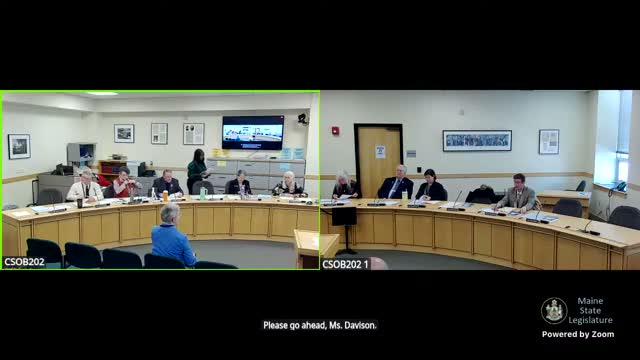
The Joint Standing Committee on Marine Resources spent an extended work session reviewing proposed language for LD 13 53, an amendment that would establish a 350‑license cap for the commercial menhaden fishery, a 1:1 exit ratio, and a path for new applicants in 2026 based on prior license possession and landings.
Analyst Anne Davidson summarized the amendment: it caps commercial menhaden licenses at 350, creates a 1‑for‑1 exit ratio, and permits applicants in 2026 who held a commercial menhaden license in at least one of 2019, 2020, 2021 or 2022 and who reported legal landings of at least 20,000 pounds in at least one of those years. The Department of Marine Resources (DMR) asked the committee to clarify whether noncommercial landings should count toward the 20,000‑pound threshold.
Deirdre Gilbert (DMR) gave updated counts: if the committee excludes 2022 from the set of qualifying years, the department estimates an additional 20 individuals would be eligible to purchase a license in 2026; if the committee includes 2022, that expands to about 43 individuals. Gilbert also noted the state currently has about 356 commercial menhaden licenses in recent records and that inclusion of noncommercial landings would add three additional cases to the eligible pool.
Fishermen who signed up to speak urged caution. James West, a seine fisherman from Sorrento, said the committee should “have it stop at the 25,000” threshold originally used, warning that incremental reductions in the qualifying poundage and repeated rule changes risked overcapitalizing the fishery and reducing the amounts any single permit holder could catch. Tad (Ira) Miller of Tenants Harbor and Matinicus cited observed declines in fish size and lesions on fish, called for building a proper limited‑entry pathway and said he did not “feel a sense of urgency to have to do this now.”
Committee members debated tradeoffs: supporters of the amendment said the proposed language creates a statutory cap and a pathway the department can use to implement limited entry; opponents cited ASMFC guidance (DMR noted a planned 20% quota reduction in 2026) and concern that expanding eligibility now would add fishing capacity while the stock and the coast’s bait needs are in flux.
After discussion and a friendly amendment clarifying that qualifying landings must be commercial and removing 2022 from the landings‑qualification clause, the committee took a roll‑call vote on the amended language. The clerk recorded 6 votes in favor and 6 opposed; the tie meant the amended motion failed to carry in committee. The chair noted the difficulty of the policy tradeoffs and that final language review and reporting must be completed before the committee’s legislative deadline.
DMR told the committee it can begin rulemaking for a limited‑entry system once the license count falls below the statutory cap (350) and signaled it would use its rulemaking authority when that threshold is met; clerks and analysts said the committee may reconsider language and the department would return with final implementation details if directed.
Analyst Anne Davidson summarized the amendment: it caps commercial menhaden licenses at 350, creates a 1‑for‑1 exit ratio, and permits applicants in 2026 who held a commercial menhaden license in at least one of 2019, 2020, 2021 or 2022 and who reported legal landings of at least 20,000 pounds in at least one of those years. The Department of Marine Resources (DMR) asked the committee to clarify whether noncommercial landings should count toward the 20,000‑pound threshold.
Deirdre Gilbert (DMR) gave updated counts: if the committee excludes 2022 from the set of qualifying years, the department estimates an additional 20 individuals would be eligible to purchase a license in 2026; if the committee includes 2022, that expands to about 43 individuals. Gilbert also noted the state currently has about 356 commercial menhaden licenses in recent records and that inclusion of noncommercial landings would add three additional cases to the eligible pool.
Fishermen who signed up to speak urged caution. James West, a seine fisherman from Sorrento, said the committee should “have it stop at the 25,000” threshold originally used, warning that incremental reductions in the qualifying poundage and repeated rule changes risked overcapitalizing the fishery and reducing the amounts any single permit holder could catch. Tad (Ira) Miller of Tenants Harbor and Matinicus cited observed declines in fish size and lesions on fish, called for building a proper limited‑entry pathway and said he did not “feel a sense of urgency to have to do this now.”
Committee members debated tradeoffs: supporters of the amendment said the proposed language creates a statutory cap and a pathway the department can use to implement limited entry; opponents cited ASMFC guidance (DMR noted a planned 20% quota reduction in 2026) and concern that expanding eligibility now would add fishing capacity while the stock and the coast’s bait needs are in flux.
After discussion and a friendly amendment clarifying that qualifying landings must be commercial and removing 2022 from the landings‑qualification clause, the committee took a roll‑call vote on the amended language. The clerk recorded 6 votes in favor and 6 opposed; the tie meant the amended motion failed to carry in committee. The chair noted the difficulty of the policy tradeoffs and that final language review and reporting must be completed before the committee’s legislative deadline.
DMR told the committee it can begin rulemaking for a limited‑entry system once the license count falls below the statutory cap (350) and signaled it would use its rulemaking authority when that threshold is met; clerks and analysts said the committee may reconsider language and the department would return with final implementation details if directed.
View the Full Meeting & All Its Details
This article offers just a summary. Unlock complete video, transcripts, and insights as a Founder Member.
✓
Watch full, unedited meeting videos
✓
Search every word spoken in unlimited transcripts
✓
AI summaries & real-time alerts (all government levels)
✓
Permanent access to expanding government content
30-day money-back guarantee
