Public Safety Committee approves $650,000 programming phase for county jail study
January 29, 2026 | Rutherford County, Tennessee
This article was created by AI summarizing key points discussed. AI makes mistakes, so for full details and context, please refer to the video of the full meeting. Please report any errors so we can fix them. Report an error »
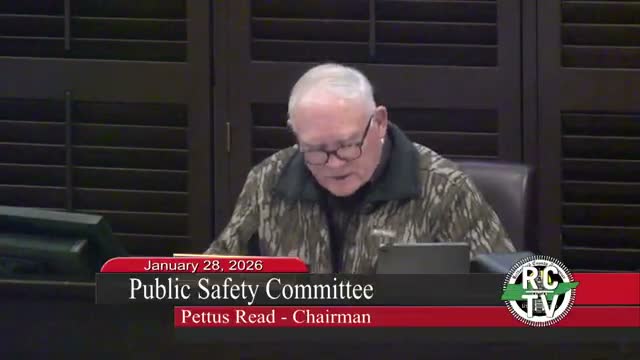
Rutherford County’s Public Safety Committee voted Thursday to advance a two-year jail study into a six-month programming phase at an estimated cost of $650,000, the first formal step toward deciding whether to renovate the existing detention center or build a new facility.
The committee’s decision followed a multi-hour briefing from the mayor’s jail study working group, the county sheriff and two outside consultants. The mayor, introducing the discussion, said the purpose was information-gathering, not a decision to build: “Tonight is not about do we build a new facility, do we renovate a new facility,” the mayor said during the presentation.
Sheriff Mike Fitzhugh told the committee the county’s detention complex — parts of which date to 1987 and 1998 — has been repeatedly altered to increase capacity and now faces serious physical‑plant and operational limits. He warned the jail’s overcrowding and out‑of‑date infrastructure put the county at risk during state inspections. The sheriff described limits on intake, a cramped sally port and worn mechanical systems, and said the facility is operating under strain that can affect staff safety and inmate classification.
Two outside experts urged the county to move to a programming phase that would produce the technical information decision‑makers need. Jim Hart of the County Technical Assistance Service said the programming phase would gather data on the building’s remaining life, mechanical systems and staffing costs and provide projections out to 2045. “That information gathering is gonna tell us … how much more life does our building have,” Hart said.
Bob Bass of the Tennessee Corrections Institute explained the state inspection process and the “plan of action” the Institute requires when fixed‑ratio (space) deficiencies are found. He warned that, if inspectors find unfixable space problems, the jail could be placed under a plan of action and face increased oversight and legal risk. “If we inspected that jail today, you would join a list of about 18 counties that would be under a plan of action,” Bass said, and added that monthly reporting and active corrective steps would then be required.
Bart Klein, the programming consultant the working group recommended, described the scope of the six‑month effort: a program update, site investigations, structure and systems assessments, classification and staffing studies, and schematic‑level solution options that will include estimated cost ranges and operational tradeoffs. Klein said the programming deliverable would be detailed enough that “anybody can build a jail off of that” once the county chooses a direction.
During discussion, Finance Director Michael Smith identified several ways to pay for the programming work, including reallocating excess capital project funds, using fund balance or including the amount in a future bond issue. Smith told commissioners he would bring specific funding options to the budget committee for a final decision.
Commissioner Beverly made the motion to move forward with programming at $650,000 and to forward the recommendation to property management and then to the budget committee; the motion passed on a roll call with the commissioners present voting in favor. The committee also approved a separate request to develop a small travel budget so commissioners and staff can visit comparable facilities during the programming phase.
Next steps: the programming phase is expected to take about six months. The consultant’s work will return to the Public Safety Committee and then to property and budget committees at go/no‑go waypoints; any decision to build, renovate or do nothing would be made later and would require further approvals and, if necessary, funding decisions from the county commission.
Votes and formal actions from the meeting were procedural and limited to advancing the programming phase and approving ancillary travel funding; no construction, site selection or bond issuance was approved at Thursday’s meeting.
The committee’s decision followed a multi-hour briefing from the mayor’s jail study working group, the county sheriff and two outside consultants. The mayor, introducing the discussion, said the purpose was information-gathering, not a decision to build: “Tonight is not about do we build a new facility, do we renovate a new facility,” the mayor said during the presentation.
Sheriff Mike Fitzhugh told the committee the county’s detention complex — parts of which date to 1987 and 1998 — has been repeatedly altered to increase capacity and now faces serious physical‑plant and operational limits. He warned the jail’s overcrowding and out‑of‑date infrastructure put the county at risk during state inspections. The sheriff described limits on intake, a cramped sally port and worn mechanical systems, and said the facility is operating under strain that can affect staff safety and inmate classification.
Two outside experts urged the county to move to a programming phase that would produce the technical information decision‑makers need. Jim Hart of the County Technical Assistance Service said the programming phase would gather data on the building’s remaining life, mechanical systems and staffing costs and provide projections out to 2045. “That information gathering is gonna tell us … how much more life does our building have,” Hart said.
Bob Bass of the Tennessee Corrections Institute explained the state inspection process and the “plan of action” the Institute requires when fixed‑ratio (space) deficiencies are found. He warned that, if inspectors find unfixable space problems, the jail could be placed under a plan of action and face increased oversight and legal risk. “If we inspected that jail today, you would join a list of about 18 counties that would be under a plan of action,” Bass said, and added that monthly reporting and active corrective steps would then be required.
Bart Klein, the programming consultant the working group recommended, described the scope of the six‑month effort: a program update, site investigations, structure and systems assessments, classification and staffing studies, and schematic‑level solution options that will include estimated cost ranges and operational tradeoffs. Klein said the programming deliverable would be detailed enough that “anybody can build a jail off of that” once the county chooses a direction.
During discussion, Finance Director Michael Smith identified several ways to pay for the programming work, including reallocating excess capital project funds, using fund balance or including the amount in a future bond issue. Smith told commissioners he would bring specific funding options to the budget committee for a final decision.
Commissioner Beverly made the motion to move forward with programming at $650,000 and to forward the recommendation to property management and then to the budget committee; the motion passed on a roll call with the commissioners present voting in favor. The committee also approved a separate request to develop a small travel budget so commissioners and staff can visit comparable facilities during the programming phase.
Next steps: the programming phase is expected to take about six months. The consultant’s work will return to the Public Safety Committee and then to property and budget committees at go/no‑go waypoints; any decision to build, renovate or do nothing would be made later and would require further approvals and, if necessary, funding decisions from the county commission.
Votes and formal actions from the meeting were procedural and limited to advancing the programming phase and approving ancillary travel funding; no construction, site selection or bond issuance was approved at Thursday’s meeting.
Don't Miss a Word: See the Full Meeting!
Go beyond summaries. Unlock every video, transcript, and key insight with a Founder Membership.
✓
Get instant access to full meeting videos
✓
Search and clip any phrase from complete transcripts
✓
Receive AI-powered summaries & custom alerts
✓
Enjoy lifetime, unrestricted access to government data
30-day money-back guarantee
