Everett council holds first reading of ordinance to curb unlicensed mobile food vendors
January 29, 2026 | Everett, Snohomish County, Washington
This article was created by AI summarizing key points discussed. AI makes mistakes, so for full details and context, please refer to the video of the full meeting. Please report any errors so we can fix them. Report an error »
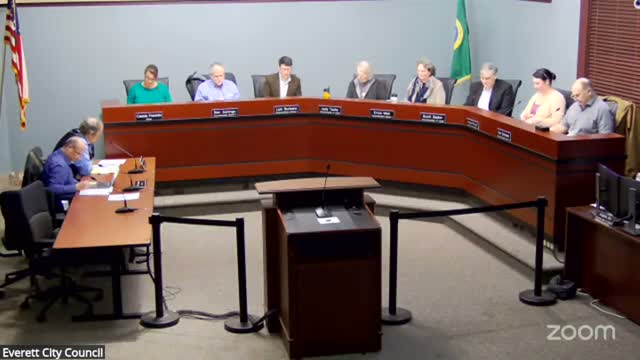
Everett — The Everett City Council on Jan. 28 held a first reading of an ordinance intended to regulate unlicensed and unpermitted mobile food vending, with staff saying the measure is aimed at protecting public health, neighborhood safety and fairness for licensed businesses.
"This ordinance will provide city staff with an effective tool to not only educate, unpermitted and unlicensed mobile food vendors, but also take enforcement action if they continue to repeatedly operate in violation," said Dan Templeman, who introduced the item during the meeting.
Assistant City Attorney Lacey Offit walked the council through the ordinance’s structure, saying it defines mobile food vendors, sets licensing, operational and location restrictions, lists broad exemptions for licensed food trucks, nonprofit activity and farmers markets, and establishes enforcement authority that runs in parallel with county and state health officials. Offit described criminal penalties under the draft: a responsible operator could face a misdemeanor with a maximum 90-day jail term and a $1,000 fine, while an employer could face a gross misdemeanor punishable by up to a 364-day jail term and a $5,000 fine.
"The employer ... is subject to a gross misdemeanor. That is defined as up to a 364 day jail stay and a $5,000 fine," Offit said.
The proposal drew public comment from a local restaurant owner, who said tents and pop-up stands operate without handwashing stations, potable water or refrigeration. "They're not following the sanitation policy," said David Bly, who identified himself as a restaurant owner and Everett resident.
Council members questioned exemptions and enforcement practice. Vice President Ryan asked why some non-food activities are listed as exemptions and asked whether nonprofits would be allowed to operate without licenses; Offit said the exemptions were intentionally broad to avoid inadvertently sweeping in small-scale or charitable activity. Ryan also urged caution about penalizing workers and said, "I don't think the workers should be fined," expressing concern most workers may be exploited or trafficked.
Deputy Chief Jeff Hendrickson described recent outreach: "For the last 2 months, we've been doing operations during the evening times where we send out officers and lieutenants, to actually make contact with all the vendors," and said the city had prepared bilingual materials and partnered with the county health district.
Councilmember Bader and others pressed whether impoundment of equipment could be used for swift deterrent effect. Offit said the ordinance explicitly includes language permitting seizure in certain circumstances but that the city will provide training and enforcement protocols to protect constitutional rights and ensure consistent application.
Templeman said the measure is meant to be an enforcement tool backed by education: "Passing this ordinance will not eliminate the opportunity for warnings in education and in fact that will remain a primary component of all of our enforcement efforts." He told the council the ordinance is intended to make enforcement "fair, transparent, and focused on community safety."
The item was presented as a first reading; the third and final reading is scheduled for Feb. 11, 2026. Council members and staff said they will continue refining the ordinance language and enforcement protocols, coordinate with Snohomish County health officials and provide clearer public guidance on how residents can report unlicensed vendors.
Next steps: the council will return the ordinance for a second and third reading, with a Feb. 11 date set for final action if the council proceeds.
"This ordinance will provide city staff with an effective tool to not only educate, unpermitted and unlicensed mobile food vendors, but also take enforcement action if they continue to repeatedly operate in violation," said Dan Templeman, who introduced the item during the meeting.
Assistant City Attorney Lacey Offit walked the council through the ordinance’s structure, saying it defines mobile food vendors, sets licensing, operational and location restrictions, lists broad exemptions for licensed food trucks, nonprofit activity and farmers markets, and establishes enforcement authority that runs in parallel with county and state health officials. Offit described criminal penalties under the draft: a responsible operator could face a misdemeanor with a maximum 90-day jail term and a $1,000 fine, while an employer could face a gross misdemeanor punishable by up to a 364-day jail term and a $5,000 fine.
"The employer ... is subject to a gross misdemeanor. That is defined as up to a 364 day jail stay and a $5,000 fine," Offit said.
The proposal drew public comment from a local restaurant owner, who said tents and pop-up stands operate without handwashing stations, potable water or refrigeration. "They're not following the sanitation policy," said David Bly, who identified himself as a restaurant owner and Everett resident.
Council members questioned exemptions and enforcement practice. Vice President Ryan asked why some non-food activities are listed as exemptions and asked whether nonprofits would be allowed to operate without licenses; Offit said the exemptions were intentionally broad to avoid inadvertently sweeping in small-scale or charitable activity. Ryan also urged caution about penalizing workers and said, "I don't think the workers should be fined," expressing concern most workers may be exploited or trafficked.
Deputy Chief Jeff Hendrickson described recent outreach: "For the last 2 months, we've been doing operations during the evening times where we send out officers and lieutenants, to actually make contact with all the vendors," and said the city had prepared bilingual materials and partnered with the county health district.
Councilmember Bader and others pressed whether impoundment of equipment could be used for swift deterrent effect. Offit said the ordinance explicitly includes language permitting seizure in certain circumstances but that the city will provide training and enforcement protocols to protect constitutional rights and ensure consistent application.
Templeman said the measure is meant to be an enforcement tool backed by education: "Passing this ordinance will not eliminate the opportunity for warnings in education and in fact that will remain a primary component of all of our enforcement efforts." He told the council the ordinance is intended to make enforcement "fair, transparent, and focused on community safety."
The item was presented as a first reading; the third and final reading is scheduled for Feb. 11, 2026. Council members and staff said they will continue refining the ordinance language and enforcement protocols, coordinate with Snohomish County health officials and provide clearer public guidance on how residents can report unlicensed vendors.
Next steps: the council will return the ordinance for a second and third reading, with a Feb. 11 date set for final action if the council proceeds.
View the Full Meeting & All Its Details
This article offers just a summary. Unlock complete video, transcripts, and insights as a Founder Member.
✓
Watch full, unedited meeting videos
✓
Search every word spoken in unlimited transcripts
✓
AI summaries & real-time alerts (all government levels)
✓
Permanent access to expanding government content
30-day money-back guarantee
