Spokane planning bodies review draft climate-policy package for Plan Spokane 2046
January 29, 2026 | Spokane, Spokane County, Washington
This article was created by AI summarizing key points discussed. AI makes mistakes, so for full details and context, please refer to the video of the full meeting. Please report any errors so we can fix them. Report an error »
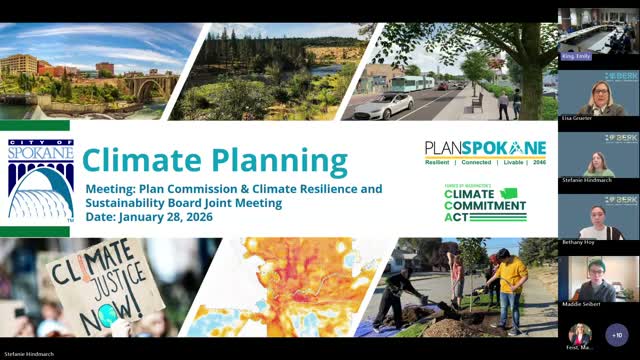
SPOKANE, Jan. 28, 2026 — The Spokane Plan Commission and the Spokane Climate Resilience and Sustainability Board heard a detailed briefing Wednesday on a draft climate-policy package that staff plan to fold into Plan Spokane 2046 and send to the Climate Board for a public hearing and vote on Feb. 12.
Consultants leading the update said the package was developed to comply with House Bill 1181, which requires a climate element in the city’s comprehensive plan. "House Bill 1181 is requiring the climate element as part of the Growth Management Act to be integrated into our comprehensive plan," consultant Maren said during the presentation. Staff are also preparing a draft environmental impact statement (EIS) tied to the comprehensive-plan update; Casey, a city planner leading the outreach, said the EIS and summary materials are open for public comment through Feb. 18.
Why it matters: The rules under HB 1181 direct local governments to include resilience and greenhouse-gas reduction elements in comprehensive plans. Spokane staff told commissioners they selected a set of policies the city will monitor and report to the state as the climate element, and a second set of "secondary" policies that may remain in the comprehensive plan but would not be tracked in the state matrix.
What was presented: Bethany, the consultant who led the evaluation, described a three-step prioritization analysis: a relevance filter, scoring across six themes (resilience; GHG reduction; overburdened-community benefit; logistics; degree of certainty; co-benefits), and a final holistic review to remove redundancies. The consultants reported they reviewed about 142 candidate policies, retired roughly 40 as duplicative, and left about 102 policies in the live tool, with 55 shown on the public dashboard. "The final, draft package meets the minimum requirements of the commerce guidance," Bethany said.
Public engagement and metrics: City staff said the outreach campaign was large: more than 3,400 individual community responses in 2025 across surveys, focus groups, workshops and more. Staff encouraged commissioners and members of the public to review the EIS summary and the story map posted on planspokane.org.
Key issues raised by commissioners: Commissioners repeatedly asked for clearer cross-references and implementation pathways. Several members questioned whether the draft language sufficiently addressed ecosystem- and species-migration protections required under the state guidance; staff replied that ecosystem and land-use policies together were used to meet that test and said they would pull and show the exact language that satisfies the requirement.
Emergency management and wildland-urban interface (WUI): Members pressed staff on emergency access and design standards for WUI and flood-prone areas, suggesting the resilience-focused development standards might need more detail or stronger emphasis for neighborhoods with limited evacuation routes.
Water, stormwater and recharge: Commissioners urged stronger direction on rainwater retention, groundwater recharge and city demonstration projects to model water-conserving practices. Staff said policies encouraging on-site stormwater management and water-conservation targets are included and could be clarified further.
Waste and circular-economy language: The team presented four primary waste policies (zero-waste alignment, expand composting, outreach/technical assistance, reuse/recycling for construction and demolition materials). Multiple commissioners asked for measurable targets and warned that phrases like "maximum extent feasible" need clearer metrics or should be tightened.
Process and next steps: Consultants asked for written edits by the end of day the next business day to allow a week of internal edits; staff said the Climate Board (CRSB) will hold a public hearing and vote on the policy package on Feb. 12. Casey said the packet for that meeting will include the main policy set. The consultants also reminded commissioners that the EIS public comment period closes Feb. 18.
Formal actions at the meeting: The commission approved the January meeting minutes and the meeting agenda by voice votes earlier in the session; those were procedural approvals with no recorded individual roll-call on the record.
What comes next: The consultants will incorporate written edits, return a revised policy package to CRSB for the Feb. 12 hearing and then work to integrate the approved policies into the full Plan Spokane 2046 comprehensive-plan chapters. Staff emphasized further opportunities for public listening hours and encouraged residents to submit comments on the draft EIS.
Ending: The joint meeting closed after the consultants and staff summarized next steps and deadlines.
Consultants leading the update said the package was developed to comply with House Bill 1181, which requires a climate element in the city’s comprehensive plan. "House Bill 1181 is requiring the climate element as part of the Growth Management Act to be integrated into our comprehensive plan," consultant Maren said during the presentation. Staff are also preparing a draft environmental impact statement (EIS) tied to the comprehensive-plan update; Casey, a city planner leading the outreach, said the EIS and summary materials are open for public comment through Feb. 18.
Why it matters: The rules under HB 1181 direct local governments to include resilience and greenhouse-gas reduction elements in comprehensive plans. Spokane staff told commissioners they selected a set of policies the city will monitor and report to the state as the climate element, and a second set of "secondary" policies that may remain in the comprehensive plan but would not be tracked in the state matrix.
What was presented: Bethany, the consultant who led the evaluation, described a three-step prioritization analysis: a relevance filter, scoring across six themes (resilience; GHG reduction; overburdened-community benefit; logistics; degree of certainty; co-benefits), and a final holistic review to remove redundancies. The consultants reported they reviewed about 142 candidate policies, retired roughly 40 as duplicative, and left about 102 policies in the live tool, with 55 shown on the public dashboard. "The final, draft package meets the minimum requirements of the commerce guidance," Bethany said.
Public engagement and metrics: City staff said the outreach campaign was large: more than 3,400 individual community responses in 2025 across surveys, focus groups, workshops and more. Staff encouraged commissioners and members of the public to review the EIS summary and the story map posted on planspokane.org.
Key issues raised by commissioners: Commissioners repeatedly asked for clearer cross-references and implementation pathways. Several members questioned whether the draft language sufficiently addressed ecosystem- and species-migration protections required under the state guidance; staff replied that ecosystem and land-use policies together were used to meet that test and said they would pull and show the exact language that satisfies the requirement.
Emergency management and wildland-urban interface (WUI): Members pressed staff on emergency access and design standards for WUI and flood-prone areas, suggesting the resilience-focused development standards might need more detail or stronger emphasis for neighborhoods with limited evacuation routes.
Water, stormwater and recharge: Commissioners urged stronger direction on rainwater retention, groundwater recharge and city demonstration projects to model water-conserving practices. Staff said policies encouraging on-site stormwater management and water-conservation targets are included and could be clarified further.
Waste and circular-economy language: The team presented four primary waste policies (zero-waste alignment, expand composting, outreach/technical assistance, reuse/recycling for construction and demolition materials). Multiple commissioners asked for measurable targets and warned that phrases like "maximum extent feasible" need clearer metrics or should be tightened.
Process and next steps: Consultants asked for written edits by the end of day the next business day to allow a week of internal edits; staff said the Climate Board (CRSB) will hold a public hearing and vote on the policy package on Feb. 12. Casey said the packet for that meeting will include the main policy set. The consultants also reminded commissioners that the EIS public comment period closes Feb. 18.
Formal actions at the meeting: The commission approved the January meeting minutes and the meeting agenda by voice votes earlier in the session; those were procedural approvals with no recorded individual roll-call on the record.
What comes next: The consultants will incorporate written edits, return a revised policy package to CRSB for the Feb. 12 hearing and then work to integrate the approved policies into the full Plan Spokane 2046 comprehensive-plan chapters. Staff emphasized further opportunities for public listening hours and encouraged residents to submit comments on the draft EIS.
Ending: The joint meeting closed after the consultants and staff summarized next steps and deadlines.
Don't Miss a Word: See the Full Meeting!
Go beyond summaries. Unlock every video, transcript, and key insight with a Founder Membership.
✓
Get instant access to full meeting videos
✓
Search and clip any phrase from complete transcripts
✓
Receive AI-powered summaries & custom alerts
✓
Enjoy lifetime, unrestricted access to government data
30-day money-back guarantee
