Spokane council rules overhaul sparks heated debate over public testimony format
January 27, 2026 | Spokane, Spokane County, Washington
This article was created by AI summarizing key points discussed. AI makes mistakes, so for full details and context, please refer to the video of the full meeting. Please report any errors so we can fix them. Report an error »
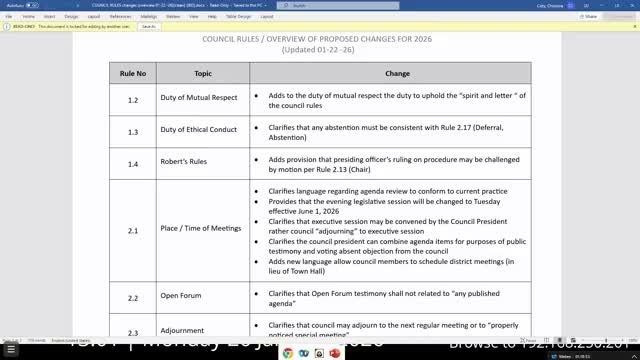
Council staff and Mr. Wright reviewed a package of proposed rule changes that would separate agenda-review and legislative meeting days, reduce the number of published agendas and create an explicit majority-call mechanism for special meetings. The package also included a proposal to require presentations and slide decks to be posted online.
A high-profile element of the discussion focused on changing how oral testimony is scheduled: one proposal would consolidate oral testimony on legislative items to the start of the meeting and limit each person to three minutes to address any or all agenda items, with open forum retained at the end. Supporters said front-loading testimony would make participation more accessible for those who cannot stay late; critics warned it could restrict item-specific comment, encourage stacking of controversial items on single nights, and disadvantage people who need more time for complex testimony.
Council debate became vocal and at times emotional. Opponents called the three-minute, front-loaded model a restriction on public access: "The idea that we're going to restrict people from commenting on individual ordinances and resolutions to three minutes — to me that's a slap in the face to the public," one council member said. Supporters argued many other jurisdictions use front-loaded testimony and that additional written testimony and email channels would remain available.
Staff agreed to continue refining rule language, incorporate feedback on website posting and special meeting notice mechanics, and return a revised package for future committee and council consideration.
A high-profile element of the discussion focused on changing how oral testimony is scheduled: one proposal would consolidate oral testimony on legislative items to the start of the meeting and limit each person to three minutes to address any or all agenda items, with open forum retained at the end. Supporters said front-loading testimony would make participation more accessible for those who cannot stay late; critics warned it could restrict item-specific comment, encourage stacking of controversial items on single nights, and disadvantage people who need more time for complex testimony.
Council debate became vocal and at times emotional. Opponents called the three-minute, front-loaded model a restriction on public access: "The idea that we're going to restrict people from commenting on individual ordinances and resolutions to three minutes — to me that's a slap in the face to the public," one council member said. Supporters argued many other jurisdictions use front-loaded testimony and that additional written testimony and email channels would remain available.
Staff agreed to continue refining rule language, incorporate feedback on website posting and special meeting notice mechanics, and return a revised package for future committee and council consideration.
Don't Miss a Word: See the Full Meeting!
Go beyond summaries. Unlock every video, transcript, and key insight with a Founder Membership.
✓
Get instant access to full meeting videos
✓
Search and clip any phrase from complete transcripts
✓
Receive AI-powered summaries & custom alerts
✓
Enjoy lifetime, unrestricted access to government data
30-day money-back guarantee
