Salinas advisory committee hears county 9-1-1 dispatch briefing; chief previews AB 481 report
January 29, 2026 | Salinas, Monterey County, California
This article was created by AI summarizing key points discussed. AI makes mistakes, so for full details and context, please refer to the video of the full meeting. Please report any errors so we can fix them. Report an error »
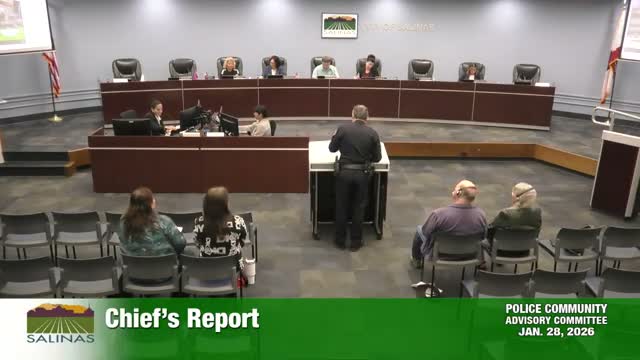
At its January meeting, the Salinas Community Advisory Committee heard a detailed briefing from Monterey County emergency communications staff on how 9-1-1 calls are handled and how dispatch priorities are set.
Lehi Reganti, emergency communications manager, said calls are first answered by trained call-takers who complete a four-week classroom academy followed by about 16 weeks of on-the-job training with a training officer. "The first thing is that the call is going to be answered by a trained call taker," Reganti said. Call-takers collect the callers location and phone number, determine the nature of the emergency and enter incident details into the computer-aided dispatch (CAD) system, which dispatchers then use to assign units and monitor officer safety.
Reganti and assistant director Olivia Madrigal outlined how calls are prioritized. Priority 1 encompasses immediate life-safety incidents such as gunshot victims or structure fires; Priority 2 requires an immediate response; Priority 3 is handled "as soon as possible" (Reganti said a Priority 3 call may be held up to 10 minutes before a watch commander is notified); Priority 4 is addressed when units are available; and Priority 9 covers cold or officer-initiated matters. All call audio and radio traffic are recorded in the CAD system, Reganti said.
County staff described where AI is used and where it is not. Reganti said the county uses AI on nonemergency lines for phone-tree functions and to send links for online reporting and CAD entry. He described one example during the Moss Landing power fire where automated prompts offered callers resources such as evacuation information. "Were able to provide a lot more information to callers on the fly using that technology," Reganti said. However, he said a real-time public queue-status tool that would show a caller their place in line is not currently implemented in the county.
During questions, staff said the center typically has about 12 to 15 employees on duty to cover dispatching for multiple law enforcement and fire agencies; they coordinate with watch commanders when calls are held because of higher-priority incidents. On abandoned vehicles, presenters said towing is governed by existing contracts and state/local rules; in many cases towing cannot occur after regular business hours or on weekends and dispatch will refer callers to a dedicated abandoned-vehicles phone line. Staff offered to provide that phone number by the end of the meeting.
Chief Acosta used the chiefs report to notify the committee that the departments AB 481 annual report had been released and that the department will present the report to the PCAC on Feb. 25 and to the county on March 10. "The AB 481 report ... requires state and local law enforcement agencies to obtain their governing bodiesapproval before funding, acquiring or specific use defined as military equipment," he said, and it mandates public transparency, publication of use policies, public hearings and annual reporting.
Votes at a glance: The committee approved the consent agenda minutes from Dec. 15, 2025. Committee member Shanice moved to approve; Committee member Gasca seconded; the motion passed on a roll-call vote.
Next steps: PCAC members were told the department will present the AB 481 report at the Feb. 25 PCAC meeting and the county presentation will follow on March 10.
Lehi Reganti, emergency communications manager, said calls are first answered by trained call-takers who complete a four-week classroom academy followed by about 16 weeks of on-the-job training with a training officer. "The first thing is that the call is going to be answered by a trained call taker," Reganti said. Call-takers collect the callers location and phone number, determine the nature of the emergency and enter incident details into the computer-aided dispatch (CAD) system, which dispatchers then use to assign units and monitor officer safety.
Reganti and assistant director Olivia Madrigal outlined how calls are prioritized. Priority 1 encompasses immediate life-safety incidents such as gunshot victims or structure fires; Priority 2 requires an immediate response; Priority 3 is handled "as soon as possible" (Reganti said a Priority 3 call may be held up to 10 minutes before a watch commander is notified); Priority 4 is addressed when units are available; and Priority 9 covers cold or officer-initiated matters. All call audio and radio traffic are recorded in the CAD system, Reganti said.
County staff described where AI is used and where it is not. Reganti said the county uses AI on nonemergency lines for phone-tree functions and to send links for online reporting and CAD entry. He described one example during the Moss Landing power fire where automated prompts offered callers resources such as evacuation information. "Were able to provide a lot more information to callers on the fly using that technology," Reganti said. However, he said a real-time public queue-status tool that would show a caller their place in line is not currently implemented in the county.
During questions, staff said the center typically has about 12 to 15 employees on duty to cover dispatching for multiple law enforcement and fire agencies; they coordinate with watch commanders when calls are held because of higher-priority incidents. On abandoned vehicles, presenters said towing is governed by existing contracts and state/local rules; in many cases towing cannot occur after regular business hours or on weekends and dispatch will refer callers to a dedicated abandoned-vehicles phone line. Staff offered to provide that phone number by the end of the meeting.
Chief Acosta used the chiefs report to notify the committee that the departments AB 481 annual report had been released and that the department will present the report to the PCAC on Feb. 25 and to the county on March 10. "The AB 481 report ... requires state and local law enforcement agencies to obtain their governing bodiesapproval before funding, acquiring or specific use defined as military equipment," he said, and it mandates public transparency, publication of use policies, public hearings and annual reporting.
Votes at a glance: The committee approved the consent agenda minutes from Dec. 15, 2025. Committee member Shanice moved to approve; Committee member Gasca seconded; the motion passed on a roll-call vote.
Next steps: PCAC members were told the department will present the AB 481 report at the Feb. 25 PCAC meeting and the county presentation will follow on March 10.
View the Full Meeting & All Its Details
This article offers just a summary. Unlock complete video, transcripts, and insights as a Founder Member.
✓
Watch full, unedited meeting videos
✓
Search every word spoken in unlimited transcripts
✓
AI summaries & real-time alerts (all government levels)
✓
Permanent access to expanding government content
30-day money-back guarantee
