City releases draft Vision Salinas/Salinas 2040 for public review; Feb. 7 workshop set
January 26, 2026 | Salinas, Monterey County, California
This article was created by AI summarizing key points discussed. AI makes mistakes, so for full details and context, please refer to the video of the full meeting. Please report any errors so we can fix them. Report an error »
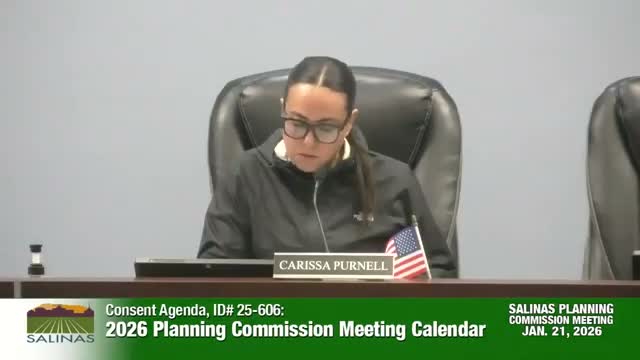
Jonathan Moore, a city planning presenter, told the Planning Commission that the city released the first public review draft of Vision Salinas / Salinas 2040 in December and opened an informal comment period running tentatively through Feb. 13, with a public workshop scheduled for Feb. 7 at the Hebron Family Center.
The draft bundles the plan into three pillars — built environment, environment and sustainability, and socioeconomic systems — and inserts new material including a community design option and an explicit health and environmental justice element. Moore described the document as the product of multiyear work and as building on previous efforts such as the Downtown Partnership Plan and the Chinatown Revitalization Plan. "We have released the draft that's in front of you, first public review draft, released in December," Moore said.
Moore emphasized that this early release is an informal review phase. The formal 45-day comment period will begin when staff releases the public draft of the environmental impact report (EIR). "When we release the public draft of the environmental impact report, that's when the formal 45 day comment period starts," he said.
Commissioners used the presentation to press staff on specific topics likely to draw attention from residents. On housing, Moore explained the plan's emphasis on "missing middle" housing — housing types between single-family homes and large apartment buildings, such as duplexes, triplexes and accessory dwelling units — and said zoning-code updates and specific plans will determine how those types are allowed. "Missing middle housing is ... think of all the housing between a single family home and a big apartment building," Moore said.
On parking, commissioners worried that higher-density housing could worsen on-street parking in neighborhoods with high rates of car ownership. Moore said the circulation element addresses parking resources and that actual parking ratios and limits will be handled through the zoning code and specific-plan processes; he also noted state rules that limit parking maximums near transit and for ADUs.
Commissioners also raised concerns about tree removal and canopy loss on the city's south side. Moore said the climate action plan assumes increased tree canopy and that the city has created an urban forest management plan; he said enforcement and specific replacement requirements mostly arise when plan policies are translated into ordinances such as the tree ordinance or zoning code provisions.
A member of the public, Eloise Young, asked commissioners to request the 2010 PG&E site soil report for the Chinatown area, citing a newspaper article and a Department of Toxic Substances Control finding of petroleum-based fuels at an old gas storage location. "I think the commission should request the outcome of that PG and E site soil report from 2010," Young said. The request was noted by staff for follow-up during the plan review process.
Staff said they will continue engagement through study sessions, a roadshow and the Feb. 7 workshop; translation of the document is planned but had not been completed at the time of the meeting. Moore said staff expects substantial public comments when the EIR is released and that the comment quality may influence the revision timeline. The next procedural steps are the Feb. 7 workshop and later the public release of the EIR, which will trigger the formal 45-day review period.
The draft bundles the plan into three pillars — built environment, environment and sustainability, and socioeconomic systems — and inserts new material including a community design option and an explicit health and environmental justice element. Moore described the document as the product of multiyear work and as building on previous efforts such as the Downtown Partnership Plan and the Chinatown Revitalization Plan. "We have released the draft that's in front of you, first public review draft, released in December," Moore said.
Moore emphasized that this early release is an informal review phase. The formal 45-day comment period will begin when staff releases the public draft of the environmental impact report (EIR). "When we release the public draft of the environmental impact report, that's when the formal 45 day comment period starts," he said.
Commissioners used the presentation to press staff on specific topics likely to draw attention from residents. On housing, Moore explained the plan's emphasis on "missing middle" housing — housing types between single-family homes and large apartment buildings, such as duplexes, triplexes and accessory dwelling units — and said zoning-code updates and specific plans will determine how those types are allowed. "Missing middle housing is ... think of all the housing between a single family home and a big apartment building," Moore said.
On parking, commissioners worried that higher-density housing could worsen on-street parking in neighborhoods with high rates of car ownership. Moore said the circulation element addresses parking resources and that actual parking ratios and limits will be handled through the zoning code and specific-plan processes; he also noted state rules that limit parking maximums near transit and for ADUs.
Commissioners also raised concerns about tree removal and canopy loss on the city's south side. Moore said the climate action plan assumes increased tree canopy and that the city has created an urban forest management plan; he said enforcement and specific replacement requirements mostly arise when plan policies are translated into ordinances such as the tree ordinance or zoning code provisions.
A member of the public, Eloise Young, asked commissioners to request the 2010 PG&E site soil report for the Chinatown area, citing a newspaper article and a Department of Toxic Substances Control finding of petroleum-based fuels at an old gas storage location. "I think the commission should request the outcome of that PG and E site soil report from 2010," Young said. The request was noted by staff for follow-up during the plan review process.
Staff said they will continue engagement through study sessions, a roadshow and the Feb. 7 workshop; translation of the document is planned but had not been completed at the time of the meeting. Moore said staff expects substantial public comments when the EIR is released and that the comment quality may influence the revision timeline. The next procedural steps are the Feb. 7 workshop and later the public release of the EIR, which will trigger the formal 45-day review period.
View the Full Meeting & All Its Details
This article offers just a summary. Unlock complete video, transcripts, and insights as a Founder Member.
✓
Watch full, unedited meeting videos
✓
Search every word spoken in unlimited transcripts
✓
AI summaries & real-time alerts (all government levels)
✓
Permanent access to expanding government content
30-day money-back guarantee
