Fruita council adopts housing needs assessment and action plan to guide next six years
January 26, 2026 | Fruita City, Mesa County, Colorado
This article was created by AI summarizing key points discussed. AI makes mistakes, so for full details and context, please refer to the video of the full meeting. Please report any errors so we can fix them. Report an error »
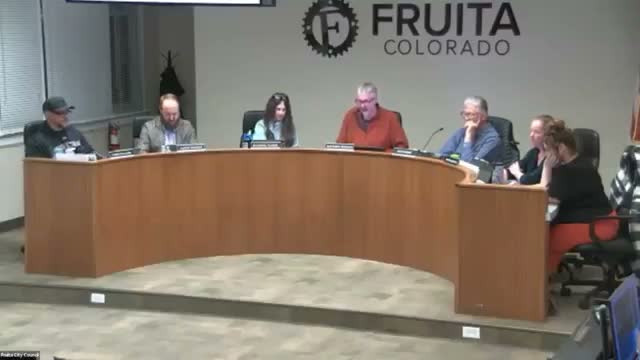
Fruita — The Fruita City Council on Tuesday unanimously adopted a housing needs assessment (HNA) and housing action plan (HAP) intended to guide housing policy and projects over the next six years and meet state requirements under SB 24‑174.
Henry Hemphill, Fruita’s planning director, introduced the consultant team from Points, who reviewed the study’s methods and findings and recommended a set of strategies for the city. Consultant Carson said the project combined stakeholder interviews, a resident survey and a land‑capacity analysis to produce actionable recommendations. “This document is a dynamic guiding document that reflects our community’s current conditions and priorities,” Hemphill said.
The presentation highlighted a limited, undiversified housing stock and widening affordability pressures. The consultants reported the city currently could accommodate roughly 664 additional housing units on available land under realistic density assumptions, and identified a shortfall of new units needed across income tiers under their growth scenarios. They reported the median home price in Fruita at about $536,000 and noted mortgage rates and price increases since 2020 have reduced affordability.
Key recommendations the plan lists include encouraging accessory dwelling units and missing‑middle housing types (duplexes, triplexes, cottage courts), expanding density bonuses and flexible zoning, targeted overlay districts to enable redevelopment of underutilized parcels, and pursuing gap funding and partnerships (downtown or housing authorities, community land trusts) to support affordable and workforce housing. The plan proposes measurable success metrics — for example, monitoring the number of ADU permits, non‑single‑family units approved, and units built at or below 120% of area median income.
Thomas Wells, who identified himself as a member of the planning commission speaking for himself, praised the report’s public outreach and urged councilors to pursue missing‑middle housing, ADUs and infill to preserve Fruita’s character while increasing affordability. Councilors asked detailed questions about assumptions, water and wastewater capacity, and differences between ‘‘market‑driven’’ and ‘‘needs‑driven’’ scenarios; consultants said wastewater capacity is available at roughly half of firm capacity and recommended focusing infill near existing services.
After discussion, Councilor [mover name recorded in minutes] moved to adopt Resolution 2026‑08 to adopt the HNA and HAP as guiding policy documents. Deb Woods conducted a roll call; the motion passed 6‑0. The plan will be updated to include public comments and an appendix before formal submission to the Colorado Department of Local Affairs for compliance review.
Henry Hemphill, Fruita’s planning director, introduced the consultant team from Points, who reviewed the study’s methods and findings and recommended a set of strategies for the city. Consultant Carson said the project combined stakeholder interviews, a resident survey and a land‑capacity analysis to produce actionable recommendations. “This document is a dynamic guiding document that reflects our community’s current conditions and priorities,” Hemphill said.
The presentation highlighted a limited, undiversified housing stock and widening affordability pressures. The consultants reported the city currently could accommodate roughly 664 additional housing units on available land under realistic density assumptions, and identified a shortfall of new units needed across income tiers under their growth scenarios. They reported the median home price in Fruita at about $536,000 and noted mortgage rates and price increases since 2020 have reduced affordability.
Key recommendations the plan lists include encouraging accessory dwelling units and missing‑middle housing types (duplexes, triplexes, cottage courts), expanding density bonuses and flexible zoning, targeted overlay districts to enable redevelopment of underutilized parcels, and pursuing gap funding and partnerships (downtown or housing authorities, community land trusts) to support affordable and workforce housing. The plan proposes measurable success metrics — for example, monitoring the number of ADU permits, non‑single‑family units approved, and units built at or below 120% of area median income.
Thomas Wells, who identified himself as a member of the planning commission speaking for himself, praised the report’s public outreach and urged councilors to pursue missing‑middle housing, ADUs and infill to preserve Fruita’s character while increasing affordability. Councilors asked detailed questions about assumptions, water and wastewater capacity, and differences between ‘‘market‑driven’’ and ‘‘needs‑driven’’ scenarios; consultants said wastewater capacity is available at roughly half of firm capacity and recommended focusing infill near existing services.
After discussion, Councilor [mover name recorded in minutes] moved to adopt Resolution 2026‑08 to adopt the HNA and HAP as guiding policy documents. Deb Woods conducted a roll call; the motion passed 6‑0. The plan will be updated to include public comments and an appendix before formal submission to the Colorado Department of Local Affairs for compliance review.
View the Full Meeting & All Its Details
This article offers just a summary. Unlock complete video, transcripts, and insights as a Founder Member.
✓
Watch full, unedited meeting videos
✓
Search every word spoken in unlimited transcripts
✓
AI summaries & real-time alerts (all government levels)
✓
Permanent access to expanding government content
30-day money-back guarantee
