Wyandotte Creek GSA advances draft two-part regulatory fee, directs ad hoc to refine allocations
January 29, 2026 | Oroville, Butte County, California
This article was created by AI summarizing key points discussed. AI makes mistakes, so for full details and context, please refer to the video of the full meeting. Please report any errors so we can fix them. Report an error »
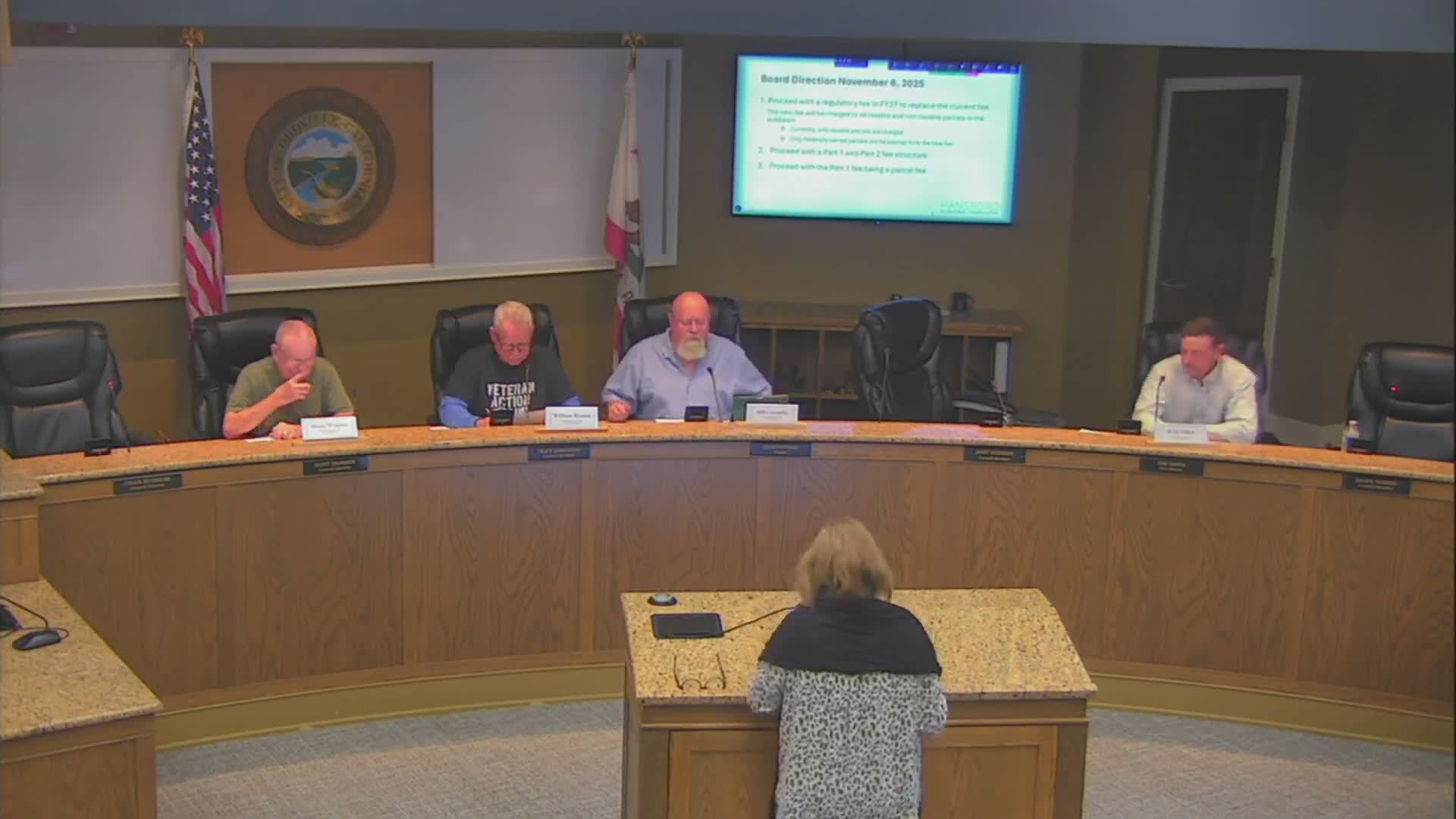
The Wyandotte Creek Groundwater Sustainability Agency board on Jan. 29 reviewed a consultant’s draft fee study and directed staff and an ad hoc committee to refine how costs are split between a parcel-based Part 1 fee and usage-based Part 2 charges.
Consultant Catherine Hansford of Hansford Economic Consulting summarized the November direction and presented a draft five-year outlook. Hansford said the proposed regulatory fee would replace the current fee and apply to all non‑federal parcels in the basin, with exemptions for parcels the Butte County assessor classifies as unusable. She said the study models a budget scenario that starts at $470,000 and includes an annual inflation factor to smooth year-to-year changes.
Why it matters: the two-part design separates fixed administrative costs (Part 1) from costs tied to SGMA compliance and groundwater monitoring (Part 2), which the board and staff say makes the fee more defensible as usage-based where required by law.
What the draft shows: Hansford presented example calculations under a $470,000 baseline. In that scenario she showed a Part 1 parcel fee of $20.50; a Part 2 agricultural rate of $15.58 per cropped or managed-wetland acre; and a Part 2 domestic rate of about $3.78 per developed parcel before any imported-water adjustments. Using state and local agency data, the consultant estimated that some domestic customers supplied primarily with imported Feather River water (for example, South Feather Water and Power Authority customers) would receive a significant Part 2 credit; Cal Water and Thermolito customers were estimated to receive roughly a 75% credit (paying about 25% of the domestic Part 2 charge, shown in the consultant’s materials as about $0.94). A very small number of agricultural parcels that divert Feather River water would receive a smaller ag credit (about 15%).
Board direction and legal constraints: board members asked staff to explore alternative splits between Part 1 and Part 2 and to quantify the resulting fee impacts. Dylan and staff said legal counsel advised the fee allocation must be defensible and tied to usage where Part 2 is usage-based, so both agricultural and domestic users must be included and the board should be able to justify chosen percentages. The board signaled support for the ad hoc to produce multiple fee scenarios, legal justifications, and comparisons to likely household water-bill impacts.
Equity and reserves: some board members pushed for measures that would reduce disproportionate impacts on minimal-use domestic parcels, noting domestic users are numerous but consume less groundwater. Others argued for keeping reserves modest because the fee is an annual parcel-based collection; staff highlighted cash-flow timing (county tax disbursements in December, April and June) and existing set‑asides for legal defense and fee-study costs.
Next steps and public outreach: staff said a draft report will go to legal review and the management committee in February, with online webinars planned for early–mid March. The board aims to approve a draft and set a public hearing date in March and hold the public hearing in May. Staff noted statutory requirements that all data be publicly available at least 20 days before the hearing and that newspaper notices run for 14 days beforehand.
Quotes: "We are going to continue the discussion on a new fee for Wyandotte Creek GSA," said Catherine Hansford. Chair Bill Connolly said the rationale presented was "justified and rational" as staff moves the matter to the ad hoc for more detailed scenarios and legal review.
What remains unresolved: the board did not adopt a final fee level or a single percentage split between Part 1 and Part 2. The ad hoc will return with defensible allocation options, scenario tables showing fee impacts on representative parcel types, and suggested wording for the fee resolution that would govern annual adjustments.
Provenance: discussion and numerical examples appear in the consultant presentation and board discussion recorded Jan. 29 (transcript segments covering the fee study and examples).
Consultant Catherine Hansford of Hansford Economic Consulting summarized the November direction and presented a draft five-year outlook. Hansford said the proposed regulatory fee would replace the current fee and apply to all non‑federal parcels in the basin, with exemptions for parcels the Butte County assessor classifies as unusable. She said the study models a budget scenario that starts at $470,000 and includes an annual inflation factor to smooth year-to-year changes.
Why it matters: the two-part design separates fixed administrative costs (Part 1) from costs tied to SGMA compliance and groundwater monitoring (Part 2), which the board and staff say makes the fee more defensible as usage-based where required by law.
What the draft shows: Hansford presented example calculations under a $470,000 baseline. In that scenario she showed a Part 1 parcel fee of $20.50; a Part 2 agricultural rate of $15.58 per cropped or managed-wetland acre; and a Part 2 domestic rate of about $3.78 per developed parcel before any imported-water adjustments. Using state and local agency data, the consultant estimated that some domestic customers supplied primarily with imported Feather River water (for example, South Feather Water and Power Authority customers) would receive a significant Part 2 credit; Cal Water and Thermolito customers were estimated to receive roughly a 75% credit (paying about 25% of the domestic Part 2 charge, shown in the consultant’s materials as about $0.94). A very small number of agricultural parcels that divert Feather River water would receive a smaller ag credit (about 15%).
Board direction and legal constraints: board members asked staff to explore alternative splits between Part 1 and Part 2 and to quantify the resulting fee impacts. Dylan and staff said legal counsel advised the fee allocation must be defensible and tied to usage where Part 2 is usage-based, so both agricultural and domestic users must be included and the board should be able to justify chosen percentages. The board signaled support for the ad hoc to produce multiple fee scenarios, legal justifications, and comparisons to likely household water-bill impacts.
Equity and reserves: some board members pushed for measures that would reduce disproportionate impacts on minimal-use domestic parcels, noting domestic users are numerous but consume less groundwater. Others argued for keeping reserves modest because the fee is an annual parcel-based collection; staff highlighted cash-flow timing (county tax disbursements in December, April and June) and existing set‑asides for legal defense and fee-study costs.
Next steps and public outreach: staff said a draft report will go to legal review and the management committee in February, with online webinars planned for early–mid March. The board aims to approve a draft and set a public hearing date in March and hold the public hearing in May. Staff noted statutory requirements that all data be publicly available at least 20 days before the hearing and that newspaper notices run for 14 days beforehand.
Quotes: "We are going to continue the discussion on a new fee for Wyandotte Creek GSA," said Catherine Hansford. Chair Bill Connolly said the rationale presented was "justified and rational" as staff moves the matter to the ad hoc for more detailed scenarios and legal review.
What remains unresolved: the board did not adopt a final fee level or a single percentage split between Part 1 and Part 2. The ad hoc will return with defensible allocation options, scenario tables showing fee impacts on representative parcel types, and suggested wording for the fee resolution that would govern annual adjustments.
Provenance: discussion and numerical examples appear in the consultant presentation and board discussion recorded Jan. 29 (transcript segments covering the fee study and examples).
View the Full Meeting & All Its Details
This article offers just a summary. Unlock complete video, transcripts, and insights as a Founder Member.
✓
Watch full, unedited meeting videos
✓
Search every word spoken in unlimited transcripts
✓
AI summaries & real-time alerts (all government levels)
✓
Permanent access to expanding government content
30-day money-back guarantee
