Bremer County supervisors map budget tradeoffs as levy, capital and outside‑agency requests rise
January 27, 2026 | Bremer County, Iowa
This article was created by AI summarizing key points discussed. AI makes mistakes, so for full details and context, please refer to the video of the full meeting. Please report any errors so we can fix them. Report an error »
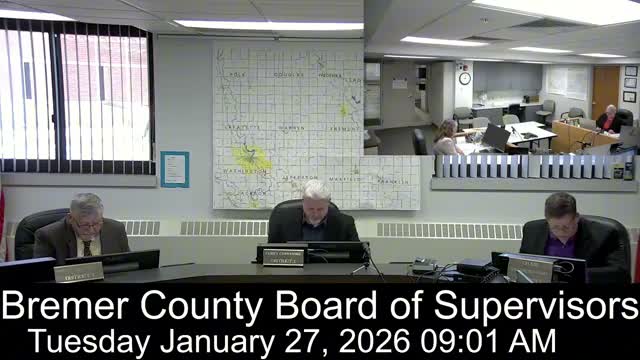
Bremer County supervisors spent the bulk of a daylong work session refining fiscal 2027 budget assumptions, focusing on wage increases, levy rates and competing capital projects tied to a possible courthouse remodel.
The county’s finance director, Cassandra, presented department and fund-level worksheets and said the proposed levy structure currently reflects higher levy rates and may require choices on general supplemental reductions to offset increases. Board discussion centered on whether to preserve existing local option sales tax balances for projects such as bridges and road paving or to apply those proceeds toward major capital needs associated with a courthouse remodel.
Supervisors repeatedly flagged capital requests as the principal uncertainty. Facilities staff described two capital items — a courthouse security camera and panic‑alarm upgrade and long‑deferred tuckpointing to address water intrusion on the third floor — and said some costs were included in the remodel estimate while standalone contingencies were listed in the capital fund.
Outside-agency funding drew pointed attention. The board asked staff to follow up with organizations whose requests the county routinely funds under service agreements; members were skeptical about contributing toward capital campaigns without explicit service contracts. The Allen Child Protection Center’s capital campaign was discussed; supervisors expressed reluctance to fund a construction campaign without a clear service agreement and asked staff to evaluate the county’s legal ability to support capital campaigns versus paying for services. The board signaled openness to restoring Northeast Iowa Community Action funding to a previously reached level — roughly $15,000 — if the agency can justify services provided to county residents.
Supervisors also expressed interest in a measured, transparent approach to capital planning: they asked finance staff to propose a target capital‑spending envelope and to return with ranked projects that reflect two scenarios — with and without the courthouse remodel — so the board can prioritize.
The board approved two FY‑26 budget amendment resolutions following a brief public hearing with no speakers and closed the session after voting on the amendments.
The county’s finance director, Cassandra, presented department and fund-level worksheets and said the proposed levy structure currently reflects higher levy rates and may require choices on general supplemental reductions to offset increases. Board discussion centered on whether to preserve existing local option sales tax balances for projects such as bridges and road paving or to apply those proceeds toward major capital needs associated with a courthouse remodel.
Supervisors repeatedly flagged capital requests as the principal uncertainty. Facilities staff described two capital items — a courthouse security camera and panic‑alarm upgrade and long‑deferred tuckpointing to address water intrusion on the third floor — and said some costs were included in the remodel estimate while standalone contingencies were listed in the capital fund.
Outside-agency funding drew pointed attention. The board asked staff to follow up with organizations whose requests the county routinely funds under service agreements; members were skeptical about contributing toward capital campaigns without explicit service contracts. The Allen Child Protection Center’s capital campaign was discussed; supervisors expressed reluctance to fund a construction campaign without a clear service agreement and asked staff to evaluate the county’s legal ability to support capital campaigns versus paying for services. The board signaled openness to restoring Northeast Iowa Community Action funding to a previously reached level — roughly $15,000 — if the agency can justify services provided to county residents.
Supervisors also expressed interest in a measured, transparent approach to capital planning: they asked finance staff to propose a target capital‑spending envelope and to return with ranked projects that reflect two scenarios — with and without the courthouse remodel — so the board can prioritize.
The board approved two FY‑26 budget amendment resolutions following a brief public hearing with no speakers and closed the session after voting on the amendments.
Don't Miss a Word: See the Full Meeting!
Go beyond summaries. Unlock every video, transcript, and key insight with a Founder Membership.
✓
Get instant access to full meeting videos
✓
Search and clip any phrase from complete transcripts
✓
Receive AI-powered summaries & custom alerts
✓
Enjoy lifetime, unrestricted access to government data
30-day money-back guarantee
