County-funded Community Priority Fund credited with stabilizing families; evaluators recommend lump-sum grants and stronger evaluation
January 29, 2026 | Washtenaw County, Michigan
This article was created by AI summarizing key points discussed. AI makes mistakes, so for full details and context, please refer to the video of the full meeting. Please report any errors so we can fix them. Report an error »
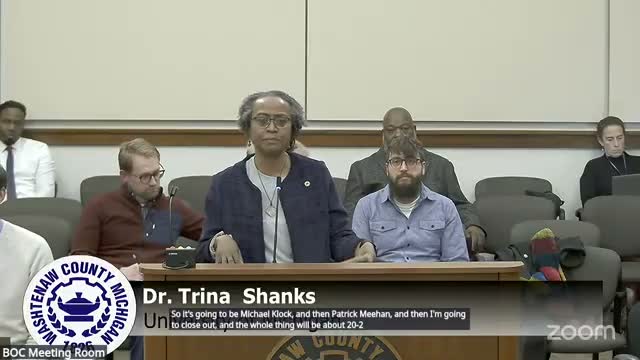
University of Michigan researchers presented final findings on Washtenaw County
ommunity Priority Fund (CPF), saying CPF
wards supported immediate needs and expanded nonprofit capacity but revealed administrative burdens that threaten sustainability.
The evaluation team highlighted direct-assistance results: about $620,000 distributed for rent, utilities and groceries concentrated in Ypsilanti and Whitmore Lake; 32 evictions or utility shutoffs prevented; distribution of roughly 250,000 pounds of food; and about 300 people receiving holiday meals paired with health and financial referrals. "This structure not only documented outcomes, but also positioned grantees for future funding and sustainability," Michael Clark, a member of the evaluation team, said.
Researchers grouped CPF-funded work into five categories and reported outcomes across them. Patrick Meehan said CPF-funded community-violence intervention partners served more than 822 returning citizens with job-readiness, mentoring and life-skills programs, and that some programs reported high placement rates: "I think that speaks again to Brighter Way's success," Meehan said. In housing and recovery work, evaluators said Dawn Farm placed 38 participants into stable housing with an average of about 187 days of stability.
Early-childhood investments were prominent in the report. The evaluation team said CPF supported roughly 730 childcare scholarships and 182 families through case management and referral services, plus expansions in preschool slots and summer-camp capacity. An unidentified Childcare Network representative told the board that CPF-supported scholarships and case management helped families gain stability and reduced stress.
Presenters also highlighted measurable gains from literacy and tutoring programs: among students who began below grade level, 59% met or exceeded benchmark reading targets and 73% met or exceeded math benchmarks after targeted interventions, according to Dr. Trina Shanks.
Despite the results, presenters flagged implementation challenges. Evaluators and grantees reported that reimbursement-based contracts strained small organizations ecause many had to front costs while waiting for payments. "If you had to do the work and then show all your receipts and then get reimbursed, that means you had to pay for it upfront," Shanks said, adding that some organizations closed after their grants ended because they did not receive staff funding.
Recommendations to the board included: favoring lump-sum or upfront payments where possible to prevent cash-flow burdens on small providers; pairing flexible funding with technical assistance and capacity-building (for accounting, data collection and evaluation); and establishing clearer evaluation frameworks and logic models at the outset so outcomes can be tracked consistently.
During Q&A, commissioners asked how much of award dollars went to staffing versus direct services; Derek Jackson (Racial Equity Office) and evaluators said contract language specifies allowable uses and county staff can produce a contract-by-contract percentage breakdown on request. The evaluators repeatedly pointed commissioners to project logic models and to CPF impact-report pages for specifics on metrics; Michael Clark cited the report's logic models as the source for measurable outcomes.
There was no board action or vote on CPF policy or funding during this meeting; staff indicated they would return with more detailed budget breakdowns and that the Racial Equity Office is piloting a small "CPF 2" seed to test lump-sum approaches.
What happens next: County staff said they will provide a detailed breakdown of contract spending (staffing vs. services) and evaluators encouraged use of targeted evaluation frameworks and capacity supports if the board considers a future CPF round.
wards supported immediate needs and expanded nonprofit capacity but revealed administrative burdens that threaten sustainability.
The evaluation team highlighted direct-assistance results: about $620,000 distributed for rent, utilities and groceries concentrated in Ypsilanti and Whitmore Lake; 32 evictions or utility shutoffs prevented; distribution of roughly 250,000 pounds of food; and about 300 people receiving holiday meals paired with health and financial referrals. "This structure not only documented outcomes, but also positioned grantees for future funding and sustainability," Michael Clark, a member of the evaluation team, said.
Researchers grouped CPF-funded work into five categories and reported outcomes across them. Patrick Meehan said CPF-funded community-violence intervention partners served more than 822 returning citizens with job-readiness, mentoring and life-skills programs, and that some programs reported high placement rates: "I think that speaks again to Brighter Way's success," Meehan said. In housing and recovery work, evaluators said Dawn Farm placed 38 participants into stable housing with an average of about 187 days of stability.
Early-childhood investments were prominent in the report. The evaluation team said CPF supported roughly 730 childcare scholarships and 182 families through case management and referral services, plus expansions in preschool slots and summer-camp capacity. An unidentified Childcare Network representative told the board that CPF-supported scholarships and case management helped families gain stability and reduced stress.
Presenters also highlighted measurable gains from literacy and tutoring programs: among students who began below grade level, 59% met or exceeded benchmark reading targets and 73% met or exceeded math benchmarks after targeted interventions, according to Dr. Trina Shanks.
Despite the results, presenters flagged implementation challenges. Evaluators and grantees reported that reimbursement-based contracts strained small organizations ecause many had to front costs while waiting for payments. "If you had to do the work and then show all your receipts and then get reimbursed, that means you had to pay for it upfront," Shanks said, adding that some organizations closed after their grants ended because they did not receive staff funding.
Recommendations to the board included: favoring lump-sum or upfront payments where possible to prevent cash-flow burdens on small providers; pairing flexible funding with technical assistance and capacity-building (for accounting, data collection and evaluation); and establishing clearer evaluation frameworks and logic models at the outset so outcomes can be tracked consistently.
During Q&A, commissioners asked how much of award dollars went to staffing versus direct services; Derek Jackson (Racial Equity Office) and evaluators said contract language specifies allowable uses and county staff can produce a contract-by-contract percentage breakdown on request. The evaluators repeatedly pointed commissioners to project logic models and to CPF impact-report pages for specifics on metrics; Michael Clark cited the report's logic models as the source for measurable outcomes.
There was no board action or vote on CPF policy or funding during this meeting; staff indicated they would return with more detailed budget breakdowns and that the Racial Equity Office is piloting a small "CPF 2" seed to test lump-sum approaches.
What happens next: County staff said they will provide a detailed breakdown of contract spending (staffing vs. services) and evaluators encouraged use of targeted evaluation frameworks and capacity supports if the board considers a future CPF round.
View the Full Meeting & All Its Details
This article offers just a summary. Unlock complete video, transcripts, and insights as a Founder Member.
✓
Watch full, unedited meeting videos
✓
Search every word spoken in unlimited transcripts
✓
AI summaries & real-time alerts (all government levels)
✓
Permanent access to expanding government content
30-day money-back guarantee
