Washtenaw County equity office unveils blueprint, highlights mobile support bus that reached thousands
January 29, 2026 | Washtenaw County, Michigan
This article was created by AI summarizing key points discussed. AI makes mistakes, so for full details and context, please refer to the video of the full meeting. Please report any errors so we can fix them. Report an error »
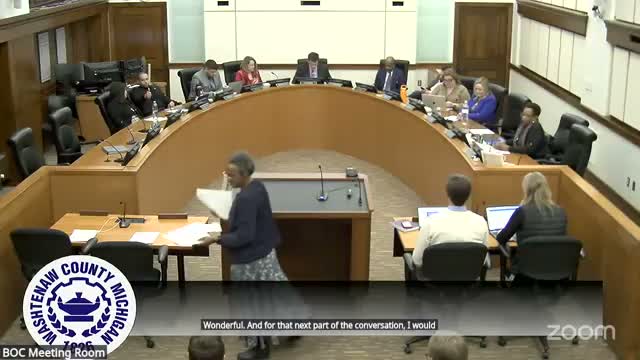
Derek Jackson, Washtenaw County's Racial Equity Officer, presented an Equity Blueprint to the Board and highlighted operational initiatives including the Mobile Support Services Initiative (MSSI), equity liaisons and an Equity Fellows pilot.
"It is how we look and think about the work that we do," Jackson said, describing the office's role of embedding racial equity in county operations and policy decisions.
Jackson summarized the blueprint
s three pillars—individual staff growth, institutional change and structural transformation—framed by 13 program areas the office intends to advance. The board learned that about 31 county staff serve as equity liaisons representing roughly 15 departments; county staff said they are actively recruiting additional departmental liaisons so that every department can be represented.
A centerpiece of the presentation was MSSI, a mobile outreach vehicle that the office has deployed across the county. Jackson reported the MSSI dashboard (May 2025 to present) shows 138 events across ~270 days of deployment, about 527 hours in the community and nearly 5,000 individuals served. Among locations, the MSSI visited Arbor 1 about 41 times and supported activities ranging from food distribution and health clinics to housing outreach and community engagement. Jackson and staff credited the MSSI with increasing trust and access where residents lack transportation or have distrust of government.
Jackson described other programs the office is developing or seeking support for in 2026: a Youth Assessment Center, expansion of the Washington Equity Partnership recommendations into practice, structured equity impact statements and resolution-review processes, and the Legacy Project (genealogy and intergenerational learning). He said the office will return with specific staffing requests, including a project manager for the Youth Assessment Center.
Presenters stressed operational lessons and policy recommendations: prioritize money for community-led work (including considering lump-sum contracts rather than reimbursement-only contracts), pair funding with technical assistance and adopt standardized reporting that reduces burdens on small providers. Jackson said the office is piloting smaller lump-sum CPF-style awards internally to test the approach.
Commissioners voiced support for MSSI, asked for a list of departments without liaisons, and urged staff to provide concrete budget requests and timelines for 2026 work. Multiple commissioners praised staff members Victoria Keen and Akeem (equity liaison leadership) for outreach and consistent presence in difficult community situations.
What happens next: REO staff said they will bring back staffing requests, a more formal resolution-review process, and an evaluation plan to measure progress toward policy outcomes in 2027.
"It is how we look and think about the work that we do," Jackson said, describing the office's role of embedding racial equity in county operations and policy decisions.
Jackson summarized the blueprint
s three pillars—individual staff growth, institutional change and structural transformation—framed by 13 program areas the office intends to advance. The board learned that about 31 county staff serve as equity liaisons representing roughly 15 departments; county staff said they are actively recruiting additional departmental liaisons so that every department can be represented.
A centerpiece of the presentation was MSSI, a mobile outreach vehicle that the office has deployed across the county. Jackson reported the MSSI dashboard (May 2025 to present) shows 138 events across ~270 days of deployment, about 527 hours in the community and nearly 5,000 individuals served. Among locations, the MSSI visited Arbor 1 about 41 times and supported activities ranging from food distribution and health clinics to housing outreach and community engagement. Jackson and staff credited the MSSI with increasing trust and access where residents lack transportation or have distrust of government.
Jackson described other programs the office is developing or seeking support for in 2026: a Youth Assessment Center, expansion of the Washington Equity Partnership recommendations into practice, structured equity impact statements and resolution-review processes, and the Legacy Project (genealogy and intergenerational learning). He said the office will return with specific staffing requests, including a project manager for the Youth Assessment Center.
Presenters stressed operational lessons and policy recommendations: prioritize money for community-led work (including considering lump-sum contracts rather than reimbursement-only contracts), pair funding with technical assistance and adopt standardized reporting that reduces burdens on small providers. Jackson said the office is piloting smaller lump-sum CPF-style awards internally to test the approach.
Commissioners voiced support for MSSI, asked for a list of departments without liaisons, and urged staff to provide concrete budget requests and timelines for 2026 work. Multiple commissioners praised staff members Victoria Keen and Akeem (equity liaison leadership) for outreach and consistent presence in difficult community situations.
What happens next: REO staff said they will bring back staffing requests, a more formal resolution-review process, and an evaluation plan to measure progress toward policy outcomes in 2027.
Don't Miss a Word: See the Full Meeting!
Go beyond summaries. Unlock every video, transcript, and key insight with a Founder Membership.
✓
Get instant access to full meeting videos
✓
Search and clip any phrase from complete transcripts
✓
Receive AI-powered summaries & custom alerts
✓
Enjoy lifetime, unrestricted access to government data
30-day money-back guarantee
