Anoka County highlights opioid-prevention push, screens 'Faces of Hope' documentary
January 27, 2026 | Anoka County, Minnesota
This article was created by AI summarizing key points discussed. AI makes mistakes, so for full details and context, please refer to the video of the full meeting. Please report any errors so we can fix them. Report an error »
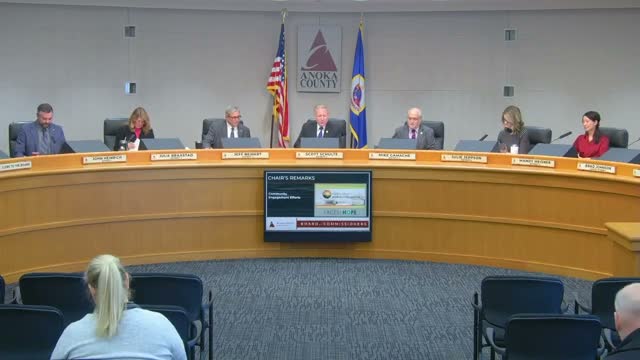
Anoka County commissioners heard an update on Jan. 27 from Patty Constant, the county’s senior program specialist in opioid prevention, detailing how settlement funds have been used to expand naloxone access, support prevention grants and launch a community resource hub.
Constant said the county is stewarding opioid settlement funding and that public health is leading the effort. "All of these efforts are funded by opioid settlement funding," she told the board, describing an advisory council that prioritized prevention and naloxone education and distribution.
The county contracted with Hope Network (Steve Rumler) to distribute free naloxone and increase access points. Constant said library and public access points rose from five to 30 and that the county has placed naloxone in "over 300" public AEDs as part of an ongoing effort. She also described leave-behind kits with EMS and law enforcement responses as an emerging practice.
On prevention, Constant said the county awarded two-year grants to seven community-based agencies, selected to reach different ages and geographic areas; those grantees are about half a year into their work. The county also launched facesofhopeanoka.org, which hosts personal stories, resource links and the 23½-minute documentary. Constant said the site will include shorter video segments for use in programs and that the county is pursuing an additional RFP to develop eight hours of continuing medical education for clinicians.
Commissioner Meisner, who opened the presentation, said Anoka County had among the highest numbers of opioid overdoses in Minnesota in 2024 and stressed the need to reduce stigma and increase community-based responses. He invited the public to a free screening and panel on Tuesday, Feb. 3, at Lyric Arts Main Street stage.
Commissioner Reiner asked about monthly distribution volumes. Constant replied, "I would say on average, there's about 70 per month going out of our library locations" for nasal naloxone, "around 70 intramuscular naloxone and around 70 fentanyl test strips," while noting that uptake is higher when a new location is introduced.
The presentation emphasized outreach (19 community events to date), more naloxone access points, prevention grants and a public awareness push. Constant encouraged commissioners and community members who cannot attend the screening to view the documentary at facesofhopeanoka.org.
Next steps noted to the board were continued expansion of naloxone access points, ongoing grant-funded prevention work and the Feb. 3 screening with a subsequent panel discussion for community questions.
Constant said the county is stewarding opioid settlement funding and that public health is leading the effort. "All of these efforts are funded by opioid settlement funding," she told the board, describing an advisory council that prioritized prevention and naloxone education and distribution.
The county contracted with Hope Network (Steve Rumler) to distribute free naloxone and increase access points. Constant said library and public access points rose from five to 30 and that the county has placed naloxone in "over 300" public AEDs as part of an ongoing effort. She also described leave-behind kits with EMS and law enforcement responses as an emerging practice.
On prevention, Constant said the county awarded two-year grants to seven community-based agencies, selected to reach different ages and geographic areas; those grantees are about half a year into their work. The county also launched facesofhopeanoka.org, which hosts personal stories, resource links and the 23½-minute documentary. Constant said the site will include shorter video segments for use in programs and that the county is pursuing an additional RFP to develop eight hours of continuing medical education for clinicians.
Commissioner Meisner, who opened the presentation, said Anoka County had among the highest numbers of opioid overdoses in Minnesota in 2024 and stressed the need to reduce stigma and increase community-based responses. He invited the public to a free screening and panel on Tuesday, Feb. 3, at Lyric Arts Main Street stage.
Commissioner Reiner asked about monthly distribution volumes. Constant replied, "I would say on average, there's about 70 per month going out of our library locations" for nasal naloxone, "around 70 intramuscular naloxone and around 70 fentanyl test strips," while noting that uptake is higher when a new location is introduced.
The presentation emphasized outreach (19 community events to date), more naloxone access points, prevention grants and a public awareness push. Constant encouraged commissioners and community members who cannot attend the screening to view the documentary at facesofhopeanoka.org.
Next steps noted to the board were continued expansion of naloxone access points, ongoing grant-funded prevention work and the Feb. 3 screening with a subsequent panel discussion for community questions.
View the Full Meeting & All Its Details
This article offers just a summary. Unlock complete video, transcripts, and insights as a Founder Member.
✓
Watch full, unedited meeting videos
✓
Search every word spoken in unlimited transcripts
✓
AI summaries & real-time alerts (all government levels)
✓
Permanent access to expanding government content
30-day money-back guarantee
