Wenatchee, East Wenatchee officials say pallet shelters nearly complete; outline new homeless response administrator and eligibility rules
August 30, 2024 | Wenatchee City, Chelan County, Washington
This article was created by AI summarizing key points discussed. AI makes mistakes, so for full details and context, please refer to the video of the full meeting. Please report any errors so we can fix them. Report an error »
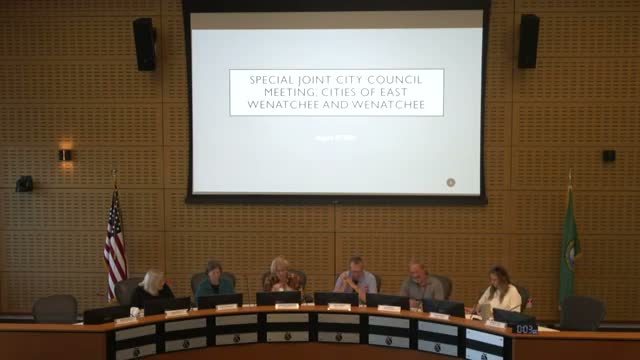
At a joint workshop, Glenn DeVries, community development director for the City of Wenatchee, told Wenatchee and East Wenatchee elected officials that the capital work for new pallet-shelter units will be finished imminently and that the regional shelter system will have about 204 low-barrier shelter beds and 51 RV safe-park stalls.
“This brings low-barrier shelter capacity to where we had none before,” DeVries said, and added that the pallet-shelter capital work would be complete “tomorrow” (as of the workshop). He said the system is intended to be low-barrier with wraparound services and that the sites include ADA-accessible units and one four-person family unit to support outreach placement of families.
The update outlined why the cities adopted a low-barrier model and how the program will operate. Laura Gloria, identified in the workshop as the East Wenatchee city administrator, said the cities plan to hire a full-time homeless response administrator whose duties will include in-field outreach, coordinating service partners and monitoring contracts. “Having more capacity behind it was really important to, again, have that full time boots on the ground,” Gloria said.
Why it matters: the two cities entered an interlocal agreement in October 2021 under which the City of Wenatchee administers joint homeless funds and program oversight. Staff said the effort is part of a larger regional coordinated-entry system and that continued progress on operational metrics and contract performance is necessary to move people from shelter to permanent housing.
Key program details provided by staff include:
- Capacity: DeVries said the system will include about 204 low-barrier beds citywide and 51 RV safe-park stalls. He said 43 of those beds are pallet-shelter units; a four-person family unit will be added later this year. (Transcript numbers and timing were provided by staff during the workshop.)
- Prioritization and referrals: staff will prioritize chronically homeless adults (those experiencing homelessness for a year or on multiple occasions), people with disabling conditions and those needing ADA accommodations. Initial referrals and client lists will be managed by outreach partners and the Wenatchee Rescue Mission, Catholic Charities outreach, the People’s Foundation, Saint Francis Shelter, the YWCA and the city homeless response administrator. DeVries said the program will not accept external transfers for the first 30 days as operations stabilize.
- Operations and rules: staff said pallet shelters are a low-barrier model with behavior-based expectations and daily checks; two units are reserved for law-enforcement placements. DeVries told the councils that enrollment in the state coordinated-entry system and engagement in housing-stability planning and case management are expected during initial stays; there is no fixed length of stay, though staff described a 90-day engagement period as an operational benchmark for focusing on progress.
- Data and coordination: DeVries described the regional coordinated-entry system and HMIS reporting (a state/federal data system used to prioritize housing). He recounted recent point-in-time counts and characterized the trend as a decrease in unsheltered individuals, while noting point-in-time figures fluctuate seasonally. (Point-in-time counts were recited in the workshop; transcript figures did not consistently identify the year for each number.)
- Funding and contracts: DeVries said the program is funded primarily through the local option housing tax (staff estimated East Wenatchee revenue at about $609,000 and Wenatchee at about $1,600,000) plus roughly $194,000 in additional City of Wenatchee funds for the program. He said many of the pallet shelters were purchased with Department of Commerce grants and that site work was funded locally. The eight city contracts supporting shelter operations technically expire in December (year not specified in the transcript) and county contracts expire in January (date unclear); staff plan to propose contract extensions to the Columbia River Homeless Task Force in October and then to the Wenatchee City Council.
Public input and county report: during the public-comment period, several residents asked about service origins and safety; one attendee asked whether cities bus people from other jurisdictions. Staff said they would follow up after the meeting with additional information. Sasha Slayman, housing program manager for Chelan County, said the county will issue a public survey as part of a strategic-planning process and that since the county took over the coordinated-entry program in July it had exited nine households into permanent housing and moved about 15 households into transitional housing.
Next steps: staff recommended returning to the councils with performance metrics and that the new homeless response administrator be included in future briefings; DeVries suggested roughly a six-month follow-up workshop to review performance targets and planning priorities.
Votes at a glance: Council Member O'Cie moved to adjourn the meeting and Council Member Hornby seconded; voices responded “Aye” and the meeting was closed. The transcript does not include a roll-call tally.
What remains unclear from the workshop record: several numerical items cited during the presentation (point-in-time counts, contract expiration years, and exact past grant amounts) were given in the oral presentation without consistent year labels or documentation in the transcript; staff committed to sharing the presentation materials and follow-up statistics with the councils and the public.
“This brings low-barrier shelter capacity to where we had none before,” DeVries said, and added that the pallet-shelter capital work would be complete “tomorrow” (as of the workshop). He said the system is intended to be low-barrier with wraparound services and that the sites include ADA-accessible units and one four-person family unit to support outreach placement of families.
The update outlined why the cities adopted a low-barrier model and how the program will operate. Laura Gloria, identified in the workshop as the East Wenatchee city administrator, said the cities plan to hire a full-time homeless response administrator whose duties will include in-field outreach, coordinating service partners and monitoring contracts. “Having more capacity behind it was really important to, again, have that full time boots on the ground,” Gloria said.
Why it matters: the two cities entered an interlocal agreement in October 2021 under which the City of Wenatchee administers joint homeless funds and program oversight. Staff said the effort is part of a larger regional coordinated-entry system and that continued progress on operational metrics and contract performance is necessary to move people from shelter to permanent housing.
Key program details provided by staff include:
- Capacity: DeVries said the system will include about 204 low-barrier beds citywide and 51 RV safe-park stalls. He said 43 of those beds are pallet-shelter units; a four-person family unit will be added later this year. (Transcript numbers and timing were provided by staff during the workshop.)
- Prioritization and referrals: staff will prioritize chronically homeless adults (those experiencing homelessness for a year or on multiple occasions), people with disabling conditions and those needing ADA accommodations. Initial referrals and client lists will be managed by outreach partners and the Wenatchee Rescue Mission, Catholic Charities outreach, the People’s Foundation, Saint Francis Shelter, the YWCA and the city homeless response administrator. DeVries said the program will not accept external transfers for the first 30 days as operations stabilize.
- Operations and rules: staff said pallet shelters are a low-barrier model with behavior-based expectations and daily checks; two units are reserved for law-enforcement placements. DeVries told the councils that enrollment in the state coordinated-entry system and engagement in housing-stability planning and case management are expected during initial stays; there is no fixed length of stay, though staff described a 90-day engagement period as an operational benchmark for focusing on progress.
- Data and coordination: DeVries described the regional coordinated-entry system and HMIS reporting (a state/federal data system used to prioritize housing). He recounted recent point-in-time counts and characterized the trend as a decrease in unsheltered individuals, while noting point-in-time figures fluctuate seasonally. (Point-in-time counts were recited in the workshop; transcript figures did not consistently identify the year for each number.)
- Funding and contracts: DeVries said the program is funded primarily through the local option housing tax (staff estimated East Wenatchee revenue at about $609,000 and Wenatchee at about $1,600,000) plus roughly $194,000 in additional City of Wenatchee funds for the program. He said many of the pallet shelters were purchased with Department of Commerce grants and that site work was funded locally. The eight city contracts supporting shelter operations technically expire in December (year not specified in the transcript) and county contracts expire in January (date unclear); staff plan to propose contract extensions to the Columbia River Homeless Task Force in October and then to the Wenatchee City Council.
Public input and county report: during the public-comment period, several residents asked about service origins and safety; one attendee asked whether cities bus people from other jurisdictions. Staff said they would follow up after the meeting with additional information. Sasha Slayman, housing program manager for Chelan County, said the county will issue a public survey as part of a strategic-planning process and that since the county took over the coordinated-entry program in July it had exited nine households into permanent housing and moved about 15 households into transitional housing.
Next steps: staff recommended returning to the councils with performance metrics and that the new homeless response administrator be included in future briefings; DeVries suggested roughly a six-month follow-up workshop to review performance targets and planning priorities.
Votes at a glance: Council Member O'Cie moved to adjourn the meeting and Council Member Hornby seconded; voices responded “Aye” and the meeting was closed. The transcript does not include a roll-call tally.
What remains unclear from the workshop record: several numerical items cited during the presentation (point-in-time counts, contract expiration years, and exact past grant amounts) were given in the oral presentation without consistent year labels or documentation in the transcript; staff committed to sharing the presentation materials and follow-up statistics with the councils and the public.
Don't Miss a Word: See the Full Meeting!
Go beyond summaries. Unlock every video, transcript, and key insight with a Founder Membership.
✓
Get instant access to full meeting videos
✓
Search and clip any phrase from complete transcripts
✓
Receive AI-powered summaries & custom alerts
✓
Enjoy lifetime, unrestricted access to government data
30-day money-back guarantee
