Housing providers tell Spokane council legal, financing and construction costs are squeezing affordable housing production
January 29, 2026 | Spokane, Spokane County, Washington
This article was created by AI summarizing key points discussed. AI makes mistakes, so for full details and context, please refer to the video of the full meeting. Please report any errors so we can fix them. Report an error »
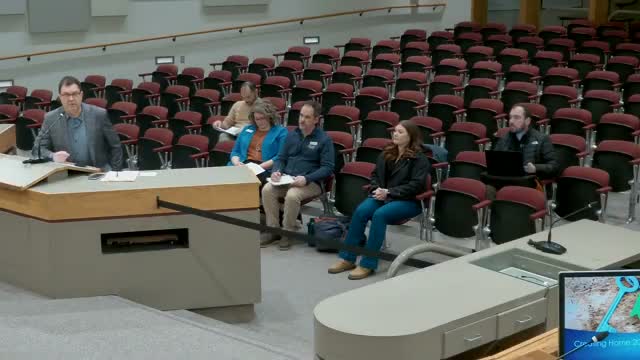
Housing providers told the Spokane City Council on Monday that Spokane needs far more subsidized units and that rising legal, financing and construction costs are constraining production.
At a study session, a presenter from the Low Income Housing Consortium said the city and region face a 20‑year shortfall concentrated “at 80% AMI or below,” and said Spokane currently produces roughly 200 low‑income units per year while the region needs tens of thousands. “We lost about 30% of the low income affordable housing downtown … 3,000 plus units,” the presenter said, describing long‑term gaps tied to past redevelopment.
Jonathan Malahan, executive director of Catholic Housing Ventures, asked the council to act as an early public funder to help developers unlock larger pools of state and federal money. “Be the first funder committed,” Malahan said, adding that a prior city action to forgive about $600,000 in debt helped Catholic Charities leverage roughly $38,000,000 in non‑city investment to preserve housing.
Speakers identified several cost drivers that make affordable projects harder to build: high interest rates, rising construction costs and regulatory compliance that can require expensive third‑party analyses. Malahan said interest and construction pressures are reducing production even where federal programs recently expanded capacity, citing an example he said showed a $758,000 interest expense on a roughly $19,000,000 project.
Presenters emphasized that operating subsidy — ongoing funds to cover operations and services — can be as important as capital grants in making projects feasible. They also pointed to local funding tools such as land banks, landlord mitigation funds and state programs like the CHIP (Connecting Housing to Infrastructure Program) as useful levers.
Several presenters described service and programmatic challenges in supportive housing. One nonprofit speaker said HUD’s best‑practice case manager ratio (about 10–20 households per case manager) is often unmet and that agencies typically operate with fewer staff per household. On eligibility questions, a presenter said whether substance use counts as a qualifying disability “depends on the funder, but I believe usually substance use is considered a disability.”
Presenters offered to provide the council with data, objective scoring tools for funding applications and early notice of timelines for funding rounds. They also asked the city to consider policy tools — fee waivers, permit timing changes, and small operating subsidies or interest buy‑downs — that could improve project feasibility.
The briefing concluded with the council and presenters agreeing to follow up. Members said they would receive a letter summarizing questions about a separate proposed eviction ordinance and that housing groups would submit additional information and examples for the council’s review.
At a study session, a presenter from the Low Income Housing Consortium said the city and region face a 20‑year shortfall concentrated “at 80% AMI or below,” and said Spokane currently produces roughly 200 low‑income units per year while the region needs tens of thousands. “We lost about 30% of the low income affordable housing downtown … 3,000 plus units,” the presenter said, describing long‑term gaps tied to past redevelopment.
Jonathan Malahan, executive director of Catholic Housing Ventures, asked the council to act as an early public funder to help developers unlock larger pools of state and federal money. “Be the first funder committed,” Malahan said, adding that a prior city action to forgive about $600,000 in debt helped Catholic Charities leverage roughly $38,000,000 in non‑city investment to preserve housing.
Speakers identified several cost drivers that make affordable projects harder to build: high interest rates, rising construction costs and regulatory compliance that can require expensive third‑party analyses. Malahan said interest and construction pressures are reducing production even where federal programs recently expanded capacity, citing an example he said showed a $758,000 interest expense on a roughly $19,000,000 project.
Presenters emphasized that operating subsidy — ongoing funds to cover operations and services — can be as important as capital grants in making projects feasible. They also pointed to local funding tools such as land banks, landlord mitigation funds and state programs like the CHIP (Connecting Housing to Infrastructure Program) as useful levers.
Several presenters described service and programmatic challenges in supportive housing. One nonprofit speaker said HUD’s best‑practice case manager ratio (about 10–20 households per case manager) is often unmet and that agencies typically operate with fewer staff per household. On eligibility questions, a presenter said whether substance use counts as a qualifying disability “depends on the funder, but I believe usually substance use is considered a disability.”
Presenters offered to provide the council with data, objective scoring tools for funding applications and early notice of timelines for funding rounds. They also asked the city to consider policy tools — fee waivers, permit timing changes, and small operating subsidies or interest buy‑downs — that could improve project feasibility.
The briefing concluded with the council and presenters agreeing to follow up. Members said they would receive a letter summarizing questions about a separate proposed eviction ordinance and that housing groups would submit additional information and examples for the council’s review.
View the Full Meeting & All Its Details
This article offers just a summary. Unlock complete video, transcripts, and insights as a Founder Member.
✓
Watch full, unedited meeting videos
✓
Search every word spoken in unlimited transcripts
✓
AI summaries & real-time alerts (all government levels)
✓
Permanent access to expanding government content
30-day money-back guarantee
