Salinas staff report Measure G revenue pacing and launch outreach for possible 2026 extension
January 26, 2026 | Salinas, Monterey County, California
This article was created by AI summarizing key points discussed. AI makes mistakes, so for full details and context, please refer to the video of the full meeting. Please report any errors so we can fix them. Report an error »
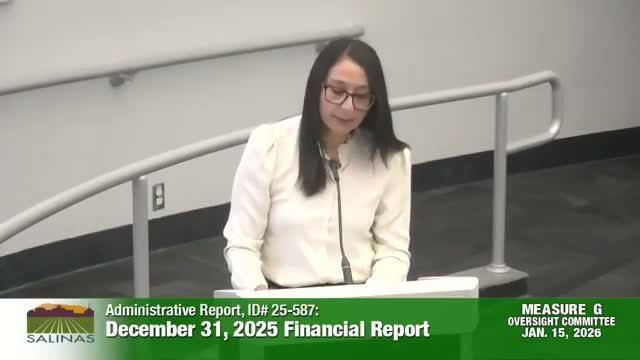
City of Salinas finance staff told the Measure G Oversight Committee on Jan. 15 that Measure G revenues for fiscal year 2025–26 are tracking slightly ahead of expectations and that the city has begun consultant-led polling and outreach in preparation for a possible ballot measure next year.
Finance management analyst Yesenia Nunez presented the quarter‑two report (as of Dec. 31, 2025), saying the measure is projected to generate $34,500,000 for FY2025–26 and that $12,500,000 (about 36% of the budget) had been received for July through October, just above the four-month benchmark of 33%. She reported departmental expenditures of roughly $12,900,000 (50% expended or encumbered) and non‑departmental expenditures of $8,900,000 (36% expended or encumbered). "Please note that these numbers are unaudited," Nunez told the committee.
Nunez also said Measure G supports about 106.5 full‑time positions across public works, police, recreation, community development, fire, finance, IT, human resources and administration, and listed major CIP projects that include streets and sidewalk repairs, ADA work and park improvements.
City Manager Renee Mendez said the city has retained consulting support and begun drafting survey questions, outreach plans and a messaging strategy. "We've started the process on SRG," Mendez said, describing a team drawn from her office, finance, the city attorney and the city clerk (who will act as project manager). She added that the city can provide information about a potential renewal but cannot legally advocate once a measure is finalized. "We can provide information. We really can't advocate once it's established and set," Mendez said.
Mendez told the committee the city will present polling results and recommended messaging back to the advisory committee and the council, and that it may request additional committee meetings before the regular quarterly schedule as outreach work intensifies. She said the city is aiming to show clearly what Measure G revenues have supported in order to build public trust and avoid perceptions that funds were "frittered away."
Committee members pressed staff on consultant selection criteria and local experience; Mendez said firms were chosen based on demonstrated understanding of the city's needs, polling methodology and the ability to work with the city attorney on ballot language and legal constraints.
Mendez and staff also discussed tax-structure choices: a general‑use local sales tax measure requires a simple majority, while a specific‑use (dedicated) measure would require a two‑thirds vote and could invite legal challenges if drafted incorrectly. Mendez said staff will continue refining financial presentations, pursue tighter audit and reporting practices, and consider a two‑year budget cycle to give more runway for planning.
Next steps: staff will complete polling and outreach, return findings to the committee and council and recommend whether to proceed with a ballot placement this year. The committee took no formal actions at the Jan. 15 meeting because there was no quorum.
Finance management analyst Yesenia Nunez presented the quarter‑two report (as of Dec. 31, 2025), saying the measure is projected to generate $34,500,000 for FY2025–26 and that $12,500,000 (about 36% of the budget) had been received for July through October, just above the four-month benchmark of 33%. She reported departmental expenditures of roughly $12,900,000 (50% expended or encumbered) and non‑departmental expenditures of $8,900,000 (36% expended or encumbered). "Please note that these numbers are unaudited," Nunez told the committee.
Nunez also said Measure G supports about 106.5 full‑time positions across public works, police, recreation, community development, fire, finance, IT, human resources and administration, and listed major CIP projects that include streets and sidewalk repairs, ADA work and park improvements.
City Manager Renee Mendez said the city has retained consulting support and begun drafting survey questions, outreach plans and a messaging strategy. "We've started the process on SRG," Mendez said, describing a team drawn from her office, finance, the city attorney and the city clerk (who will act as project manager). She added that the city can provide information about a potential renewal but cannot legally advocate once a measure is finalized. "We can provide information. We really can't advocate once it's established and set," Mendez said.
Mendez told the committee the city will present polling results and recommended messaging back to the advisory committee and the council, and that it may request additional committee meetings before the regular quarterly schedule as outreach work intensifies. She said the city is aiming to show clearly what Measure G revenues have supported in order to build public trust and avoid perceptions that funds were "frittered away."
Committee members pressed staff on consultant selection criteria and local experience; Mendez said firms were chosen based on demonstrated understanding of the city's needs, polling methodology and the ability to work with the city attorney on ballot language and legal constraints.
Mendez and staff also discussed tax-structure choices: a general‑use local sales tax measure requires a simple majority, while a specific‑use (dedicated) measure would require a two‑thirds vote and could invite legal challenges if drafted incorrectly. Mendez said staff will continue refining financial presentations, pursue tighter audit and reporting practices, and consider a two‑year budget cycle to give more runway for planning.
Next steps: staff will complete polling and outreach, return findings to the committee and council and recommend whether to proceed with a ballot placement this year. The committee took no formal actions at the Jan. 15 meeting because there was no quorum.
View the Full Meeting & All Its Details
This article offers just a summary. Unlock complete video, transcripts, and insights as a Founder Member.
✓
Watch full, unedited meeting videos
✓
Search every word spoken in unlimited transcripts
✓
AI summaries & real-time alerts (all government levels)
✓
Permanent access to expanding government content
30-day money-back guarantee
