Residents press Salinas oversight panel on proactive code enforcement, policing and rec center spending
January 26, 2026 | Salinas, Monterey County, California
This article was created by AI summarizing key points discussed. AI makes mistakes, so for full details and context, please refer to the video of the full meeting. Please report any errors so we can fix them. Report an error »
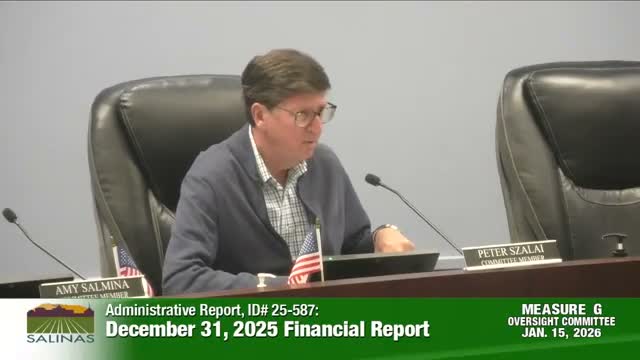
During public comment at the Measure G Oversight Committee meeting on Jan. 15, a resident pressed city staff for more proactive code enforcement, arguing that reactive enforcement creates inequitable service distribution and neighborhood blight.
The resident told the committee that lack of proactive enforcement had allowed repeated violations to accumulate and urged Measure G funds be used to create a proactive code enforcement model across districts. Staff acknowledged the complaints and said staffing turnover has slowed the transition; they described a plan to organize two code‑enforcement teams—one proactive and one complaint‑driven—and to develop a formal work plan for the year.
The resident also proposed technology and operational ideas, suggesting "cameras mounted on street sweepers or on garbage trucks" and dividing neighborhoods into zones for targeted enforcement. The resident said they had shared a company's name and contacts with staff (referenced as "Lorenzo") for follow-up.
After the code enforcement exchange, the resident asked to speak with department chiefs. The Police Chief told the committee Measure G supports both enforcement and community engagement: "We have 12 sworn positions and 17 non‑sworn," the chief said, and described new motor officer assignments, the use of collateral overtime for enforcement, and Measure G's support for the Violence Suppression Task Force (VSTF), which the chief credited with significant seizures.
The Fire Chief answered questions about response protocols and said the department adjusts the number of units based on incident type and life‑safety risk. He explained that many calls are EMS (one paramedic unit) while structure fires require scaled responses and that OSHA mandates influence crew sizes for certain actions.
A separate exchange with Library/Community Services staff clarified District 5 recreation center funding: staff said $6.9 million of an $8.1 million allocation came from Measure E and $1.2 million from Measure G, and corrected that $47,000 (not $50,000) had been expended on a feasibility study. Staff said consultants were instructed to design within the $8.1 million budget and that the CIP commitment would require council direction to change.
The meeting included repeated citizen concerns that past Measure G messaging overstated dedicated uses and that the city must do more to show how funds have been allocated. Staff and the city manager said they will work on clearer reporting and more frequent touch points with the advisory committee.
The committee took no formal action because there was no quorum, and the meeting adjourned at 5:51 p.m.
The resident told the committee that lack of proactive enforcement had allowed repeated violations to accumulate and urged Measure G funds be used to create a proactive code enforcement model across districts. Staff acknowledged the complaints and said staffing turnover has slowed the transition; they described a plan to organize two code‑enforcement teams—one proactive and one complaint‑driven—and to develop a formal work plan for the year.
The resident also proposed technology and operational ideas, suggesting "cameras mounted on street sweepers or on garbage trucks" and dividing neighborhoods into zones for targeted enforcement. The resident said they had shared a company's name and contacts with staff (referenced as "Lorenzo") for follow-up.
After the code enforcement exchange, the resident asked to speak with department chiefs. The Police Chief told the committee Measure G supports both enforcement and community engagement: "We have 12 sworn positions and 17 non‑sworn," the chief said, and described new motor officer assignments, the use of collateral overtime for enforcement, and Measure G's support for the Violence Suppression Task Force (VSTF), which the chief credited with significant seizures.
The Fire Chief answered questions about response protocols and said the department adjusts the number of units based on incident type and life‑safety risk. He explained that many calls are EMS (one paramedic unit) while structure fires require scaled responses and that OSHA mandates influence crew sizes for certain actions.
A separate exchange with Library/Community Services staff clarified District 5 recreation center funding: staff said $6.9 million of an $8.1 million allocation came from Measure E and $1.2 million from Measure G, and corrected that $47,000 (not $50,000) had been expended on a feasibility study. Staff said consultants were instructed to design within the $8.1 million budget and that the CIP commitment would require council direction to change.
The meeting included repeated citizen concerns that past Measure G messaging overstated dedicated uses and that the city must do more to show how funds have been allocated. Staff and the city manager said they will work on clearer reporting and more frequent touch points with the advisory committee.
The committee took no formal action because there was no quorum, and the meeting adjourned at 5:51 p.m.
View the Full Meeting & All Its Details
This article offers just a summary. Unlock complete video, transcripts, and insights as a Founder Member.
✓
Watch full, unedited meeting videos
✓
Search every word spoken in unlimited transcripts
✓
AI summaries & real-time alerts (all government levels)
✓
Permanent access to expanding government content
30-day money-back guarantee
