San Diego supervisors approve Saturn Boulevard repairs, health studies and expanded air‑purifier program to address Tijuana River pollution
January 29, 2026 | San Diego County, California
This article was created by AI summarizing key points discussed. AI makes mistakes, so for full details and context, please refer to the video of the full meeting. Please report any errors so we can fix them. Report an error »
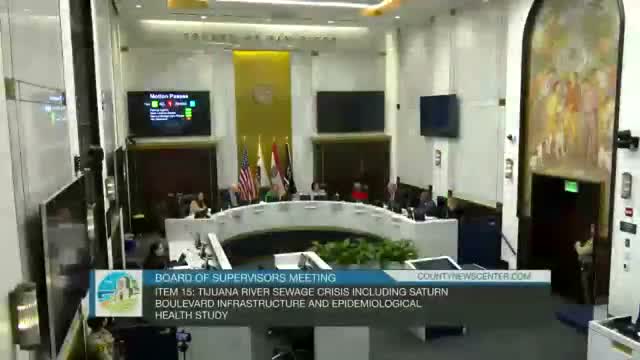
After hours of public testimony from residents, scientists and environmental groups, the San Diego County Board of Supervisors voted Jan. 28 to move forward on a package of nearly‑term and study measures aimed at mitigating the Tijuana River pollution crisis.
The board unanimously approved funding and authorization for immediate infrastructure interventions at the Saturn Boulevard hot spot — described as a location where polluted flows churn through culverts and release noxious gases — and approved a companion set of health‑study contracts to document chronic exposure. The package allocated $2.5 million for a temporary pipe extension at Saturn Boulevard (capital costs), $250,000 for a retrospective exposure study and $2 million for a long‑term cohort epidemiological study to examine chronic health impacts, according to staff and sponsor remarks.
The board broke the item into two votes. Recommendations authorizing immediate infrastructure work (recommendation 2(c)) and a request for a letter of support to federal bodies passed unanimously. Supervisors then approved the remaining recommendations, including the health studies and related contracting authority, with Supervisor Desmond recorded as voting no on the second motion.
In a related action (item 16) the board approved expanding the Air Improvement Relief Effort (IDA) program run by the San Diego County Air Pollution Control District to provide multiple air purifiers per household and agreed to use unlocked reserve funds to scale the program. APCD staff reported distribution of over 10,000 purifiers to date and said the affected area contains roughly 35,000 households; county staff and co‑sponsors proposed using $4 million to expand IDA toward the state guidance of three purifiers per household.
Researchers from San Diego State University and local health advocates urged the board to fund epidemiological work to document respiratory, neurological and stress‑related symptoms that residents report, and said emergency exposure levels (including hydrogen sulfide events) have already prompted air‑quality advisories.
Opponents and some supervisors said studies and band‑aid measures risk delay of permanent regional infrastructure fixes and urged more immediate, local engineering solutions; one public commenter and a local estimator offered a lower‑cost engineering fix on county property, and supervisors asked staff to follow up and evaluate the proposal.
The board also agreed to send a county letter supporting recently negotiated federal minute orders committing binational funds for treatment‑plant upgrades and pump‑station work. Sponsors emphasized the need to coordinate local, state, federal and philanthropic partners to leverage county funds and protect public health while long‑term binational work proceeds.
The infrastructure and program votes move forward county contracting and budgeting steps consistent with the staff recommendations; the CAO and relevant departments will return with implementation details and contracting timelines.
The board unanimously approved funding and authorization for immediate infrastructure interventions at the Saturn Boulevard hot spot — described as a location where polluted flows churn through culverts and release noxious gases — and approved a companion set of health‑study contracts to document chronic exposure. The package allocated $2.5 million for a temporary pipe extension at Saturn Boulevard (capital costs), $250,000 for a retrospective exposure study and $2 million for a long‑term cohort epidemiological study to examine chronic health impacts, according to staff and sponsor remarks.
The board broke the item into two votes. Recommendations authorizing immediate infrastructure work (recommendation 2(c)) and a request for a letter of support to federal bodies passed unanimously. Supervisors then approved the remaining recommendations, including the health studies and related contracting authority, with Supervisor Desmond recorded as voting no on the second motion.
In a related action (item 16) the board approved expanding the Air Improvement Relief Effort (IDA) program run by the San Diego County Air Pollution Control District to provide multiple air purifiers per household and agreed to use unlocked reserve funds to scale the program. APCD staff reported distribution of over 10,000 purifiers to date and said the affected area contains roughly 35,000 households; county staff and co‑sponsors proposed using $4 million to expand IDA toward the state guidance of three purifiers per household.
Researchers from San Diego State University and local health advocates urged the board to fund epidemiological work to document respiratory, neurological and stress‑related symptoms that residents report, and said emergency exposure levels (including hydrogen sulfide events) have already prompted air‑quality advisories.
Opponents and some supervisors said studies and band‑aid measures risk delay of permanent regional infrastructure fixes and urged more immediate, local engineering solutions; one public commenter and a local estimator offered a lower‑cost engineering fix on county property, and supervisors asked staff to follow up and evaluate the proposal.
The board also agreed to send a county letter supporting recently negotiated federal minute orders committing binational funds for treatment‑plant upgrades and pump‑station work. Sponsors emphasized the need to coordinate local, state, federal and philanthropic partners to leverage county funds and protect public health while long‑term binational work proceeds.
The infrastructure and program votes move forward county contracting and budgeting steps consistent with the staff recommendations; the CAO and relevant departments will return with implementation details and contracting timelines.
View the Full Meeting & All Its Details
This article offers just a summary. Unlock complete video, transcripts, and insights as a Founder Member.
✓
Watch full, unedited meeting videos
✓
Search every word spoken in unlimited transcripts
✓
AI summaries & real-time alerts (all government levels)
✓
Permanent access to expanding government content
30-day money-back guarantee
