Agoura Hills council votes to introduce ordinance to raise council pay under new state guidance
January 29, 2026 | Agoura Hills, Los Angeles County, California
This article was created by AI summarizing key points discussed. AI makes mistakes, so for full details and context, please refer to the video of the full meeting. Please report any errors so we can fix them. Report an error »
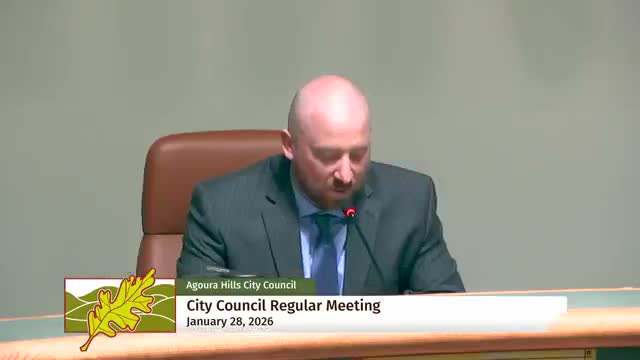
Agoura Hills City Council voted unanimously Thursday to introduce an ordinance that would raise councilmember compensation to $850 per month, a change staff said is intended to align with state guidance and broaden opportunity for prospective candidates.
City Manager Nathan Hamburger told the council the change responds to Senate Bill 329, which allows cities with populations up to 35,000 to set councilmember pay up to $950 per month. Hidalgo said the city’s stipend had not been adjusted since 1986; staff proposed $850 monthly as a number below the state ceiling. Hamburger noted the pay change would not take effect until after the formal certification of the November election.
Council member Penny Sylvester, who sponsored the item, said the 40-year gap in adjustments has left council pay far below inflation. “When it was set 40 years ago, the purchasing power was three times less than it is today,” Sylvester said, arguing the increase would help make the council open to residents of differing incomes.
Council member Kate Anderson said she was initially uncomfortable with timing but, after consulting constituents and asking staff about fiscal impacts, concluded the city’s finances were stable enough to proceed. “We could approve this tonight,” Anderson said, “and if the financial picture changes at midyear, the council could decide then whether to implement the increase.” City Manager Hamburger told council he did not anticipate cuts solely to accommodate the increase because of prior expenditure reductions and revenue adjustments.
Council member Chris Anstead noted the current annual total he recited—$3,300 per year for council service—and supported the change as a modest adjustment to improve access to public office for residents with caregiving or work constraints. Mayor Pro Tem Deborah Klein Lopez and Mayor Jeremy Wolf also supported the introduction.
Sylvester moved and Anderson seconded the motion to approve staff’s recommendation to waive full reading and introduce Ordinance No. 26-484. The motion passed on a 5–0 roll call vote.
The ordinance briefing and vote were procedural steps to advance the measure; the change is scheduled to be incorporated in the city’s midcycle budget review and may be revisited in future budget cycles if conditions change.
Next steps: The council introduced the ordinance and waived a full reading; staff will pursue the procedural steps necessary for final adoption and implementation after the prescribed post-election certification period.
City Manager Nathan Hamburger told the council the change responds to Senate Bill 329, which allows cities with populations up to 35,000 to set councilmember pay up to $950 per month. Hidalgo said the city’s stipend had not been adjusted since 1986; staff proposed $850 monthly as a number below the state ceiling. Hamburger noted the pay change would not take effect until after the formal certification of the November election.
Council member Penny Sylvester, who sponsored the item, said the 40-year gap in adjustments has left council pay far below inflation. “When it was set 40 years ago, the purchasing power was three times less than it is today,” Sylvester said, arguing the increase would help make the council open to residents of differing incomes.
Council member Kate Anderson said she was initially uncomfortable with timing but, after consulting constituents and asking staff about fiscal impacts, concluded the city’s finances were stable enough to proceed. “We could approve this tonight,” Anderson said, “and if the financial picture changes at midyear, the council could decide then whether to implement the increase.” City Manager Hamburger told council he did not anticipate cuts solely to accommodate the increase because of prior expenditure reductions and revenue adjustments.
Council member Chris Anstead noted the current annual total he recited—$3,300 per year for council service—and supported the change as a modest adjustment to improve access to public office for residents with caregiving or work constraints. Mayor Pro Tem Deborah Klein Lopez and Mayor Jeremy Wolf also supported the introduction.
Sylvester moved and Anderson seconded the motion to approve staff’s recommendation to waive full reading and introduce Ordinance No. 26-484. The motion passed on a 5–0 roll call vote.
The ordinance briefing and vote were procedural steps to advance the measure; the change is scheduled to be incorporated in the city’s midcycle budget review and may be revisited in future budget cycles if conditions change.
Next steps: The council introduced the ordinance and waived a full reading; staff will pursue the procedural steps necessary for final adoption and implementation after the prescribed post-election certification period.
View the Full Meeting & All Its Details
This article offers just a summary. Unlock complete video, transcripts, and insights as a Founder Member.
✓
Watch full, unedited meeting videos
✓
Search every word spoken in unlimited transcripts
✓
AI summaries & real-time alerts (all government levels)
✓
Permanent access to expanding government content
30-day money-back guarantee
