Subcommittee reviews SB 400 amendments to curb private youth transport practices, asks for consolidated draft
March 29, 2025 | Judiciary Committee, HOUSE OF REPRESENTATIVES, Committees, Legislative, Maryland
This article was created by AI summarizing key points discussed. AI makes mistakes, so for full details and context, please refer to the video of the full meeting. Please report any errors so we can fix them. Report an error »
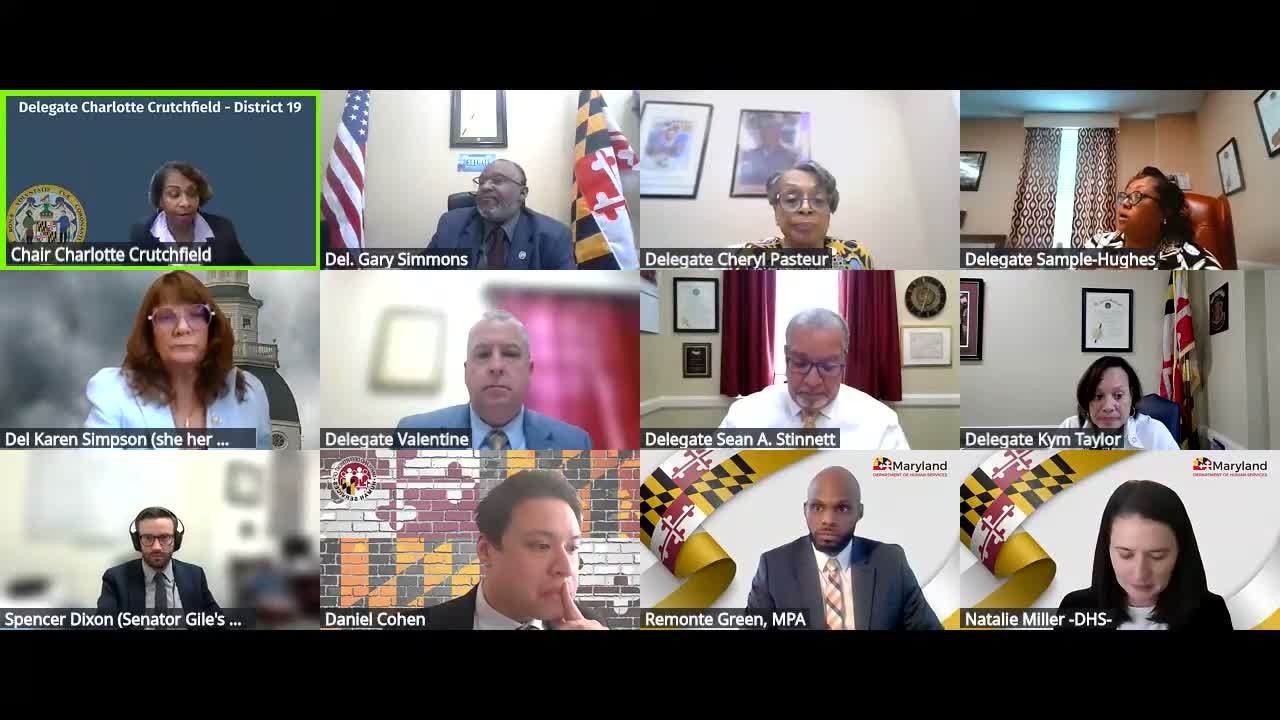
Delegate Charlotte Crutchfield, chair of the Family and Juvenile Law Subcommittee, convened a remote meeting to review SB 400, a bill addressing private companies that transport children to residential programs, and requested a consolidated overlay of Senate and House amendments before the panel votes.
Sponsor Delegate Stewart said the bill’s amendments aim to close loopholes and strengthen protections for children. He summarized key changes that would: clarify the bill applies when the final intended destination is a residential childcare program even if there are interim stops; add compensatory damages alongside restitution and attorneys’ fees; make the law prospective (not retroactive); set a 10‑year statute of limitations for claims against transport companies; bar contract provisions that would waive a child’s right to sue; categorically prohibit mechanical restraints while limiting physical restraints to the bill’s standards; and exempt the Department of Human Services from the bill’s time restriction on transports (9 p.m.–6 a.m.) while leaving other requirements in place.
"We prevented one of those contracts from including a provision purporting to waive the child's right to bring a lawsuit," Delegate Stewart said, arguing that parents sometimes sign away children’s later ability to sue. He also described survivor accounts in which transports often occurred at night and included blindfolds or handcuffs, saying advocates estimate the number of Marylanders transported annually is "probably in the hundreds." Stewart characterized the package as largely clarifying and remedial rather than expansive policy change.
A representative from the Department of Human Services, identified in the meeting as Mister Green, urged caution on two fronts: the bill’s definition of "child" could leave DHS unable to exercise authority over children not in its custody, and oversight of certain restraints falls under the Department of Health for some populations. "That's never our intent when we're trying to keep a child safe," Mister Green said, adding that strictly limiting transport hours could harm DHS operations across jurisdictions because the agency sometimes needs flexibility to move youth at various times for safety or placement reasons.
Members pressed for more data on the prevalence of the targeted transports and whether state funds subsidize private transport companies. Stewart said he had not found definitive records of Maryland‑headquartered firms and that the extent of state subsidies (Medicaid or other funding) remains unclear; he pledged to pursue those questions in the interim. Deputy and committee staff noted differences between the Senate and House language on definitions and restraint standards and recommended the sponsor produce a single, conformed Senate bill with the sponsor’s agreed amendments for the subcommittee’s review.
Delegate Bartlett asked whether the bill contains penalties for parents who contract with transport companies; Stewart said the current draft does not, and he invited the committee to consider that as a separate or future step while noting existing neglect or abuse causes of action may apply in some cases.
The committee agreed to reconvene briefly after Stewart and staff circulate a consolidated reprint that overlays the sponsor’s amendments onto the Senate bill so members can read and verify the intended language. Spencer moved to adjourn, Chair Crutchfield seconded, and the subcommittee was adjourned without a roll‑call vote.
The subcommittee did not take a final vote on SB 400; the next procedural step is a follow‑up subcommittee meeting once a consolidated draft is available.
Sponsor Delegate Stewart said the bill’s amendments aim to close loopholes and strengthen protections for children. He summarized key changes that would: clarify the bill applies when the final intended destination is a residential childcare program even if there are interim stops; add compensatory damages alongside restitution and attorneys’ fees; make the law prospective (not retroactive); set a 10‑year statute of limitations for claims against transport companies; bar contract provisions that would waive a child’s right to sue; categorically prohibit mechanical restraints while limiting physical restraints to the bill’s standards; and exempt the Department of Human Services from the bill’s time restriction on transports (9 p.m.–6 a.m.) while leaving other requirements in place.
"We prevented one of those contracts from including a provision purporting to waive the child's right to bring a lawsuit," Delegate Stewart said, arguing that parents sometimes sign away children’s later ability to sue. He also described survivor accounts in which transports often occurred at night and included blindfolds or handcuffs, saying advocates estimate the number of Marylanders transported annually is "probably in the hundreds." Stewart characterized the package as largely clarifying and remedial rather than expansive policy change.
A representative from the Department of Human Services, identified in the meeting as Mister Green, urged caution on two fronts: the bill’s definition of "child" could leave DHS unable to exercise authority over children not in its custody, and oversight of certain restraints falls under the Department of Health for some populations. "That's never our intent when we're trying to keep a child safe," Mister Green said, adding that strictly limiting transport hours could harm DHS operations across jurisdictions because the agency sometimes needs flexibility to move youth at various times for safety or placement reasons.
Members pressed for more data on the prevalence of the targeted transports and whether state funds subsidize private transport companies. Stewart said he had not found definitive records of Maryland‑headquartered firms and that the extent of state subsidies (Medicaid or other funding) remains unclear; he pledged to pursue those questions in the interim. Deputy and committee staff noted differences between the Senate and House language on definitions and restraint standards and recommended the sponsor produce a single, conformed Senate bill with the sponsor’s agreed amendments for the subcommittee’s review.
Delegate Bartlett asked whether the bill contains penalties for parents who contract with transport companies; Stewart said the current draft does not, and he invited the committee to consider that as a separate or future step while noting existing neglect or abuse causes of action may apply in some cases.
The committee agreed to reconvene briefly after Stewart and staff circulate a consolidated reprint that overlays the sponsor’s amendments onto the Senate bill so members can read and verify the intended language. Spencer moved to adjourn, Chair Crutchfield seconded, and the subcommittee was adjourned without a roll‑call vote.
The subcommittee did not take a final vote on SB 400; the next procedural step is a follow‑up subcommittee meeting once a consolidated draft is available.
View the Full Meeting & All Its Details
This article offers just a summary. Unlock complete video, transcripts, and insights as a Founder Member.
✓
Watch full, unedited meeting videos
✓
Search every word spoken in unlimited transcripts
✓
AI summaries & real-time alerts (all government levels)
✓
Permanent access to expanding government content
30-day money-back guarantee
