Oakland planning commission backs S14 zoning amendments, urges administrative guidelines
January 21, 2026 | Oakland , Alameda County, California
This article was created by AI summarizing key points discussed. AI makes mistakes, so for full details and context, please refer to the video of the full meeting. Please report any errors so we can fix them. Report an error »
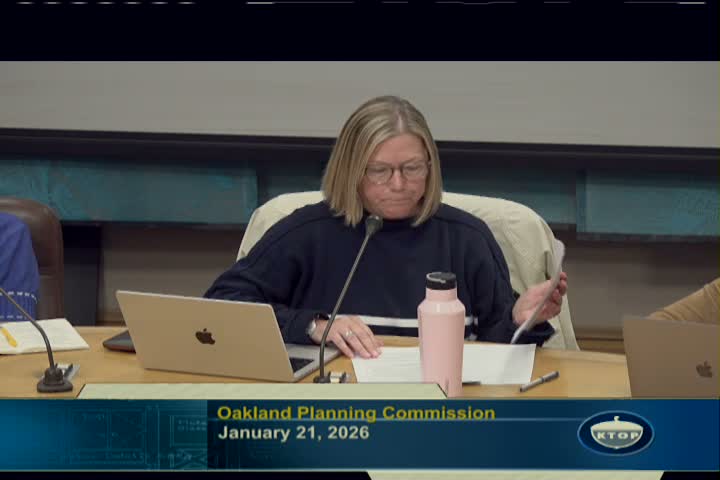
Vice Chair Nellie Sandoval moved and the Oakland Planning Commission unanimously voted to recommend that the City Council adopt amendments to the S14 housing-sites combining zone and authorize administrative guidelines to support implementation.
The amendments revise the definition of what qualifies as a "development project," add a conditional-use permit (CUP) pathway for certain nonhousing uses on S14 sites when those uses provide "substantial community or economic benefit," and update work-live and live-work unit-area limits to match recent changes to the California Building Code. Strategic Planning Manager Laura Kaminski told commissioners staff would return ordinance language to council with corresponding California Environmental Quality Act findings and noted staff had consulted with the state Department of Housing and Community Development on the no-net-loss approach.
Kaminski summarized the threshold language staff are proposing: projects that add floor area to buildings occupied by businesses established after 01/21/2026 and increase square footage by 50% or more (or by 30,000 square feet, whichever is less) would be treated as development projects; limited expansions to existing businesses in place by 01/01/2026 would not automatically trigger a development-project designation. She also said the CUP would only be available when staff can find that remaining housing sites still enable the city to meet its regional housing need and that no-net-loss is preserved across income tiers.
Commissioners pressed staff on how to make the "substantial community benefit" finding objective. Chair Jennifer Rank said what "jumped out" for her was "the subjectivity of the benefits and sort of how...we hold applicants' feet to the fire," and multiple commissioners urged written administrative guidelines to define metrics and make decision-making consistent. Deputy Director Ed Manasseh recommended a structured administrative guideline that could be returned to the commission for feedback; staff agreed to include authorization and direction for administrative guidelines in the ordinance.
The commission's motion, moved by Vice Chair Nellie Sandoval and seconded as recorded, passed on a roll-call vote and will be transmitted to the City Council for consideration on the schedule staff outlined (February 24 to the Community and Economic Development subcommittee, March 3 for first reading of the ordinance). The commission recorded the motion as passing and directed staff to prepare the draft ordinance and administrative guidelines as part of the record for council review.
The next procedural step is for staff to prepare the ordinance language and administrative guidance for council consideration and for staff to report back as the item advances through the council process.
The amendments revise the definition of what qualifies as a "development project," add a conditional-use permit (CUP) pathway for certain nonhousing uses on S14 sites when those uses provide "substantial community or economic benefit," and update work-live and live-work unit-area limits to match recent changes to the California Building Code. Strategic Planning Manager Laura Kaminski told commissioners staff would return ordinance language to council with corresponding California Environmental Quality Act findings and noted staff had consulted with the state Department of Housing and Community Development on the no-net-loss approach.
Kaminski summarized the threshold language staff are proposing: projects that add floor area to buildings occupied by businesses established after 01/21/2026 and increase square footage by 50% or more (or by 30,000 square feet, whichever is less) would be treated as development projects; limited expansions to existing businesses in place by 01/01/2026 would not automatically trigger a development-project designation. She also said the CUP would only be available when staff can find that remaining housing sites still enable the city to meet its regional housing need and that no-net-loss is preserved across income tiers.
Commissioners pressed staff on how to make the "substantial community benefit" finding objective. Chair Jennifer Rank said what "jumped out" for her was "the subjectivity of the benefits and sort of how...we hold applicants' feet to the fire," and multiple commissioners urged written administrative guidelines to define metrics and make decision-making consistent. Deputy Director Ed Manasseh recommended a structured administrative guideline that could be returned to the commission for feedback; staff agreed to include authorization and direction for administrative guidelines in the ordinance.
The commission's motion, moved by Vice Chair Nellie Sandoval and seconded as recorded, passed on a roll-call vote and will be transmitted to the City Council for consideration on the schedule staff outlined (February 24 to the Community and Economic Development subcommittee, March 3 for first reading of the ordinance). The commission recorded the motion as passing and directed staff to prepare the draft ordinance and administrative guidelines as part of the record for council review.
The next procedural step is for staff to prepare the ordinance language and administrative guidance for council consideration and for staff to report back as the item advances through the council process.
Don't Miss a Word: See the Full Meeting!
Go beyond summaries. Unlock every video, transcript, and key insight with a Founder Membership.
✓
Get instant access to full meeting videos
✓
Search and clip any phrase from complete transcripts
✓
Receive AI-powered summaries & custom alerts
✓
Enjoy lifetime, unrestricted access to government data
30-day money-back guarantee
