Lafayette council briefed on emergency operations, EOC activation and community role
January 27, 2026 | Lafayette, Contra Costa County, California
This article was created by AI summarizing key points discussed. AI makes mistakes, so for full details and context, please refer to the video of the full meeting. Please report any errors so we can fix them. Report an error »
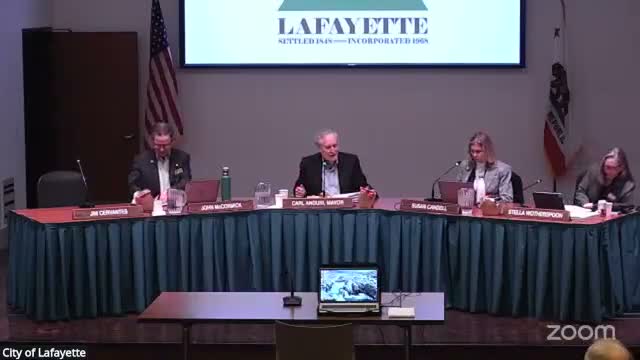
Andy Conley, an emergency services trainer, told the Lafayette City Council during a training session that responding to and recovering from disasters requires coordinated work across the whole community. "Responding to disasters and preparing for them ... takes the whole community," he said, as he walked the council through the National Incident Management System and the Incident Command System.
Conley described how incidents scale from field incident command to a city Emergency Operations Center (EOC), then to the county operational area and beyond when additional resources are needed. He said the EOC’s role is to support field operations — prioritizing resources, tracking logistics and coordinating with other jurisdictions and volunteer organizations.
On legal authority, Conley said a local emergency proclamation is required to give the EOC the legal tools and access to funding it needs. Under the municipal code, the mayor can request a proclamation and the council must ratify it within seven days, or the proclamation lapses. He also noted the practical path for external assistance: "typically we'd go...to the county first and see what they can do to help us," with state and FEMA support following if the scale requires it.
Council members asked about thresholds for state and federal assistance, past activations and funding timing. Staff and Conley cited a recent local activation during 2023 floods and cautioned that FEMA’s initial funding and staffing levels have shifted in recent years, which can delay reimbursement. Conley advised the city to maintain careful records of staff time and expenses to aid later funding claims.
The presentation also covered sheltering, special needs populations, public information coordination (a joint information center with multiple public information officers), volunteer management, and the typical EOC organizational sections: operations, planning, logistics, finance/admin, management and policy. Conley said the city has about 23 trained EOC personnel available and described how multi‑shift operations would be staffed.
Conley concluded by urging ongoing training and coordination with county and regional partners to ensure scalable response and prompt damage assessment if larger requests for assistance are needed.
Conley described how incidents scale from field incident command to a city Emergency Operations Center (EOC), then to the county operational area and beyond when additional resources are needed. He said the EOC’s role is to support field operations — prioritizing resources, tracking logistics and coordinating with other jurisdictions and volunteer organizations.
On legal authority, Conley said a local emergency proclamation is required to give the EOC the legal tools and access to funding it needs. Under the municipal code, the mayor can request a proclamation and the council must ratify it within seven days, or the proclamation lapses. He also noted the practical path for external assistance: "typically we'd go...to the county first and see what they can do to help us," with state and FEMA support following if the scale requires it.
Council members asked about thresholds for state and federal assistance, past activations and funding timing. Staff and Conley cited a recent local activation during 2023 floods and cautioned that FEMA’s initial funding and staffing levels have shifted in recent years, which can delay reimbursement. Conley advised the city to maintain careful records of staff time and expenses to aid later funding claims.
The presentation also covered sheltering, special needs populations, public information coordination (a joint information center with multiple public information officers), volunteer management, and the typical EOC organizational sections: operations, planning, logistics, finance/admin, management and policy. Conley said the city has about 23 trained EOC personnel available and described how multi‑shift operations would be staffed.
Conley concluded by urging ongoing training and coordination with county and regional partners to ensure scalable response and prompt damage assessment if larger requests for assistance are needed.
Don't Miss a Word: See the Full Meeting!
Go beyond summaries. Unlock every video, transcript, and key insight with a Founder Membership.
✓
Get instant access to full meeting videos
✓
Search and clip any phrase from complete transcripts
✓
Receive AI-powered summaries & custom alerts
✓
Enjoy lifetime, unrestricted access to government data
30-day money-back guarantee
