Planning Commission recommends approval for limited-commercial-use expansion ordinance to help legacy small businesses
January 22, 2026 | San Francisco City, San Francisco County, California
This article was created by AI summarizing key points discussed. AI makes mistakes, so for full details and context, please refer to the video of the full meeting. Please report any errors so we can fix them. Report an error »
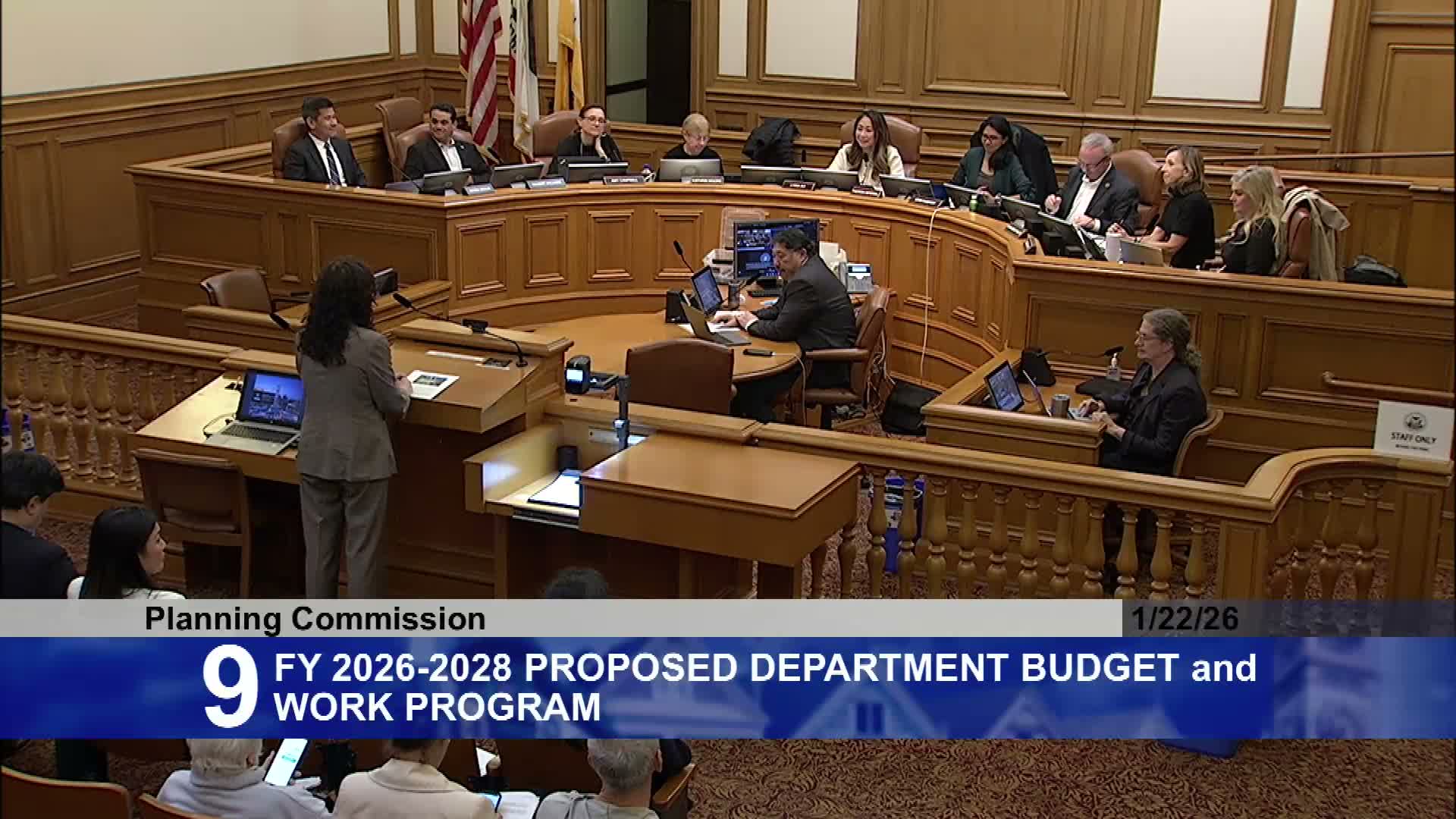
The Planning Commission on Jan. 22 voted unanimously to recommend approval of an ordinance introduced by Supervisor Jackie Fielder that would allow limited commercial uses (LCUs) in residential districts to make minor expansions without triggering a full variance process, provided expansions do not convert or demolish residential uses.
Anna Herrera, representing Supervisor Fielder, told the commission the measure was prompted by Casa Maria, a longstanding neighborhood grocery in the Mission District, which has used a rear-yard structure for refrigeration for 20 years. "Without this expanded space, Mr. Arana has explained he would have to cease operations," Herrera said, urging commissioners to support the ordinance so similar legacy small businesses can remain viable.
Planning staff (Veronica Flores) supported the ordinance's goals but recommended three modifications: require an affidavit disclosing housing services and tenant notice/compensation where services are affected; establish explicit criteria and thresholds for the zoning administrator to use when reviewing rear-yard exceptions (to assess loss of open space, impacts to housing services, demonstrated practical difficulty, and corner-lot considerations); and amend the ordinance to prohibit LCUs from expanding into any portion of a residential unit even when the expansion would not trigger the statutory thresholds for conversion or demolition.
Corey Teague, the city's zoning administrator, explained that the ordinance would create an administrative exception to allow extensions into required rear yards under limited circumstances rather than require a variance and public hearing. Teague said staff will develop criteria to assess impacts to housing services, open space loss and effects on adjacent properties.
During public comment, Socorro Arana (owner of Casa Maria) said the rear-yard refrigerators are critical to keeping fresh produce available at affordable prices for seniors and low-income families. Susana Rojas, Executive Director of the Latino Cultural District, testified the ordinance protects legacy businesses and cultural-district vitality.
Commissioners pressed staff and the sponsor to flesh out metrics for review, including noise and nighttime lighting protections, and to consider numeric square-foot thresholds akin to ADU rules so applicants and businesses can clearly understand allowable expansions. Commissioner Campbell moved to adopt a recommendation of approval with staff modifications; the motion passed 7-0.
The commission's recommendation will be transmitted back to the Board of Supervisors and the sponsor for further ordinance drafting; staff said they will continue to workshop criteria and return with refined language.
Anna Herrera, representing Supervisor Fielder, told the commission the measure was prompted by Casa Maria, a longstanding neighborhood grocery in the Mission District, which has used a rear-yard structure for refrigeration for 20 years. "Without this expanded space, Mr. Arana has explained he would have to cease operations," Herrera said, urging commissioners to support the ordinance so similar legacy small businesses can remain viable.
Planning staff (Veronica Flores) supported the ordinance's goals but recommended three modifications: require an affidavit disclosing housing services and tenant notice/compensation where services are affected; establish explicit criteria and thresholds for the zoning administrator to use when reviewing rear-yard exceptions (to assess loss of open space, impacts to housing services, demonstrated practical difficulty, and corner-lot considerations); and amend the ordinance to prohibit LCUs from expanding into any portion of a residential unit even when the expansion would not trigger the statutory thresholds for conversion or demolition.
Corey Teague, the city's zoning administrator, explained that the ordinance would create an administrative exception to allow extensions into required rear yards under limited circumstances rather than require a variance and public hearing. Teague said staff will develop criteria to assess impacts to housing services, open space loss and effects on adjacent properties.
During public comment, Socorro Arana (owner of Casa Maria) said the rear-yard refrigerators are critical to keeping fresh produce available at affordable prices for seniors and low-income families. Susana Rojas, Executive Director of the Latino Cultural District, testified the ordinance protects legacy businesses and cultural-district vitality.
Commissioners pressed staff and the sponsor to flesh out metrics for review, including noise and nighttime lighting protections, and to consider numeric square-foot thresholds akin to ADU rules so applicants and businesses can clearly understand allowable expansions. Commissioner Campbell moved to adopt a recommendation of approval with staff modifications; the motion passed 7-0.
The commission's recommendation will be transmitted back to the Board of Supervisors and the sponsor for further ordinance drafting; staff said they will continue to workshop criteria and return with refined language.
View the Full Meeting & All Its Details
This article offers just a summary. Unlock complete video, transcripts, and insights as a Founder Member.
✓
Watch full, unedited meeting videos
✓
Search every word spoken in unlimited transcripts
✓
AI summaries & real-time alerts (all government levels)
✓
Permanent access to expanding government content
30-day money-back guarantee
