Planning Commission asks staff to draft voluntary-disclosure rules for interested‑party contacts
January 22, 2026 | Santa Monica City, Los Angeles County, California
This article was created by AI summarizing key points discussed. AI makes mistakes, so for full details and context, please refer to the video of the full meeting. Please report any errors so we can fix them. Report an error »
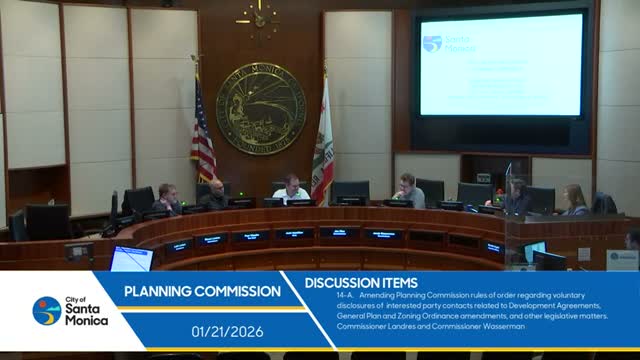
The Santa Monica Planning Commission voted to ask staff to draft proposed rules of order prompting voluntary disclosures of interested‑party contacts for development agreements, general plan and zoning ordinance amendments and other legislative matters.
The motion, moved by an unidentified commissioner and seconded by another commissioner, passed on a roll‑call vote with Commissioners Landers and Wasserman, Vice Chair Choco and Chair Hamilton recorded as voting yes. The clerk recorded the motion as passed.
Why it matters: Commissioners framed the proposal as a transparency measure to let the public know when offline conversations have occurred between commissioners and parties with a specific interest in an agenda item. Supporters said the prompt would clarify which informal discussions occurred; some commissioners urged keeping any disclosure process voluntary and not turning it into a bureaucratic requirement.
During debate, one commissioner described the difference between legally required ex parte disclosures in quasi‑judicial hearings and voluntary disclosures for other legislative items, saying that ex parte rules are a "term of art" and legally required only in quasi‑judicial contexts. Another commissioner said the measure was intended to "clear the air" when commissioners had offline conversations with applicants or interested parties, noting a recent instance involving a pawn‑shop applicant as the motivating example.
The commission directed staff to return with proposed language for the rules of order; staff indicated they would bring draft language to a future meeting for the commission's consideration. The action is procedural: it requests staff work and does not itself change code or adopt binding standards.
The commission followed this item with brief comments on mobility curb‑ramp work and design ideas for missing‑middle housing before adjourning.
The motion, moved by an unidentified commissioner and seconded by another commissioner, passed on a roll‑call vote with Commissioners Landers and Wasserman, Vice Chair Choco and Chair Hamilton recorded as voting yes. The clerk recorded the motion as passed.
Why it matters: Commissioners framed the proposal as a transparency measure to let the public know when offline conversations have occurred between commissioners and parties with a specific interest in an agenda item. Supporters said the prompt would clarify which informal discussions occurred; some commissioners urged keeping any disclosure process voluntary and not turning it into a bureaucratic requirement.
During debate, one commissioner described the difference between legally required ex parte disclosures in quasi‑judicial hearings and voluntary disclosures for other legislative items, saying that ex parte rules are a "term of art" and legally required only in quasi‑judicial contexts. Another commissioner said the measure was intended to "clear the air" when commissioners had offline conversations with applicants or interested parties, noting a recent instance involving a pawn‑shop applicant as the motivating example.
The commission directed staff to return with proposed language for the rules of order; staff indicated they would bring draft language to a future meeting for the commission's consideration. The action is procedural: it requests staff work and does not itself change code or adopt binding standards.
The commission followed this item with brief comments on mobility curb‑ramp work and design ideas for missing‑middle housing before adjourning.
Don't Miss a Word: See the Full Meeting!
Go beyond summaries. Unlock every video, transcript, and key insight with a Founder Membership.
✓
Get instant access to full meeting videos
✓
Search and clip any phrase from complete transcripts
✓
Receive AI-powered summaries & custom alerts
✓
Enjoy lifetime, unrestricted access to government data
30-day money-back guarantee
