Summit County COG orders redraft of Transportation Sales Tax policy, seeks statutory prioritization in policy
January 26, 2026 | Eastern Summit County Agriculture Preservation and Open Lands Advisory Committee, Summit County Commission and Boards, Summit County, Utah
This article was created by AI summarizing key points discussed. AI makes mistakes, so for full details and context, please refer to the video of the full meeting. Please report any errors so we can fix them. Report an error »
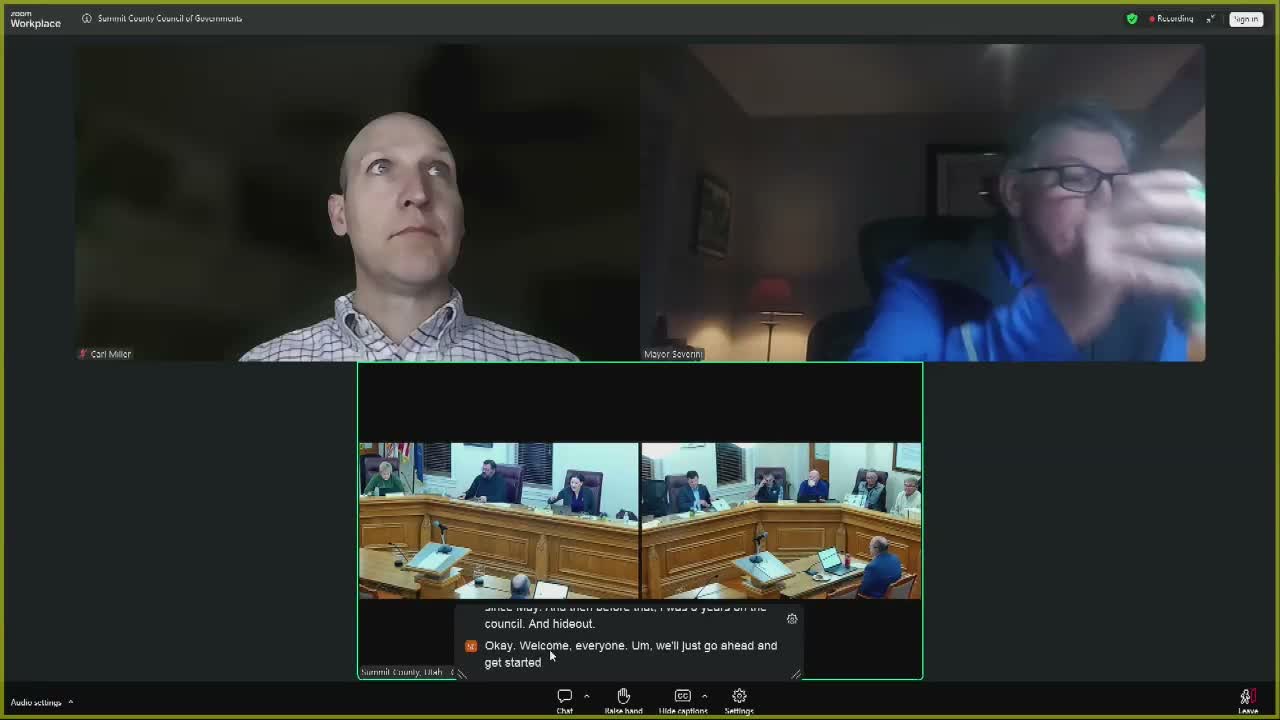
County attorney David Thomas opened the discussion by reminding members that the COG is a voluntary interlocal body, created to build consensus on cross-jurisdictional issues. "When we talk about councils of governments, we're talking about a voluntary association of local governments," Thomas said, summarizing the COGs role and voting rules.
County transportation staff described why the policy rewrite was needed. "We started a TST policy committee and identified the need for clearer policy direction, particularly on scope or cost changes and fund reallocation," said Ava (transportation staff), who led the program rewrite. Staff reported the fund generates about $8,000,000 per year, with roughly $2.5 million used annually for bond service, leaving roughly $5.56.5 million for programming depending on bond obligations.
Staff proposed using the five statutory weighted criteria in Utah Code (cost effectiveness; mitigation of regional traffic congestion; economic impact; future maintenance and operations; compliance with laws) and adding a yearly "flex" category (for example, safety) that the COG could set. Mountainlands Association of Governments (MAG) was proposed as an outside auditor to produce an initial ranked list of projects; COG would then review, deliberate and submit a single prioritized list to the County Council.
Several members raised concerns about objectivity and equity. Mayor Matt McCormick urged that the policy explicitly include the statutory prioritization process, not just the evaluation criteria, saying members needed a clear written prioritization step to avoid ambiguity. Park City representatives pressed for a mechanism (discussed previously as a 45% cap) to prevent a single applicant from receiving the majority of available TST funds, while other members warned that hard caps could restrict financing of large regional projects such as Bus Rapid Transit (BRT).
Ziva DeGarnes, a transportation planner, summarized program finances: "This fund source generates about $8,000,000 per year, and we pay 2 and a half million off the top in bond proceeds," and estimated the outstanding bond term at roughly 15 years.
The COG also discussed administrative rules staff proposed: applicants may present short (recommended three-minute) project pitches at the June selection meeting; invoicing is expected within two years of award (five years for small cities); projects inactive for three or more years could have funds recalled; and small cities retain a carved-out allocation (historically about $250,000 and now roughly $425,000) with a simplified process.
After discussion, Council Member Chris Robinson moved and Mayor Matt McCormick seconded a motion directing staff to revise the policies and procedures to "feather in" the statutory prioritization language (per Utah Code) and return a redlined draft at the next meeting. The motion passed.
Next steps: staff will update the draft to explicitly show the prioritization process and the relationship between the statutory weighted evaluation and COGs final prioritized list, circulate a redline, and return the revised document at the March meeting for further action.
View the Full Meeting & All Its Details
This article offers just a summary. Unlock complete video, transcripts, and insights as a Founder Member.
30-day money-back guarantee
