Cerritos staff outline $25M in water projects and emergency repair for damaged C‑4 well
January 22, 2026 | Cerritos City, Orange County, California
This article was created by AI summarizing key points discussed. AI makes mistakes, so for full details and context, please refer to the video of the full meeting. Please report any errors so we can fix them. Report an error »
Cerritos Director of Public Works Alvin Papa told the Community Safety Committee on Jan. 21 that the city’s water and sewer systems—built largely in the 1970s—are reaching the end of their design life and require major capital work.
"The most important project of all of those is the C‑4 well and treatment system that needs to be built," Papa said, laying out an inventory that includes four wells, about 172 miles of water pipe and roughly 146 miles of sewer pipe. He told the committee the city has identified approximately $25,000,000 in water projects and about $4,000,000 in sewer work as priorities.
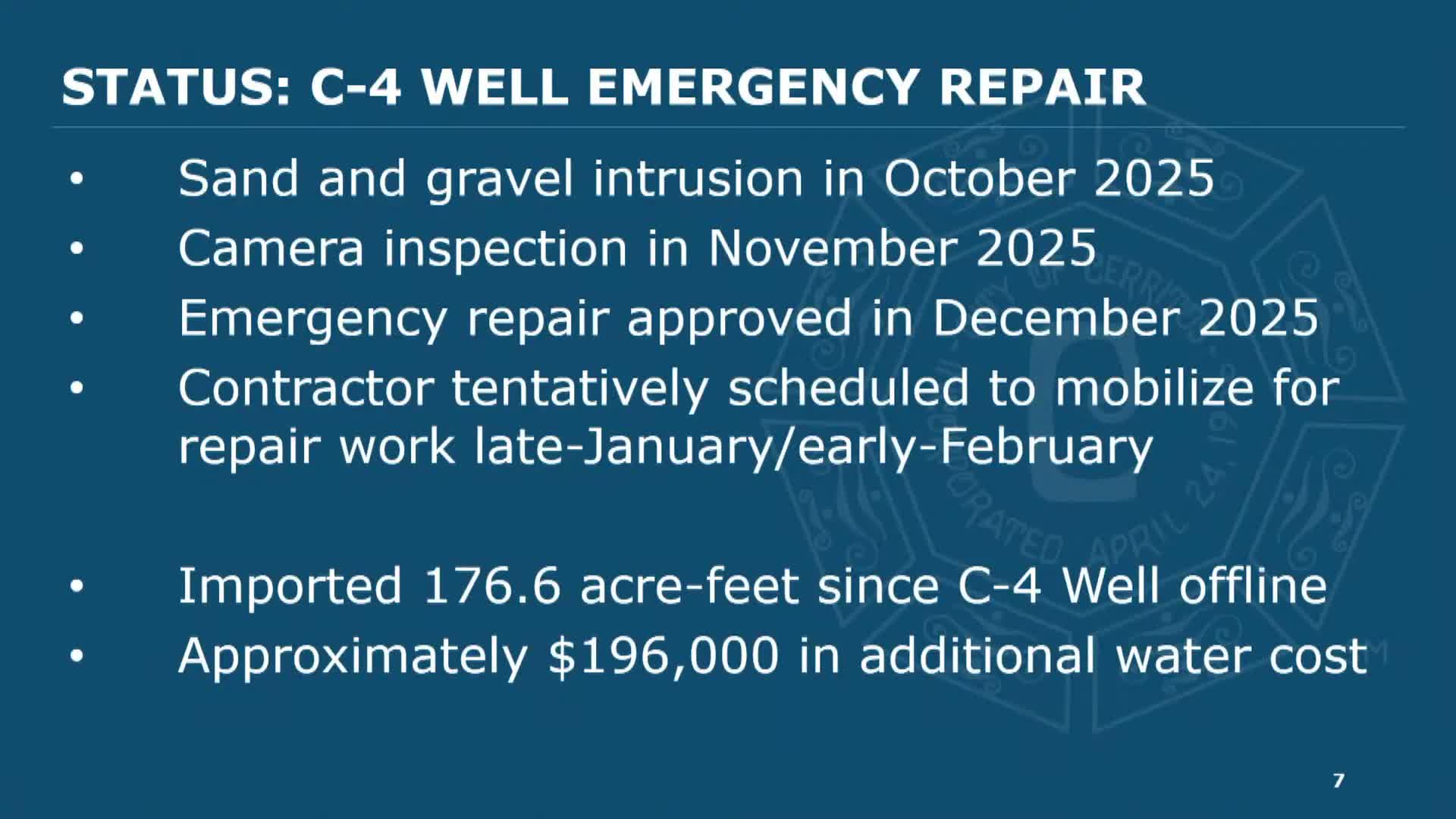
Papa described the immediate impetus for repairs: a camera inspection of the C‑4 well, near Reservoir Park and Studebaker, found sand and gravel entering the well through a hole in the casing at roughly 1,000 feet. The city shut the well off in October 2025, removed the pump and developed an emergency repair plan the City Council approved on Dec. 22, 2025.
The emergency repair is estimated at about $600,000, and the contractor is tentatively scheduled to mobilize in February. Papa said he expects repair work to take three to four months once mobilized. While the well has been offline, the city has purchased imported water; Papa reported an additional $196,000 in water costs since October and contrasted local groundwater—about $454 per acre‑foot—with imported water now costing about $1,698 per acre‑foot from the Metropolitan Water District.
On sewer needs, Papa said the priority is a CCTV inspection program to assess primarily vitrified‑clay pipelines and a matching relining or replacement program to extend pipe life by roughly 40–60 years.
Papa said the city mailed a public information flyer with a QR code linking to the city website for details on infrastructure and proposed rate adjustments. He stressed the presentation was informational and no committee action was requested at the meeting.
Next steps: staff will proceed with the emergency repair according to the council authorization and continue updating boards and commissions as the project and the capital program advance.
"The most important project of all of those is the C‑4 well and treatment system that needs to be built," Papa said, laying out an inventory that includes four wells, about 172 miles of water pipe and roughly 146 miles of sewer pipe. He told the committee the city has identified approximately $25,000,000 in water projects and about $4,000,000 in sewer work as priorities.
Papa described the immediate impetus for repairs: a camera inspection of the C‑4 well, near Reservoir Park and Studebaker, found sand and gravel entering the well through a hole in the casing at roughly 1,000 feet. The city shut the well off in October 2025, removed the pump and developed an emergency repair plan the City Council approved on Dec. 22, 2025.
The emergency repair is estimated at about $600,000, and the contractor is tentatively scheduled to mobilize in February. Papa said he expects repair work to take three to four months once mobilized. While the well has been offline, the city has purchased imported water; Papa reported an additional $196,000 in water costs since October and contrasted local groundwater—about $454 per acre‑foot—with imported water now costing about $1,698 per acre‑foot from the Metropolitan Water District.
On sewer needs, Papa said the priority is a CCTV inspection program to assess primarily vitrified‑clay pipelines and a matching relining or replacement program to extend pipe life by roughly 40–60 years.
Papa said the city mailed a public information flyer with a QR code linking to the city website for details on infrastructure and proposed rate adjustments. He stressed the presentation was informational and no committee action was requested at the meeting.
Next steps: staff will proceed with the emergency repair according to the council authorization and continue updating boards and commissions as the project and the capital program advance.
View the Full Meeting & All Its Details
This article offers just a summary. Unlock complete video, transcripts, and insights as a Founder Member.
✓
Watch full, unedited meeting videos
✓
Search every word spoken in unlimited transcripts
✓
AI summaries & real-time alerts (all government levels)
✓
Permanent access to expanding government content
30-day money-back guarantee
