Planning commissioners approve Huntington Club remodel and four member-only bungalows amid public opposition
January 27, 2026 | Huntington Beach , Orange County, California
This article was created by AI summarizing key points discussed. AI makes mistakes, so for full details and context, please refer to the video of the full meeting. Please report any errors so we can fix them. Report an error »
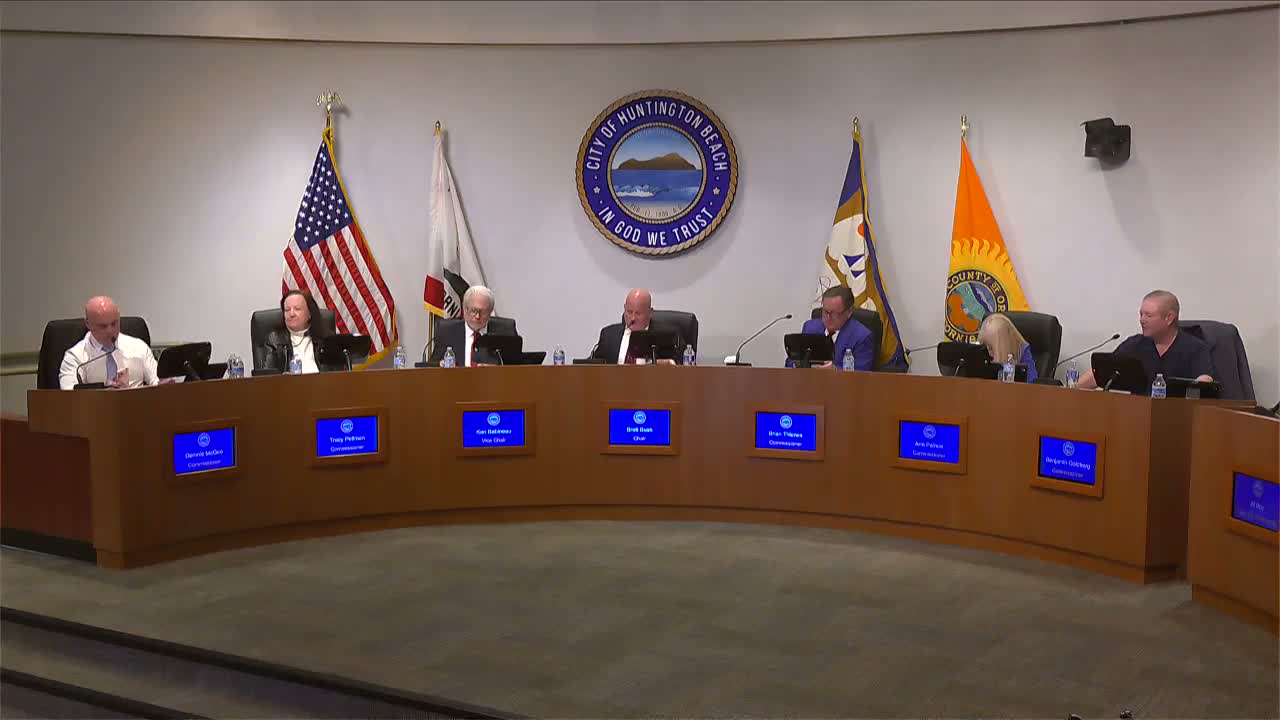
HUNTINGTON BEACH, Jan. 27, 2026 — The Huntington Beach Planning Commission voted to approve a remodel of the Huntington Club that replaces the aging tennis clubhouse with a new two-story 12,446-square-foot facility, adds a Junior Olympic pool and builds four detached bungalows and two loft units, while limiting bungalow use to members and their guests and asking staff and the applicant to pursue lighting for additional tennis courts.
The project — before the commission as conditional use permit 22-011 and coastal development permit 22-009 — drew lengthy public comment and detailed questioning from commissioners about parking, membership verification, lighting and the applicability of the California Environmental Quality Act (CEQA) Class 32 infill exemption. Principal planner Joanna Cortes presented the proposal and told commissioners staff recommends approval based on consistency with the city’s general plan and zoning (open space recreation) and the findings in the staff packet.
Applicant Jonathan Bailey, the project manager for the Huntington Club improvements, emphasized the plan’s amenities and membership-only approach. "These are exclusively meant for members and guest members," he said, describing the bungalows as short-term accommodations intended for members’ families and guests and saying revenue from bungalow rentals would help fund other improvements. Bailey also said the club counts roughly 225 tennis members and that overall membership across categories is larger.
Opponents said the bungalows amount to overnight lodging inconsistent with open-space-recreation zoning, and that removing four tennis courts — including lighted courts — would reduce recreational capacity and could jeopardize tournaments and charity events. Jim Hartman, speaking for club members, said he submitted a petition he described as signed by "over 680 individuals opposing the proposed bungalows and lofts" and urged the commission to require fuller review. Robert Kelly, a longtime resident and club member, warned the plan could create a precedent allowing overnight lodging on other open-space sites.
Supporters, including tennis professionals and some club members, said the remodeled clubhouse, larger pool and enhanced performance-therapy facilities would improve services, that lighting technology has advanced and could reduce off-site impacts, and that the project could provide new revenue for the city and club operations.
Commissioners pressed staff for details on how membership would be verified and how a future change to reciprocal access or broader rental would be prevented. Staff and the project owner said reservations would be tied to membership rosters and membership numbers; commissioners added an explicit condition that use be limited to Huntington Club members and their guests.
CEQA consultant testimony and staff materials said the project qualified for a Class 32 (infill) exemption after reviewing traffic, noise, air quality and utility service; the consultant said the analysis found no "unusual circumstances" that would preclude the exemption. Several speakers and commissioners challenged that conclusion and asked for further documentation; the commission nevertheless voted to approve the project with the added conditions.
Commissioner Brett Goldberg moved to approve the project "as presented" with an additional request that staff and the applicant pursue lighting for additional courts (subject to the usual entitlement process and neighbor review); Commissioner Dominic McGee seconded. The motion carried. Staff noted the planning commission’s action is final unless an appeal is filed to the city council within 10 days.
What happens next: The developer and tenant will pursue final building permits and any entitlement-plan amendments needed to add court lighting; any appeal of the commission decision must be filed within 10 days to trigger city council review.
The project — before the commission as conditional use permit 22-011 and coastal development permit 22-009 — drew lengthy public comment and detailed questioning from commissioners about parking, membership verification, lighting and the applicability of the California Environmental Quality Act (CEQA) Class 32 infill exemption. Principal planner Joanna Cortes presented the proposal and told commissioners staff recommends approval based on consistency with the city’s general plan and zoning (open space recreation) and the findings in the staff packet.
Applicant Jonathan Bailey, the project manager for the Huntington Club improvements, emphasized the plan’s amenities and membership-only approach. "These are exclusively meant for members and guest members," he said, describing the bungalows as short-term accommodations intended for members’ families and guests and saying revenue from bungalow rentals would help fund other improvements. Bailey also said the club counts roughly 225 tennis members and that overall membership across categories is larger.
Opponents said the bungalows amount to overnight lodging inconsistent with open-space-recreation zoning, and that removing four tennis courts — including lighted courts — would reduce recreational capacity and could jeopardize tournaments and charity events. Jim Hartman, speaking for club members, said he submitted a petition he described as signed by "over 680 individuals opposing the proposed bungalows and lofts" and urged the commission to require fuller review. Robert Kelly, a longtime resident and club member, warned the plan could create a precedent allowing overnight lodging on other open-space sites.
Supporters, including tennis professionals and some club members, said the remodeled clubhouse, larger pool and enhanced performance-therapy facilities would improve services, that lighting technology has advanced and could reduce off-site impacts, and that the project could provide new revenue for the city and club operations.
Commissioners pressed staff for details on how membership would be verified and how a future change to reciprocal access or broader rental would be prevented. Staff and the project owner said reservations would be tied to membership rosters and membership numbers; commissioners added an explicit condition that use be limited to Huntington Club members and their guests.
CEQA consultant testimony and staff materials said the project qualified for a Class 32 (infill) exemption after reviewing traffic, noise, air quality and utility service; the consultant said the analysis found no "unusual circumstances" that would preclude the exemption. Several speakers and commissioners challenged that conclusion and asked for further documentation; the commission nevertheless voted to approve the project with the added conditions.
Commissioner Brett Goldberg moved to approve the project "as presented" with an additional request that staff and the applicant pursue lighting for additional courts (subject to the usual entitlement process and neighbor review); Commissioner Dominic McGee seconded. The motion carried. Staff noted the planning commission’s action is final unless an appeal is filed to the city council within 10 days.
What happens next: The developer and tenant will pursue final building permits and any entitlement-plan amendments needed to add court lighting; any appeal of the commission decision must be filed within 10 days to trigger city council review.
View the Full Meeting & All Its Details
This article offers just a summary. Unlock complete video, transcripts, and insights as a Founder Member.
✓
Watch full, unedited meeting videos
✓
Search every word spoken in unlimited transcripts
✓
AI summaries & real-time alerts (all government levels)
✓
Permanent access to expanding government content
30-day money-back guarantee
