Panel at Avalon highlights Talbot County’s Revolutionary-era role and the local work of remembering
January 19, 2026 | Talbot County, Maryland
This article was created by AI summarizing key points discussed. AI makes mistakes, so for full details and context, please refer to the video of the full meeting. Please report any errors so we can fix them. Report an error »
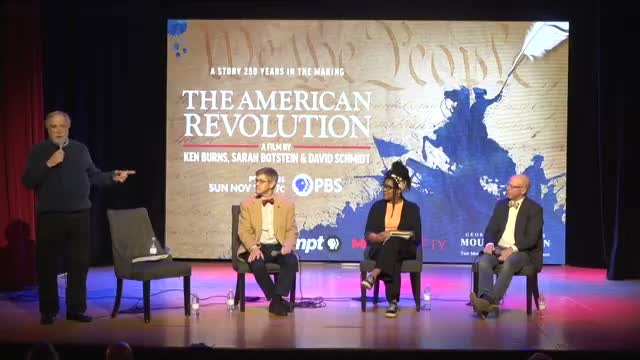
A panel hosted by The Spy and the Avalon in Talbot County brought local historians, a bookseller and a museum representative together to discuss the county’s role in the American Revolution and how local memory shapes civic life.
Pete Lesher, a curator at the Chesapeake Bay Maritime Museum and a member of the Talbot Council, said Talbot County was “a farming economy” with Oxford as its primary trading port and that Easton did not grow until around the Revolution. He said economic shifts tied to independence—such as the loss of customs revenue—reshaped local towns and livelihoods.
“This is a place, even though this is an agricultural economy, it's a relatively prosperous place, at least for the propertied members of society,” Lesher said, describing how area leaders carried Enlightenment ideas to the Maryland legislature and the Continental Congress. He pointed to the Talbot Resolves as a local response to the 1774 closure of Boston’s port.
An unnamed historian on the panel recounted how newspapers, Committees of Correspondence and networks of riders circulated information across the colonies. He detailed a 1765 episode in which the crown’s appointed stamp distributor, Zachariah Hood, landed at Oxford on Aug. 18, 1765, faced violent local protest and ultimately fled to Annapolis, illustrating how local resistance played out in the Eastern Shore towns.
Moderator and panelists also focused on how communities remember the past and whose stories are preserved. Catherine (referred to in the discussion as Captain DeShield Moon), who works with a Bellevue museum, said a sense of place and intergenerational ties keep people engaged: “The spirit of togetherness and looking out for fellow man is something that really resonated through the entire narrative.”
Lesher emphasized curatorial choices and gaps, saying museums must ask “Whose story isn't being told?” He noted contemporary threads—such as the survival of some crab-packing houses through employment of workers on H-2B visas—that museums should document to reflect the living culture.
Tim Boyle, founder of Vintage Books and Fine Art, said audiences’ interests change over time and pointed out the unpredictability of what ephemera survive for historians. “If you save stuff thinking it's going to go up in value, the exact opposite is going to happen,” Boyle said, arguing that sometimes the material people toss becomes the most valuable evidence for future researchers.
The panel closed with a reading of a quote about the Revolution’s “enduring struggle” between power and liberty. Lesher pointed to high civic engagement in Talbot County—he cited voter turnout figures around 80% and a dense network of nonprofits and volunteers—as evidence that participatory democracy remains active locally.
The event concluded with acknowledgements to Stephen Shupak and Maryland Public Television for bringing the Ken Burns production to the community and thanks to The Avalon and The Spy for hosting.
Pete Lesher, a curator at the Chesapeake Bay Maritime Museum and a member of the Talbot Council, said Talbot County was “a farming economy” with Oxford as its primary trading port and that Easton did not grow until around the Revolution. He said economic shifts tied to independence—such as the loss of customs revenue—reshaped local towns and livelihoods.
“This is a place, even though this is an agricultural economy, it's a relatively prosperous place, at least for the propertied members of society,” Lesher said, describing how area leaders carried Enlightenment ideas to the Maryland legislature and the Continental Congress. He pointed to the Talbot Resolves as a local response to the 1774 closure of Boston’s port.
An unnamed historian on the panel recounted how newspapers, Committees of Correspondence and networks of riders circulated information across the colonies. He detailed a 1765 episode in which the crown’s appointed stamp distributor, Zachariah Hood, landed at Oxford on Aug. 18, 1765, faced violent local protest and ultimately fled to Annapolis, illustrating how local resistance played out in the Eastern Shore towns.
Moderator and panelists also focused on how communities remember the past and whose stories are preserved. Catherine (referred to in the discussion as Captain DeShield Moon), who works with a Bellevue museum, said a sense of place and intergenerational ties keep people engaged: “The spirit of togetherness and looking out for fellow man is something that really resonated through the entire narrative.”
Lesher emphasized curatorial choices and gaps, saying museums must ask “Whose story isn't being told?” He noted contemporary threads—such as the survival of some crab-packing houses through employment of workers on H-2B visas—that museums should document to reflect the living culture.
Tim Boyle, founder of Vintage Books and Fine Art, said audiences’ interests change over time and pointed out the unpredictability of what ephemera survive for historians. “If you save stuff thinking it's going to go up in value, the exact opposite is going to happen,” Boyle said, arguing that sometimes the material people toss becomes the most valuable evidence for future researchers.
The panel closed with a reading of a quote about the Revolution’s “enduring struggle” between power and liberty. Lesher pointed to high civic engagement in Talbot County—he cited voter turnout figures around 80% and a dense network of nonprofits and volunteers—as evidence that participatory democracy remains active locally.
The event concluded with acknowledgements to Stephen Shupak and Maryland Public Television for bringing the Ken Burns production to the community and thanks to The Avalon and The Spy for hosting.
View the Full Meeting & All Its Details
This article offers just a summary. Unlock complete video, transcripts, and insights as a Founder Member.
✓
Watch full, unedited meeting videos
✓
Search every word spoken in unlimited transcripts
✓
AI summaries & real-time alerts (all government levels)
✓
Permanent access to expanding government content
30-day money-back guarantee
