Connecticut FOI official briefs New Canaan on meeting and records rules
January 29, 2026 | New Canaan, Fairfield, Connecticut
This article was created by AI summarizing key points discussed. AI makes mistakes, so for full details and context, please refer to the video of the full meeting. Please report any errors so we can fix them. Report an error »
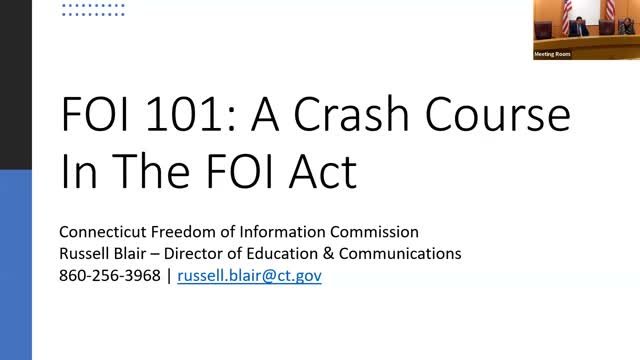
Russell Blair, director of education and communications for the Connecticut Freedom of Information Commission, told a New Canaan audience that the state's open-government law gives the public broad access to meetings and records and that local boards must take care with agendas, minutes and electronic communications.
"Sunshine is the greatest disinfectant," Blair said in opening remarks, using the phrase to frame the law's purpose: to let residents follow decisions by state and municipal agencies. He traced Connecticut's statute to 1975 and described the Commission's role as educational and complaint-driven rather than prosecutorial.
Blair summarized how FOI treats meetings: a meeting exists when a quorum of a multi-member public agency convenes (in person or electronically) and discusses or acts on board business. He gave examples (for a seven-member board the quorum is four; for nine members it is five) and warned that substantive back-and-forth by email or text among a quorum can constitute a meeting subject to FOI. "Communications you send and receive are public records," he said, noting parties sometimes discover alleged illegal meetings after emails surface.
On practical rules, Blair said regular meeting agendas and special-meeting filings must go to the town clerk; special meetings require extra notice and their agendas must be posted on the town website. Minutes must record attendance and individual votes and generally must be filed within seven days (seven business days for special meetings). Draft minutes are acceptable; recordings are not a substitute for minutes.
Blair reviewed remote-meeting rules adopted after the pandemic: remote participation is permitted but not required for the public; instructions for electronic access must be published 48 hours before regular meetings; and meetings held entirely by video or audio must be recorded, with the recording posted within seven days and kept for at least 45 days.
Executive-session guidance covered permissible topics and limits: boards may meet privately to discuss personnel, pending litigation, security matters, or pre-award RFP deliberations, and they may review records exempt from disclosure such as attorney-client memoranda. Blair emphasized that votes cannot be taken in executive session, that a two-thirds vote is needed to convene one, and that agenda language must fairly apprise the public of the subject to be discussed.
On public records, Blair defined them broadly as "any recorded data or information relating to the conduct of the public's business." He said records on personal devices can be responsive to a request and advised boards to acknowledge FOI requests within four business days and to produce records promptly or risk a complaint. He listed common exemptions (preliminary drafts and notes, certain law-enforcement materials, pending-litigation strategy, specific education-evaluation records, and RFP responses prior to contract award) and described how to consult counsel when exemptions may apply.
During a question-and-answer session, residents raised concerns about collaborative documents (Google Docs and comment threads), caucuses, vendor requests for contact lists and outsourced systems. Blair said the key test is whether an interaction amounts to a discussion by a quorum; caucuses are limited to members of the same board and same political party and do not permit outside participants; and many contact lists are public records though certain program-participant lists (for minors, for example) may be protected.
Blair closed by offering his contact information and sending the presentation materials to attendees; the host said the session recording and slides will be distributed to the meeting distribution list.
The Commission can order production of withheld records, issue fines, require training or nullify votes taken at improperly noticed meetings if a formal complaint is filed and a hearing finds a violation. Blair urged local officials to use the Commission as a resource to avoid inadvertent violations and the need for formal complaints.
"Sunshine is the greatest disinfectant," Blair said in opening remarks, using the phrase to frame the law's purpose: to let residents follow decisions by state and municipal agencies. He traced Connecticut's statute to 1975 and described the Commission's role as educational and complaint-driven rather than prosecutorial.
Blair summarized how FOI treats meetings: a meeting exists when a quorum of a multi-member public agency convenes (in person or electronically) and discusses or acts on board business. He gave examples (for a seven-member board the quorum is four; for nine members it is five) and warned that substantive back-and-forth by email or text among a quorum can constitute a meeting subject to FOI. "Communications you send and receive are public records," he said, noting parties sometimes discover alleged illegal meetings after emails surface.
On practical rules, Blair said regular meeting agendas and special-meeting filings must go to the town clerk; special meetings require extra notice and their agendas must be posted on the town website. Minutes must record attendance and individual votes and generally must be filed within seven days (seven business days for special meetings). Draft minutes are acceptable; recordings are not a substitute for minutes.
Blair reviewed remote-meeting rules adopted after the pandemic: remote participation is permitted but not required for the public; instructions for electronic access must be published 48 hours before regular meetings; and meetings held entirely by video or audio must be recorded, with the recording posted within seven days and kept for at least 45 days.
Executive-session guidance covered permissible topics and limits: boards may meet privately to discuss personnel, pending litigation, security matters, or pre-award RFP deliberations, and they may review records exempt from disclosure such as attorney-client memoranda. Blair emphasized that votes cannot be taken in executive session, that a two-thirds vote is needed to convene one, and that agenda language must fairly apprise the public of the subject to be discussed.
On public records, Blair defined them broadly as "any recorded data or information relating to the conduct of the public's business." He said records on personal devices can be responsive to a request and advised boards to acknowledge FOI requests within four business days and to produce records promptly or risk a complaint. He listed common exemptions (preliminary drafts and notes, certain law-enforcement materials, pending-litigation strategy, specific education-evaluation records, and RFP responses prior to contract award) and described how to consult counsel when exemptions may apply.
During a question-and-answer session, residents raised concerns about collaborative documents (Google Docs and comment threads), caucuses, vendor requests for contact lists and outsourced systems. Blair said the key test is whether an interaction amounts to a discussion by a quorum; caucuses are limited to members of the same board and same political party and do not permit outside participants; and many contact lists are public records though certain program-participant lists (for minors, for example) may be protected.
Blair closed by offering his contact information and sending the presentation materials to attendees; the host said the session recording and slides will be distributed to the meeting distribution list.
The Commission can order production of withheld records, issue fines, require training or nullify votes taken at improperly noticed meetings if a formal complaint is filed and a hearing finds a violation. Blair urged local officials to use the Commission as a resource to avoid inadvertent violations and the need for formal complaints.
Don't Miss a Word: See the Full Meeting!
Go beyond summaries. Unlock every video, transcript, and key insight with a Founder Membership.
✓
Get instant access to full meeting videos
✓
Search and clip any phrase from complete transcripts
✓
Receive AI-powered summaries & custom alerts
✓
Enjoy lifetime, unrestricted access to government data
30-day money-back guarantee
