Community Investment Committee backs LaSalle Park neighborhood plan after residents offer input
January 27, 2026 | South Bend City, St. Joseph County, Indiana
This article was created by AI summarizing key points discussed. AI makes mistakes, so for full details and context, please refer to the video of the full meeting. Please report any errors so we can fix them. Report an error »
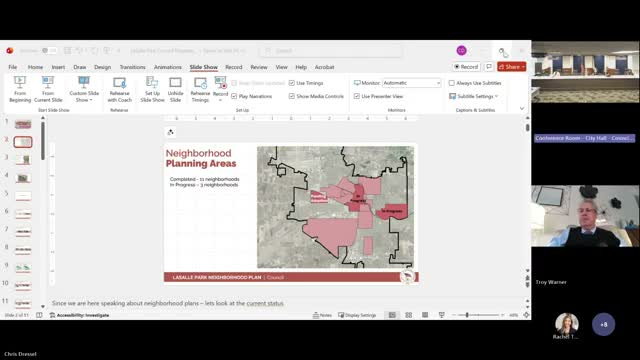
The Community Investment Committee considered and recommended the LaSalle Park neighborhood plan (bill 25-52) after a presentation by city planning staff and extended public comment.
Chris Dressel (Department of Community Investment) summarized the plan’s purpose and history, describing LaSalle Park’s boundary and historical context, including marshland origins, early public housing, environmental remediation, and later investments. Dressel told the committee the plan is intended to be a 20-year physical plan that compiles neighborhood priorities gathered through stakeholder meetings, open houses and visioning workshops.
Hannah Schrynian presented the plan’s 12 priority projects grouped into categories: housing (targeted infill and modest density increases on specified blocks), green-space improvements and LaSalle Park enhancements (completing a walking loop, adding a dock and water features), infrastructure and streetscape work (Linden Avenue trail, curb, lighting and traffic calming) and zoning adjustments to allow slightly higher density (change U1 to U2 in select locations) and to reclassify certain commercial parcels as neighborhood center to discourage automotive uses and liquor/gas outlets.
During public comment, several residents spoke. Stacy (address given in the record) said she supports the plan overall and appreciated staff engagement, but objected to two proposed park/tree projects sited on or adjacent to her property and asked that smaller, visible “low‑hanging fruit” projects be prioritized to show early progress. George Jones praised city transparency and urged innovative mixed‑income redevelopment. Lynn Coleman and other longtime residents emphasized the importance of building community character alongside physical improvements. Several speakers said they supported the plan and requested continued collaboration and the ability to tweak project details as implementation advances.
The committee accepted a substitute version of the resolution (filed after the packet) and then voted to send Bill 25-52 to the full Common Council with a favorable recommendation (roll call: unanimous ayes).
What happens next: The substitute resolution and Bill 25-52 will appear on the full council agenda for final adoption. Staff indicated implementation tasks will be parsed as short-term (1–5 years), medium and long-term actions with the city listed as lead on many items.
Chris Dressel (Department of Community Investment) summarized the plan’s purpose and history, describing LaSalle Park’s boundary and historical context, including marshland origins, early public housing, environmental remediation, and later investments. Dressel told the committee the plan is intended to be a 20-year physical plan that compiles neighborhood priorities gathered through stakeholder meetings, open houses and visioning workshops.
Hannah Schrynian presented the plan’s 12 priority projects grouped into categories: housing (targeted infill and modest density increases on specified blocks), green-space improvements and LaSalle Park enhancements (completing a walking loop, adding a dock and water features), infrastructure and streetscape work (Linden Avenue trail, curb, lighting and traffic calming) and zoning adjustments to allow slightly higher density (change U1 to U2 in select locations) and to reclassify certain commercial parcels as neighborhood center to discourage automotive uses and liquor/gas outlets.
During public comment, several residents spoke. Stacy (address given in the record) said she supports the plan overall and appreciated staff engagement, but objected to two proposed park/tree projects sited on or adjacent to her property and asked that smaller, visible “low‑hanging fruit” projects be prioritized to show early progress. George Jones praised city transparency and urged innovative mixed‑income redevelopment. Lynn Coleman and other longtime residents emphasized the importance of building community character alongside physical improvements. Several speakers said they supported the plan and requested continued collaboration and the ability to tweak project details as implementation advances.
The committee accepted a substitute version of the resolution (filed after the packet) and then voted to send Bill 25-52 to the full Common Council with a favorable recommendation (roll call: unanimous ayes).
What happens next: The substitute resolution and Bill 25-52 will appear on the full council agenda for final adoption. Staff indicated implementation tasks will be parsed as short-term (1–5 years), medium and long-term actions with the city listed as lead on many items.
View the Full Meeting & All Its Details
This article offers just a summary. Unlock complete video, transcripts, and insights as a Founder Member.
✓
Watch full, unedited meeting videos
✓
Search every word spoken in unlimited transcripts
✓
AI summaries & real-time alerts (all government levels)
✓
Permanent access to expanding government content
30-day money-back guarantee
