Oklahoma DPS asks lawmakers for billions to hire troopers, fund school panic app and modernize fleet
January 28, 2026 | 2026 Legislature OK, Oklahoma
This article was created by AI summarizing key points discussed. AI makes mistakes, so for full details and context, please refer to the video of the full meeting. Please report any errors so we can fix them. Report an error »
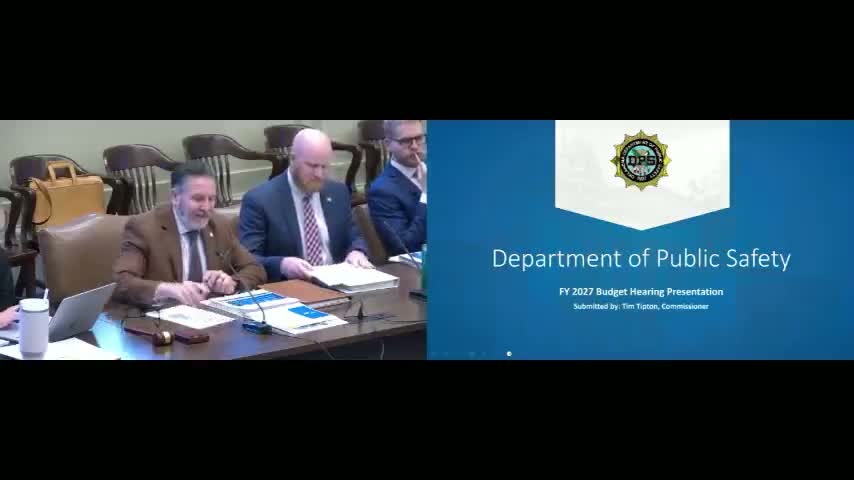
Commissioner Tipton, the head of the Oklahoma Department of Public Safety, told the Senate Appropriations Subcommittee on Judiciary and Public Safety that the department faces critical staffing, equipment and communications shortfalls and asked lawmakers for targeted funding to address them.
Tipton said manpower is DPS’s top issue and described an understaffed force with many vehicles exceeding 130,000 miles and radios that cannot communicate securely with local partners. "We're now truly putting troopers and the public safety in jeopardy by not having the numbers that we need out there," he said.
Tipton asked the committee to absorb the contract and recurring cost of the Rave panic-button app, which he said the state previously funded through the Department of Education and which provides school districts and state agencies an active‑shooter panic button. "The app does work very well. It provides a great deal of security and response coordination," he said, and requested $1,600,000 recurring plus a supplemental to finish the present contract.
On recruitment, Tipton presented detailed academy cost figures, saying a cadet’s first year — including vehicle, gear, training and salary — totals about $218,000. He said the department has $5.5 million currently budgeted for academies but that funding produces only a handful of new troopers per cycle. To rapidly boost ranks, Tipton proposed running three back‑to‑back academies — one the department will start in March using internal savings and donations and two others funded by the Legislature — and estimated the extra classes could net about 150 additional troopers over time.
Tipton and committee members discussed the math and dropout rates. He said an academy that starts with 72 cadets typically yields about 50 graduates, and outside donations and saved equipment will help offset costs for the March class.
Tipton also highlighted specialized unit shortages, saying the statewide crash reconstruction team counts 18 people but that the unit likely needs 30–40 technicians. He asked lawmakers to consider recurring salary increases to sustain higher staffing levels and estimated that reaching an additional 150 troopers would carry a recurring salary cost in the range of $13–14 million.
Tipton closed by listing ongoing capital projects — a tactical training facility near Wellston, a driving facility with concrete work slated to begin in March, and multiple troop headquarters under construction — and said several projects are out for bid.
The committee did not take a formal vote on the presentation; members thanked Tipton and moved to the next budget presenter.
Tipton said manpower is DPS’s top issue and described an understaffed force with many vehicles exceeding 130,000 miles and radios that cannot communicate securely with local partners. "We're now truly putting troopers and the public safety in jeopardy by not having the numbers that we need out there," he said.
Tipton asked the committee to absorb the contract and recurring cost of the Rave panic-button app, which he said the state previously funded through the Department of Education and which provides school districts and state agencies an active‑shooter panic button. "The app does work very well. It provides a great deal of security and response coordination," he said, and requested $1,600,000 recurring plus a supplemental to finish the present contract.
On recruitment, Tipton presented detailed academy cost figures, saying a cadet’s first year — including vehicle, gear, training and salary — totals about $218,000. He said the department has $5.5 million currently budgeted for academies but that funding produces only a handful of new troopers per cycle. To rapidly boost ranks, Tipton proposed running three back‑to‑back academies — one the department will start in March using internal savings and donations and two others funded by the Legislature — and estimated the extra classes could net about 150 additional troopers over time.
Tipton and committee members discussed the math and dropout rates. He said an academy that starts with 72 cadets typically yields about 50 graduates, and outside donations and saved equipment will help offset costs for the March class.
Tipton also highlighted specialized unit shortages, saying the statewide crash reconstruction team counts 18 people but that the unit likely needs 30–40 technicians. He asked lawmakers to consider recurring salary increases to sustain higher staffing levels and estimated that reaching an additional 150 troopers would carry a recurring salary cost in the range of $13–14 million.
Tipton closed by listing ongoing capital projects — a tactical training facility near Wellston, a driving facility with concrete work slated to begin in March, and multiple troop headquarters under construction — and said several projects are out for bid.
The committee did not take a formal vote on the presentation; members thanked Tipton and moved to the next budget presenter.
View the Full Meeting & All Its Details
This article offers just a summary. Unlock complete video, transcripts, and insights as a Founder Member.
✓
Watch full, unedited meeting videos
✓
Search every word spoken in unlimited transcripts
✓
AI summaries & real-time alerts (all government levels)
✓
Permanent access to expanding government content
30-day money-back guarantee
