Subcommittee advances solar grants, wage-alignment and multiple MEI development projects; several measures pass unanimously
January 28, 2026 | 2026 Legislature VA, Virginia
This article was created by AI summarizing key points discussed. AI makes mistakes, so for full details and context, please refer to the video of the full meeting. Please report any errors so we can fix them. Report an error »
A Virginia House subcommittee advanced a slate of bills covering renewable energy grants, economic development incentives and workforce wage standards in a single hearing, reporting most measures unanimously.
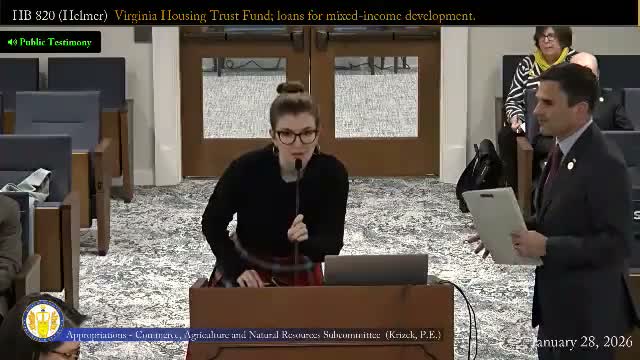
Isabelle McClain of the Virginia Housing Alliance and other witnesses supported HB 820, a substitute to establish a revolving fund for low- to moderate-income mixed-income developments. "We support the bill and thank the patron for working with us," McClain said. The substitute was reported 5–0.
The committee also advanced HB 683, which creates a solar interconnection grant fund to help public bodies such as localities and school boards offset costs of connecting new solar facilities to the grid; the program prioritizes previously developed sites and directs the administering division to issue guidelines and an annual report to the General Assembly. Emily Webb (representing Alexandria City Schools) said the bill would help expand renewables in school facilities; Rachel Henley of the Virginia Farm Bureau noted the advantage of prioritizing previously developed sites. The bill was reported 5–0.
Delegate Austin presented HB 1138 to align major incentive programs (Governor's Opportunity Fund, VJIP and the VIP grant) with the local prevailing average wage defined in the code, allowing an 85% prevailing-wage threshold for distressed localities. Lindsay Akers (VDP) and Andrew Sinclair (Virginia Chamber) supported the change as a way to target limited state dollars to higher-paying jobs. The subcommittee reported HB 1138, 5–0.
Other measures the subcommittee advanced include HB 1053 (reinstating Go Virginia matching grant eligibility for Tobacco Region Revitalization Commission awards), HB 799 (an MEI project for Hitachi in Halifax County proposing 825 jobs and a $457.2 million investment), HB 800 (an MEI for Eli Lilly in Goochland County proposing 468 jobs and a $1.2 billion investment) and HB 1076 (an MEI for AstraZeneca in Albemarle County proposing 500 jobs and a $4 billion investment). Most of those bills were reported 5–0.
Two items were set aside for further review: HB 408 (an enterprise zone housing availability grant program) was tabled and referred to the Virginia Housing Commission for further consideration; transcript numeric details for HB 408 appear garbled and were not treated as definitive in committee testimony. HB 904 (requirements for the Virginia Disaster Assistance Fund to reflect floodplain standards and prioritize nature-based solutions) was also tabled with direction to consider funding in the budget process.
The subcommittee adjourned after reporting its docket.
Isabelle McClain of the Virginia Housing Alliance and other witnesses supported HB 820, a substitute to establish a revolving fund for low- to moderate-income mixed-income developments. "We support the bill and thank the patron for working with us," McClain said. The substitute was reported 5–0.
The committee also advanced HB 683, which creates a solar interconnection grant fund to help public bodies such as localities and school boards offset costs of connecting new solar facilities to the grid; the program prioritizes previously developed sites and directs the administering division to issue guidelines and an annual report to the General Assembly. Emily Webb (representing Alexandria City Schools) said the bill would help expand renewables in school facilities; Rachel Henley of the Virginia Farm Bureau noted the advantage of prioritizing previously developed sites. The bill was reported 5–0.
Delegate Austin presented HB 1138 to align major incentive programs (Governor's Opportunity Fund, VJIP and the VIP grant) with the local prevailing average wage defined in the code, allowing an 85% prevailing-wage threshold for distressed localities. Lindsay Akers (VDP) and Andrew Sinclair (Virginia Chamber) supported the change as a way to target limited state dollars to higher-paying jobs. The subcommittee reported HB 1138, 5–0.
Other measures the subcommittee advanced include HB 1053 (reinstating Go Virginia matching grant eligibility for Tobacco Region Revitalization Commission awards), HB 799 (an MEI project for Hitachi in Halifax County proposing 825 jobs and a $457.2 million investment), HB 800 (an MEI for Eli Lilly in Goochland County proposing 468 jobs and a $1.2 billion investment) and HB 1076 (an MEI for AstraZeneca in Albemarle County proposing 500 jobs and a $4 billion investment). Most of those bills were reported 5–0.
Two items were set aside for further review: HB 408 (an enterprise zone housing availability grant program) was tabled and referred to the Virginia Housing Commission for further consideration; transcript numeric details for HB 408 appear garbled and were not treated as definitive in committee testimony. HB 904 (requirements for the Virginia Disaster Assistance Fund to reflect floodplain standards and prioritize nature-based solutions) was also tabled with direction to consider funding in the budget process.
The subcommittee adjourned after reporting its docket.
View the Full Meeting & All Its Details
This article offers just a summary. Unlock complete video, transcripts, and insights as a Founder Member.
✓
Watch full, unedited meeting videos
✓
Search every word spoken in unlimited transcripts
✓
AI summaries & real-time alerts (all government levels)
✓
Permanent access to expanding government content
30-day money-back guarantee
