House subcommittee advances bill to study Head Start capacity and funding in Virginia
January 28, 2026 | 2026 Legislature VA, Virginia
This article was created by AI summarizing key points discussed. AI makes mistakes, so for full details and context, please refer to the video of the full meeting. Please report any errors so we can fix them. Report an error »
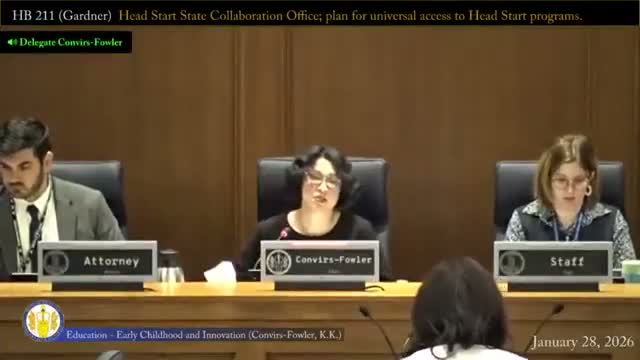
A Virginia House education subcommittee on Thursday advanced House Bill 2 11, directing a statewide review of Head Start and Early Head Start services to assess capacity, local need and the program’s fiscal sustainability.
Delegate Delia Gardner, the bill’s patron, told the panel that "Head Start and Early Head Start services are a critical component of Virginia's Unified Early Childhood Education System," and said funded enrollment for Head Start preschool and Early Head Start grantees has declined by 3,500 slots since 2019. Gardner said grant recipients are facing "rising operational costs, workforce shortages, and challenges securing facilities," and that the report will help the Commonwealth align capacity with local need and plan "data driven budget and legislative solutions" if federal funding changes.
Testimony in support came from Eric Johnson, CEO of the Virginia Community Action Partnership, who described Head Start as a "gold standard in economic mobility programming" and said community action agencies, the Virginia Head Start Association and the Department of Education should work together to "protect and maximize this core program." Kamara Parker, a family service specialist with Richmond Public Schools Head Start, urged lawmakers to strengthen state-level investment and coordination, saying Head Start provides "wrap around" services that improve school readiness for vulnerable children.
Rebecca Ulrich, assistant superintendent for early childhood at the Virginia Department of Education, and Tondra Wood Jeffries, executive director of the Head Start State Collaboration Office, told the committee that Virginia’s early childhood system is a mix of public and private providers and that a coordinated review of Head Start and Early Head Start will help leverage "all available funding sources, state and federal," to expand access for working families.
During questioning, Delegate Douglas Guzman asked whether the study would create a new program separate from federal Head Start or the Virginia Preschool Initiative (VPI). Witnesses said the aim is coordination and partnership-building—examining ways to maximize federal dollars, consider wraparound services and explore shared classroom arrangements—rather than replacing Head Start. Guzman also requested that Early Head Start be explicitly included in the data collection; Jeffries confirmed Early Head Start would be examined and noted its operational costs are higher than preschool Head Start.
Remote testimony came from Kimberly Harsley, who said she supported the bill as a caregiver and praised its emphasis on public-private partnerships and skilled early educators.
The committee voted to report HB 2 11 with the substitute on a roll call of 7 to 2. The measure will move forward for further consideration.
Delegate Delia Gardner, the bill’s patron, told the panel that "Head Start and Early Head Start services are a critical component of Virginia's Unified Early Childhood Education System," and said funded enrollment for Head Start preschool and Early Head Start grantees has declined by 3,500 slots since 2019. Gardner said grant recipients are facing "rising operational costs, workforce shortages, and challenges securing facilities," and that the report will help the Commonwealth align capacity with local need and plan "data driven budget and legislative solutions" if federal funding changes.
Testimony in support came from Eric Johnson, CEO of the Virginia Community Action Partnership, who described Head Start as a "gold standard in economic mobility programming" and said community action agencies, the Virginia Head Start Association and the Department of Education should work together to "protect and maximize this core program." Kamara Parker, a family service specialist with Richmond Public Schools Head Start, urged lawmakers to strengthen state-level investment and coordination, saying Head Start provides "wrap around" services that improve school readiness for vulnerable children.
Rebecca Ulrich, assistant superintendent for early childhood at the Virginia Department of Education, and Tondra Wood Jeffries, executive director of the Head Start State Collaboration Office, told the committee that Virginia’s early childhood system is a mix of public and private providers and that a coordinated review of Head Start and Early Head Start will help leverage "all available funding sources, state and federal," to expand access for working families.
During questioning, Delegate Douglas Guzman asked whether the study would create a new program separate from federal Head Start or the Virginia Preschool Initiative (VPI). Witnesses said the aim is coordination and partnership-building—examining ways to maximize federal dollars, consider wraparound services and explore shared classroom arrangements—rather than replacing Head Start. Guzman also requested that Early Head Start be explicitly included in the data collection; Jeffries confirmed Early Head Start would be examined and noted its operational costs are higher than preschool Head Start.
Remote testimony came from Kimberly Harsley, who said she supported the bill as a caregiver and praised its emphasis on public-private partnerships and skilled early educators.
The committee voted to report HB 2 11 with the substitute on a roll call of 7 to 2. The measure will move forward for further consideration.
Don't Miss a Word: See the Full Meeting!
Go beyond summaries. Unlock every video, transcript, and key insight with a Founder Membership.
✓
Get instant access to full meeting videos
✓
Search and clip any phrase from complete transcripts
✓
Receive AI-powered summaries & custom alerts
✓
Enjoy lifetime, unrestricted access to government data
30-day money-back guarantee
