Shawnee public works reviews sidewalk network, design standards and SIP priorities
January 27, 2026 | Shawnee, Johnson County, Kansas
This article was created by AI summarizing key points discussed. AI makes mistakes, so for full details and context, please refer to the video of the full meeting. Please report any errors so we can fix them. Report an error »
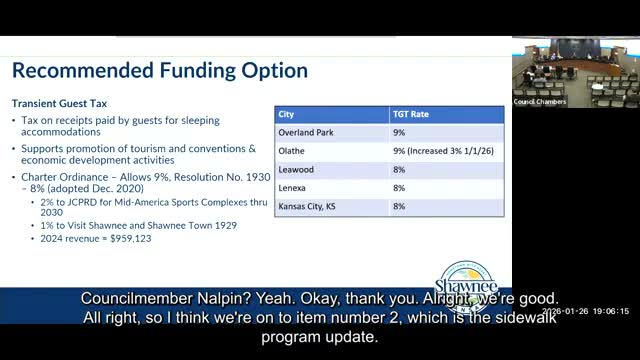
Kevin Manning, Shawnee’s Director of Public Works, gave the City Council committee an overview of the city’s sidewalk network and how the department prioritizes additions and maintenance at the Jan. 26 meeting.
Manning said Shawnee maintains roughly 260 miles of sidewalk and follows a 5-foot standard with a preferred 2-foot green buffer between curb and sidewalk; shared-use paths generally follow a 10-foot standard. “We do have a lot of sidewalk out there that’s 4 feet wide,” he said, and noted the city uses passing areas to meet ADA requirements where needed.
He described three primary ways sidewalks are built: new development (builders install frontage sidewalks), as part of roadway projects, and through the city’s SIP program for infill sections. Manning said the city replaces about 2–4 miles of sidewalk a year and typically replaces maintenance panels at the same width rather than widening during routine repair. The SIP scoring favors projects that connect existing sidewalk segments, so filling gaps that improve overall connectivity rises in priority.
Manning outlined barriers to adding sidewalks: mature trees and root zones, utility and landscaping conflicts, and ditch-section roads that require enclosing drainage (a stormwater project that increases cost dramatically). He said those stormwater costs are the primary reason some streets remain without sidewalks despite demand.
Council members pressed for targeted connectivity to improve school routes and downtown access. Council Member Person described safety concerns along Johnson Drive—narrow sidewalks without a green buffer next to traffic—and emphasized the need to prioritize filling critical gaps where schoolchildren and residents travel. Manning agreed to provide an interactive map showing sidewalk gaps and connections for the council to review.
The committee closed the item after questions and staff agreed to follow up with mapping and programmatic information; no new funding or formal policy changes were approved at the meeting.
Manning said Shawnee maintains roughly 260 miles of sidewalk and follows a 5-foot standard with a preferred 2-foot green buffer between curb and sidewalk; shared-use paths generally follow a 10-foot standard. “We do have a lot of sidewalk out there that’s 4 feet wide,” he said, and noted the city uses passing areas to meet ADA requirements where needed.
He described three primary ways sidewalks are built: new development (builders install frontage sidewalks), as part of roadway projects, and through the city’s SIP program for infill sections. Manning said the city replaces about 2–4 miles of sidewalk a year and typically replaces maintenance panels at the same width rather than widening during routine repair. The SIP scoring favors projects that connect existing sidewalk segments, so filling gaps that improve overall connectivity rises in priority.
Manning outlined barriers to adding sidewalks: mature trees and root zones, utility and landscaping conflicts, and ditch-section roads that require enclosing drainage (a stormwater project that increases cost dramatically). He said those stormwater costs are the primary reason some streets remain without sidewalks despite demand.
Council members pressed for targeted connectivity to improve school routes and downtown access. Council Member Person described safety concerns along Johnson Drive—narrow sidewalks without a green buffer next to traffic—and emphasized the need to prioritize filling critical gaps where schoolchildren and residents travel. Manning agreed to provide an interactive map showing sidewalk gaps and connections for the council to review.
The committee closed the item after questions and staff agreed to follow up with mapping and programmatic information; no new funding or formal policy changes were approved at the meeting.
View the Full Meeting & All Its Details
This article offers just a summary. Unlock complete video, transcripts, and insights as a Founder Member.
✓
Watch full, unedited meeting videos
✓
Search every word spoken in unlimited transcripts
✓
AI summaries & real-time alerts (all government levels)
✓
Permanent access to expanding government content
30-day money-back guarantee
