KDOT outlines 2026-27 budget, flags $400 million 2027 bond issuance and new US 69 Express Fund
January 22, 2026 | Transportation, Standing, Senate, Committees, Legislative, Kansas
This article was created by AI summarizing key points discussed. AI makes mistakes, so for full details and context, please refer to the video of the full meeting. Please report any errors so we can fix them. Report an error »
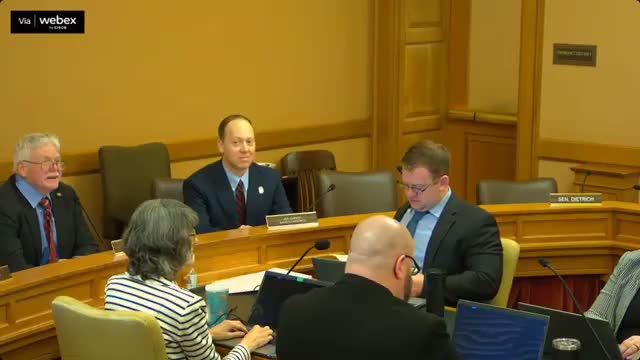
KDOT officials presented the department's proposed 2026-27 budget to a Senate Transportation Committee hearing and highlighted three takeaways: sales tax is the largest revenue source; bonding will support near-term project lettings (including a planned $400,000,000 issuance in FY2027 tied to the "Ike" program); and the packet adds a US 69 Express Fund to collect toll revenues for the new express lanes.
"Sales tax is the largest source of revenue to the state for our state our state highway fund," said Bridal Yorkie, assistant director of division administration at KDOT, while walking the committee through revenue snapshots for 2026 and 2027. Yorkie said federal funds are primarily reimbursed after state spending on projects and that motor fuels tax revenue is split so that about one-third goes to cities and counties and two-thirds to the State Highway Fund.
Kyle Anderson, presenting line-item detail, summarized the numbers in the written packet: the SB125-approved FY2026 number was $1,700,000,000; the department's revised FY2026 request showed about $2,350,000,000; and FY2027 was shown at roughly $1,670,000,000. "The agency is entirely funded by the State Highway Fund and federal funds. There is no SGF funding," Anderson said.
Yorkie described KDOT's bonding plan for the Ike program as originally estimated at $1,200,000,000 and said the department plans to issue about $400,000,000 in bond proceeds in 2027. She noted a statutory cap that limits debt-service to 18% of revenues and pointed to prior refunding and early-paydown actions that reduced interest costs (citing a 2025 refunding with about $46,000,000 in savings and a principal paydown that produced roughly $22,000,000 in savings).
KDOT projected principal outstanding of about $1,700,000,000 and a debt-service profile that could reach roughly $230,000,000 at peak before declining as specific issues mature. Anderson tied an increase in FY2027 debt-service interest and principal to the timing of the planned $400,000,000 issuance.
On the spending side, KDOT told senators construction remains the largest expenditure category (modernization, expansion, preservation, design, inspection and right-of-way). The packet shows notable FY2026 adjustments, including increases for expansion programs (about $394,100,000), preservation projects (about $177,500,000), and architectural and engineering contractual services (about $19,800,000). Anderson also identified a $10,000,000 transfer to a rail service improvement fund and creation of the US 69 Express Fund to collect and distribute toll revenues associated with the US 69 express lanes.
Committee members pressed KDOT for more specifics on revenue and operating-cost projections related to the US 69 Express Fund and for details on how the department manages excess State Highway Fund receipts and the "other" revenue category (Yorkie listed interest earnings, special permits, and recovery of prior-year expenditures). Yorkie and Anderson said they did not have all figures offhand and committed to provide follow-up responses and consolidate questions from this hearing and the previous day.
Senators also raised risk questions: one asked whether KDOT had modeled an extreme rise in interest rates; Yorkie said the rating outlook improved in 2023 and the department uses coverage tests but had not modeled the specific doubled risk-free-rate scenario and would follow up.
KDOT officials closed by noting how the department budgets full project costs in the year a contract is let even though cash payouts occur over multiple years, which explains program swings. The department committed to providing the committee with written answers to outstanding questions; the hearing adjourned after the follow-up request was made.
Clarifying details: KDOT told the committee it expects roughly $400,000,000 in bond proceeds in FY2027; an "Ike" bonding plan originally estimated at $1,200,000,000; projected principal outstanding of about $1,700,000,000; a peak debt-service profile near $230,000,000; an AC operations (agency operations) approved level of $354,000,000 for FY2026; a $10,000,000 transfer to a rail service improvement fund; and an estimated $150,000,000 in transfers to other agencies under the approved 2026 budget (all figures as stated in the presentation).
"Sales tax is the largest source of revenue to the state for our state our state highway fund," said Bridal Yorkie, assistant director of division administration at KDOT, while walking the committee through revenue snapshots for 2026 and 2027. Yorkie said federal funds are primarily reimbursed after state spending on projects and that motor fuels tax revenue is split so that about one-third goes to cities and counties and two-thirds to the State Highway Fund.
Kyle Anderson, presenting line-item detail, summarized the numbers in the written packet: the SB125-approved FY2026 number was $1,700,000,000; the department's revised FY2026 request showed about $2,350,000,000; and FY2027 was shown at roughly $1,670,000,000. "The agency is entirely funded by the State Highway Fund and federal funds. There is no SGF funding," Anderson said.
Yorkie described KDOT's bonding plan for the Ike program as originally estimated at $1,200,000,000 and said the department plans to issue about $400,000,000 in bond proceeds in 2027. She noted a statutory cap that limits debt-service to 18% of revenues and pointed to prior refunding and early-paydown actions that reduced interest costs (citing a 2025 refunding with about $46,000,000 in savings and a principal paydown that produced roughly $22,000,000 in savings).
KDOT projected principal outstanding of about $1,700,000,000 and a debt-service profile that could reach roughly $230,000,000 at peak before declining as specific issues mature. Anderson tied an increase in FY2027 debt-service interest and principal to the timing of the planned $400,000,000 issuance.
On the spending side, KDOT told senators construction remains the largest expenditure category (modernization, expansion, preservation, design, inspection and right-of-way). The packet shows notable FY2026 adjustments, including increases for expansion programs (about $394,100,000), preservation projects (about $177,500,000), and architectural and engineering contractual services (about $19,800,000). Anderson also identified a $10,000,000 transfer to a rail service improvement fund and creation of the US 69 Express Fund to collect and distribute toll revenues associated with the US 69 express lanes.
Committee members pressed KDOT for more specifics on revenue and operating-cost projections related to the US 69 Express Fund and for details on how the department manages excess State Highway Fund receipts and the "other" revenue category (Yorkie listed interest earnings, special permits, and recovery of prior-year expenditures). Yorkie and Anderson said they did not have all figures offhand and committed to provide follow-up responses and consolidate questions from this hearing and the previous day.
Senators also raised risk questions: one asked whether KDOT had modeled an extreme rise in interest rates; Yorkie said the rating outlook improved in 2023 and the department uses coverage tests but had not modeled the specific doubled risk-free-rate scenario and would follow up.
KDOT officials closed by noting how the department budgets full project costs in the year a contract is let even though cash payouts occur over multiple years, which explains program swings. The department committed to providing the committee with written answers to outstanding questions; the hearing adjourned after the follow-up request was made.
Clarifying details: KDOT told the committee it expects roughly $400,000,000 in bond proceeds in FY2027; an "Ike" bonding plan originally estimated at $1,200,000,000; projected principal outstanding of about $1,700,000,000; a peak debt-service profile near $230,000,000; an AC operations (agency operations) approved level of $354,000,000 for FY2026; a $10,000,000 transfer to a rail service improvement fund; and an estimated $150,000,000 in transfers to other agencies under the approved 2026 budget (all figures as stated in the presentation).
View the Full Meeting & All Its Details
This article offers just a summary. Unlock complete video, transcripts, and insights as a Founder Member.
✓
Watch full, unedited meeting videos
✓
Search every word spoken in unlimited transcripts
✓
AI summaries & real-time alerts (all government levels)
✓
Permanent access to expanding government content
30-day money-back guarantee
