Yucaipa residents press council over RM-24 housing permit-by-right approval; staff says state law limits local discretion
January 27, 2026 | Yucaipa, San Bernardino County, California
This article was created by AI summarizing key points discussed. AI makes mistakes, so for full details and context, please refer to the video of the full meeting. Please report any errors so we can fix them. Report an error »
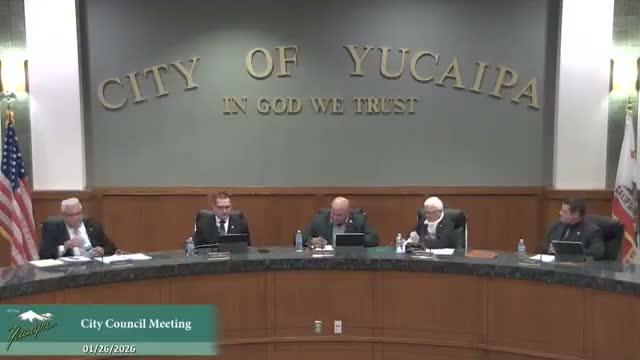
City of Yucaipa officials and dozens of nearby residents clashed on Jan. 26 over a proposed multi‑family project in the RM‑24 district that neighbors say has changed since earlier approvals and was not renotified to the public.
City Manager Doctor Moore and planner Ben explained that the site north of County Line Road in the RM‑24 zone allows high‑density development as a by‑right use under the city's development code and state law. Ben told the council the base calculation for the site was 202 units under RM‑24 and that the state density‑bonus statute automatically grants increases if a developer provides deed‑restricted affordable units; staff said the developer’s recent submission invoked that process.
Residents contended the project had been reduced in earlier negotiations (from a previously proposed 200 units to 172) and that it now appears again as a 258‑unit, three‑story proposal under a new business name. Judy Maine, a nearby homeowner, said she and other neighbors were not notified of the December planning commission action and called the change “shady.” “No one knew this was going on,” Maine said during public comment, and she asked the council to take the matter up publicly.
Multiple speakers — including parents and long‑time neighbors — raised safety and infrastructure concerns: increased traffic and parking on narrow 2nd Street near Calimesa Elementary, risks to emergency access, and faded crosswalks and inadequate safety lighting. Elias Aparicio, an engineering geologist and resident, said the council had “failed to properly forecast revenues and allocate expenditures” and warned that piecemeal high‑density approvals can strain infrastructure.
Council members asked staff whether the planning commission should have provided notice. City Attorney responded that when zoning makes a use permitted by right and the development triggers administrative review under the city’s code (cited as the RM‑24 administrative review procedure), the code and state law do not require the same public hearing notice as discretionary approvals. The attorney cited state housing law provisions and HCD (Housing and Community Development) practice as limiting circumstances in which a city may deny projects, noting the statutory standard requires a specific, unmitigable, significant adverse impact to support denial.
Fire and life‑safety capacity became a central concern during the discussion. Council members asked whether the fire department could operate on three‑story buildings with current equipment. Fire department leadership said code and plan checks (fire flow, sprinklers, access) can be satisfied at the design stage, but the operational ability to fight fires in taller buildings is separate: the chief estimated a ladder truck would cost about $2.5 million and said the department lacks that operational capability now. Staff indicated there is a funding plan to address equipment needs but that procurement and deployment are not automatic or necessarily concurrent with construction.
Faced with limited authority to deny a by‑right project, council members and staff discussed mitigation and procedural changes the city can pursue: requiring developers to submit a specific plan or 'mini' specific plan that lays out densities, infrastructure, and mitigation; committing to bring material project changes to the planning commission and council for informational briefings; exploring parking district or signage changes; and preparing advocacy letters or joining coalitions to press for more local control. The city manager and city attorney committed to return with options, including a report on development impact fees, parking strategies, and a list of possible coalition letters that would be non‑costly to pursue.
No formal denial or rescission of the administrative decision occurred at the Jan. 26 meeting. Instead, the council directed staff to develop and return with concrete options (specific plans, parking and signage measures, and potential advocacy letters) and to provide greater advance notice to the council and public if projects change materially.
What happens next: Staff will bring back proposed requirements for specific plans and mitigation steps and will provide additional information and options to council for the mid‑year strategic planning and budget discussions.
Sources: City manager’s and planner’s presentations and the public record of the Jan. 26, 2026 City of Yucaipa council meeting; direct public comment from Judy Maine, Elias Aparicio and other nearby residents.
City Manager Doctor Moore and planner Ben explained that the site north of County Line Road in the RM‑24 zone allows high‑density development as a by‑right use under the city's development code and state law. Ben told the council the base calculation for the site was 202 units under RM‑24 and that the state density‑bonus statute automatically grants increases if a developer provides deed‑restricted affordable units; staff said the developer’s recent submission invoked that process.
Residents contended the project had been reduced in earlier negotiations (from a previously proposed 200 units to 172) and that it now appears again as a 258‑unit, three‑story proposal under a new business name. Judy Maine, a nearby homeowner, said she and other neighbors were not notified of the December planning commission action and called the change “shady.” “No one knew this was going on,” Maine said during public comment, and she asked the council to take the matter up publicly.
Multiple speakers — including parents and long‑time neighbors — raised safety and infrastructure concerns: increased traffic and parking on narrow 2nd Street near Calimesa Elementary, risks to emergency access, and faded crosswalks and inadequate safety lighting. Elias Aparicio, an engineering geologist and resident, said the council had “failed to properly forecast revenues and allocate expenditures” and warned that piecemeal high‑density approvals can strain infrastructure.
Council members asked staff whether the planning commission should have provided notice. City Attorney responded that when zoning makes a use permitted by right and the development triggers administrative review under the city’s code (cited as the RM‑24 administrative review procedure), the code and state law do not require the same public hearing notice as discretionary approvals. The attorney cited state housing law provisions and HCD (Housing and Community Development) practice as limiting circumstances in which a city may deny projects, noting the statutory standard requires a specific, unmitigable, significant adverse impact to support denial.
Fire and life‑safety capacity became a central concern during the discussion. Council members asked whether the fire department could operate on three‑story buildings with current equipment. Fire department leadership said code and plan checks (fire flow, sprinklers, access) can be satisfied at the design stage, but the operational ability to fight fires in taller buildings is separate: the chief estimated a ladder truck would cost about $2.5 million and said the department lacks that operational capability now. Staff indicated there is a funding plan to address equipment needs but that procurement and deployment are not automatic or necessarily concurrent with construction.
Faced with limited authority to deny a by‑right project, council members and staff discussed mitigation and procedural changes the city can pursue: requiring developers to submit a specific plan or 'mini' specific plan that lays out densities, infrastructure, and mitigation; committing to bring material project changes to the planning commission and council for informational briefings; exploring parking district or signage changes; and preparing advocacy letters or joining coalitions to press for more local control. The city manager and city attorney committed to return with options, including a report on development impact fees, parking strategies, and a list of possible coalition letters that would be non‑costly to pursue.
No formal denial or rescission of the administrative decision occurred at the Jan. 26 meeting. Instead, the council directed staff to develop and return with concrete options (specific plans, parking and signage measures, and potential advocacy letters) and to provide greater advance notice to the council and public if projects change materially.
What happens next: Staff will bring back proposed requirements for specific plans and mitigation steps and will provide additional information and options to council for the mid‑year strategic planning and budget discussions.
Sources: City manager’s and planner’s presentations and the public record of the Jan. 26, 2026 City of Yucaipa council meeting; direct public comment from Judy Maine, Elias Aparicio and other nearby residents.
Don't Miss a Word: See the Full Meeting!
Go beyond summaries. Unlock every video, transcript, and key insight with a Founder Membership.
✓
Get instant access to full meeting videos
✓
Search and clip any phrase from complete transcripts
✓
Receive AI-powered summaries & custom alerts
✓
Enjoy lifetime, unrestricted access to government data
30-day money-back guarantee
