El Paso County hears ESD No. 2 briefing after preliminary ISO downgrade; commissioners request timeline and report
January 27, 2026 | El Paso County, Texas
This article was created by AI summarizing key points discussed. AI makes mistakes, so for full details and context, please refer to the video of the full meeting. Please report any errors so we can fix them. Report an error »
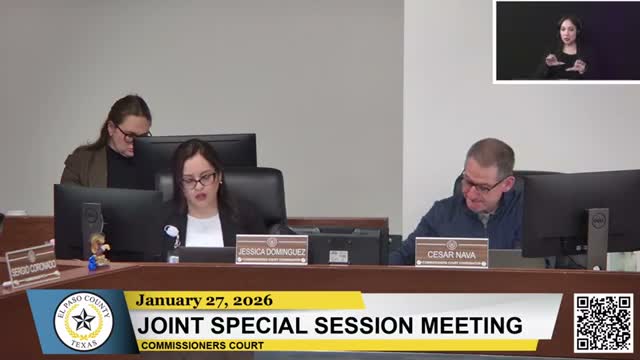
EL PASO, Texas — County commissioners on Tuesday heard a joint briefing with Emergency Services District No. 2 on a preliminary Insurance Services Office (ISO) community classification that temporarily logged parts of ESD 2 as a class 10, an outcome officials said was driven largely by missing training entries and a lack of hydrant flow-testing records.
Chief Esparza of ESD 2 told the Commissioners Court that ISO’s reviewer relied on older, decentralized records from volunteer fire stations that had not been entered into the district’s new records management system. “They went from a class 2, 3, and 4 in some areas of the county to a 10,” Esparza said, describing how unentered or inaccessible training logs and inspection material produced a sharply lower preliminary score.
The rating matters because ISO scores are reviewed by state authorities and the resulting products are made available to private insurers, which can affect residents’ property-insurance availability and premiums. William Michael Peach, a consultant retained by ESD 2, told the court that recent ISO requests for formats and historical structure-fire reports have been unusually strict and inconsistent. “A class 10 is no recognized fire protection,” Peach said, framing the preliminary finding as both a local and a broader industry concern.
ESD 2 officials said they moved to a single records-management system on June 1, 2024, and that the district now holds consolidated electronic records for most stations. Staff said they have begun submitting additional structural-fire reports and training documentation to ISO and that a formal rebuttal was submitted in December. Esparza said the state fire marshal’s office has not signed off on the preliminary class-10 classification and that the district expects state review of the materials provided.
Commissioners pressed for specifics about where the rating losses occurred. ESD staff pointed to several scoring subcategories — communications, company personnel, training and water supply — and singled out missing entries for training credits and inspection/flow-testing of hydrants as major point losses. The court heard that ESD 2 oversees about 12 station areas and that the district’s contracts with volunteer stations include $25,000 annual payments; ESD leaders said contract provisions now include withholding portions of that payment (they cited $5,000 to $10,000 ranges) for failures to comply with records and reporting requirements.
The court and ESD also discussed water-supply issues beyond ESD control. Several municipal utility districts (MUDs) and small municipalities maintain water lines and hydrants, some painted “black” to indicate out-of-service; staff said those conditions negatively affected ISO’s water-supply scoring. Commissioners suggested pursuing state-level remedies and targeting portions of a recently announced $2 billion state water-infrastructure allocation toward repairs and flow testing. Commissioner Diaz said he would raise the concern at the state safety board.
Several commissioners asked for a written package: a timeline of ISO contacts and inspections, the district’s rebuttal and a detailed breakdown of each deficiency and the specific steps taken to remediate it. Peach summarized ISO’s procedural window as roughly a 30-day notice to develop a plan and then 90 days to submit it, after which the district would provide the documentation ISO specifies. Esparza said some reviews could take up to a year depending on ISO’s internal queues.
The court did not vote or take formal action on item 4A. Instead it requested that ESD 2 provide a comprehensive written report and an on‑camera presentation in a future session that documents the preliminary scores, the corrective measures already enacted (including the centralized records management and expanded training), and the timeline for any further submissions to ISO.
Next steps: ESD 2 will continue submitting requested structure-fire reports and training records, provide the written timeline and deficiency report to the court, and present those materials in a future meeting. Commissioners indicated they would also explore legislative and intergovernmental avenues to address hydrant and water-supply gaps that are beyond the ESD’s direct control.
Chief Esparza of ESD 2 told the Commissioners Court that ISO’s reviewer relied on older, decentralized records from volunteer fire stations that had not been entered into the district’s new records management system. “They went from a class 2, 3, and 4 in some areas of the county to a 10,” Esparza said, describing how unentered or inaccessible training logs and inspection material produced a sharply lower preliminary score.
The rating matters because ISO scores are reviewed by state authorities and the resulting products are made available to private insurers, which can affect residents’ property-insurance availability and premiums. William Michael Peach, a consultant retained by ESD 2, told the court that recent ISO requests for formats and historical structure-fire reports have been unusually strict and inconsistent. “A class 10 is no recognized fire protection,” Peach said, framing the preliminary finding as both a local and a broader industry concern.
ESD 2 officials said they moved to a single records-management system on June 1, 2024, and that the district now holds consolidated electronic records for most stations. Staff said they have begun submitting additional structural-fire reports and training documentation to ISO and that a formal rebuttal was submitted in December. Esparza said the state fire marshal’s office has not signed off on the preliminary class-10 classification and that the district expects state review of the materials provided.
Commissioners pressed for specifics about where the rating losses occurred. ESD staff pointed to several scoring subcategories — communications, company personnel, training and water supply — and singled out missing entries for training credits and inspection/flow-testing of hydrants as major point losses. The court heard that ESD 2 oversees about 12 station areas and that the district’s contracts with volunteer stations include $25,000 annual payments; ESD leaders said contract provisions now include withholding portions of that payment (they cited $5,000 to $10,000 ranges) for failures to comply with records and reporting requirements.
The court and ESD also discussed water-supply issues beyond ESD control. Several municipal utility districts (MUDs) and small municipalities maintain water lines and hydrants, some painted “black” to indicate out-of-service; staff said those conditions negatively affected ISO’s water-supply scoring. Commissioners suggested pursuing state-level remedies and targeting portions of a recently announced $2 billion state water-infrastructure allocation toward repairs and flow testing. Commissioner Diaz said he would raise the concern at the state safety board.
Several commissioners asked for a written package: a timeline of ISO contacts and inspections, the district’s rebuttal and a detailed breakdown of each deficiency and the specific steps taken to remediate it. Peach summarized ISO’s procedural window as roughly a 30-day notice to develop a plan and then 90 days to submit it, after which the district would provide the documentation ISO specifies. Esparza said some reviews could take up to a year depending on ISO’s internal queues.
The court did not vote or take formal action on item 4A. Instead it requested that ESD 2 provide a comprehensive written report and an on‑camera presentation in a future session that documents the preliminary scores, the corrective measures already enacted (including the centralized records management and expanded training), and the timeline for any further submissions to ISO.
Next steps: ESD 2 will continue submitting requested structure-fire reports and training records, provide the written timeline and deficiency report to the court, and present those materials in a future meeting. Commissioners indicated they would also explore legislative and intergovernmental avenues to address hydrant and water-supply gaps that are beyond the ESD’s direct control.
View the Full Meeting & All Its Details
This article offers just a summary. Unlock complete video, transcripts, and insights as a Founder Member.
✓
Watch full, unedited meeting videos
✓
Search every word spoken in unlimited transcripts
✓
AI summaries & real-time alerts (all government levels)
✓
Permanent access to expanding government content
30-day money-back guarantee
