South Pasadena staff outline SB 79 impacts around Mission Meridian station; council favors combined delay and alternative‑plan approach
January 28, 2026 | South Pasadena City, Los Angeles County, California
This article was created by AI summarizing key points discussed. AI makes mistakes, so for full details and context, please refer to the video of the full meeting. Please report any errors so we can fix them. Report an error »
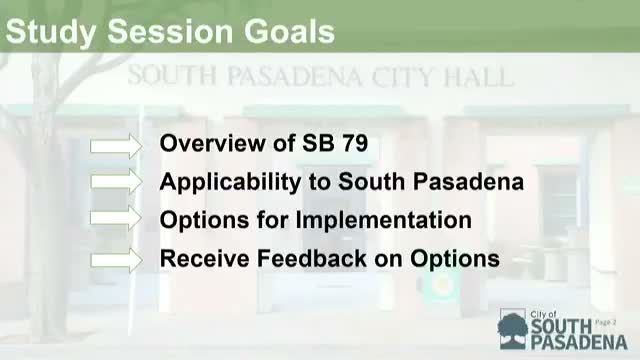
South Pasadena City Council and the Planning Commission held a joint study session on Jan. 14, 2026, to review Senate Bill 79 (the Abundant and Affordable Homes Near Transit Act) and how it would apply to the area around the city’s Metro A Line station. City attorneys and planning staff outlined statutory standards, mapping and state review processes, and presented four implementation options, and commissioners and council members urged rapid local analysis before the law’s July 1, 2026, effective date.
The presentation by city staff described SB 79 as a state law that "preempts and overrides local zoning to allow greater heights and densities for residential development within TOD zones," and said it creates two TOD tiers with different radii and standards. Staff told the body that the statute’s base SB 79 requirements include a minimum 100 dwelling units per acre, a 65‑foot height limit, and a 3.0 floor‑area ratio in the quarter‑mile TOD area; projects within 200 feet of a TOD stop may qualify for an "adjacency intensifier" that raises those limits further. The staff presentation also noted affordability thresholds (the bill’s affordability provisions trigger at projects of 11 units or more) and outlined statutory exclusions for sites that would require demolition of housing subject to rent or price controls and sites with certain historic resources.
City attorneys and staff explained the state review process: HCD (the California Department of Housing and Community Development) must adopt counting standards and will review local ordinances or alternative plans; SCAG will produce regional TOD maps that carry a rebuttable presumption of validity for applicants and jurisdictions. Staff warned the council that HCD’s statutory review timelines and SCAG mapping schedules create a compressed implementation timetable, producing a potential gap beginning July 1, 2026, if the city has not adopted an alternative compliance path.
Staff also gave an early capacity estimate for the quarter‑mile TOD area. "For the quarter mile, the net capacity number of units is approximately 15,000," a staff analyst said, while noting that figure did not yet account for any local exclusions or an alternative‑plan redistribution. Staff later clarified that their parcel‑level calculation counted parcels zoned and eligible for SB 79 treatment and did not remove parks, streets or parcels that might later be excluded under a local option.
Council members and commissioners pressed staff on several practical issues: how SCAG will measure station access points, whether state or national historic registers count toward the statute’s local‑register exclusion, how ministerial versus discretionary approvals affect CEQA review, and whether AB 1482 tenant protections qualify a site for exclusion. Staff said they are researching those legal questions and will consult outside housing counsel as needed.
Public commenters raised infrastructure, historic‑preservation and displacement concerns. One resident who identified himself as the owner of 4966 Harriman Avenue objected to a related consent item and alleged that spending discretionary funds would pose a “serious conflict of interest” because of past private conflicts with Mayor Pro Tem Omari Ferguson. Another commenter urged the city to pursue a temporary hold and an alternative plan rather than defaulting to the state law.
After discussion, multiple commissioners and council members favored Option D — a combined approach that would (1) pursue temporary, site‑specific delayed effectuation or exclusions where the statute allows and (2) prepare a local alternative plan that redistributes capacity away from sensitive parcels. Commissioners asked staff to return with a detailed scope for consultant modeling that can produce parcel‑level massing, capacity and feasibility scenarios tied to potential alternative‑plan choices. Staff said the next steps would include preparing a consultant scope and coordinating with regional partners and Pasadena on legal and legislative advocacy.
The council did not take a formal legislative action on SB 79 at the meeting. The meeting included a separate, earlier consent‑calendar vote approving two consent items (items 2 and 3) before the study session portion; the consent motion passed on a verbal roll‑call vote. The joint study session was adjourned at 8:37 p.m.
The city directed staff to: prepare a consultant scope to model parcel‑level options and massing for an alternative plan, seek clarifications from HCD on register and exclusion questions, and coordinate regionally about pending cleanup legislation and potential infrastructure funding.
The presentation by city staff described SB 79 as a state law that "preempts and overrides local zoning to allow greater heights and densities for residential development within TOD zones," and said it creates two TOD tiers with different radii and standards. Staff told the body that the statute’s base SB 79 requirements include a minimum 100 dwelling units per acre, a 65‑foot height limit, and a 3.0 floor‑area ratio in the quarter‑mile TOD area; projects within 200 feet of a TOD stop may qualify for an "adjacency intensifier" that raises those limits further. The staff presentation also noted affordability thresholds (the bill’s affordability provisions trigger at projects of 11 units or more) and outlined statutory exclusions for sites that would require demolition of housing subject to rent or price controls and sites with certain historic resources.
City attorneys and staff explained the state review process: HCD (the California Department of Housing and Community Development) must adopt counting standards and will review local ordinances or alternative plans; SCAG will produce regional TOD maps that carry a rebuttable presumption of validity for applicants and jurisdictions. Staff warned the council that HCD’s statutory review timelines and SCAG mapping schedules create a compressed implementation timetable, producing a potential gap beginning July 1, 2026, if the city has not adopted an alternative compliance path.
Staff also gave an early capacity estimate for the quarter‑mile TOD area. "For the quarter mile, the net capacity number of units is approximately 15,000," a staff analyst said, while noting that figure did not yet account for any local exclusions or an alternative‑plan redistribution. Staff later clarified that their parcel‑level calculation counted parcels zoned and eligible for SB 79 treatment and did not remove parks, streets or parcels that might later be excluded under a local option.
Council members and commissioners pressed staff on several practical issues: how SCAG will measure station access points, whether state or national historic registers count toward the statute’s local‑register exclusion, how ministerial versus discretionary approvals affect CEQA review, and whether AB 1482 tenant protections qualify a site for exclusion. Staff said they are researching those legal questions and will consult outside housing counsel as needed.
Public commenters raised infrastructure, historic‑preservation and displacement concerns. One resident who identified himself as the owner of 4966 Harriman Avenue objected to a related consent item and alleged that spending discretionary funds would pose a “serious conflict of interest” because of past private conflicts with Mayor Pro Tem Omari Ferguson. Another commenter urged the city to pursue a temporary hold and an alternative plan rather than defaulting to the state law.
After discussion, multiple commissioners and council members favored Option D — a combined approach that would (1) pursue temporary, site‑specific delayed effectuation or exclusions where the statute allows and (2) prepare a local alternative plan that redistributes capacity away from sensitive parcels. Commissioners asked staff to return with a detailed scope for consultant modeling that can produce parcel‑level massing, capacity and feasibility scenarios tied to potential alternative‑plan choices. Staff said the next steps would include preparing a consultant scope and coordinating with regional partners and Pasadena on legal and legislative advocacy.
The council did not take a formal legislative action on SB 79 at the meeting. The meeting included a separate, earlier consent‑calendar vote approving two consent items (items 2 and 3) before the study session portion; the consent motion passed on a verbal roll‑call vote. The joint study session was adjourned at 8:37 p.m.
The city directed staff to: prepare a consultant scope to model parcel‑level options and massing for an alternative plan, seek clarifications from HCD on register and exclusion questions, and coordinate regionally about pending cleanup legislation and potential infrastructure funding.
View the Full Meeting & All Its Details
This article offers just a summary. Unlock complete video, transcripts, and insights as a Founder Member.
✓
Watch full, unedited meeting videos
✓
Search every word spoken in unlimited transcripts
✓
AI summaries & real-time alerts (all government levels)
✓
Permanent access to expanding government content
30-day money-back guarantee
