Middletown planning commission reviews wide-ranging development-code draft and schedules public review
January 28, 2026 | Middletown City Council, Middletown, Butler County, Ohio
This article was created by AI summarizing key points discussed. AI makes mistakes, so for full details and context, please refer to the video of the full meeting. Please report any errors so we can fix them. Report an error »
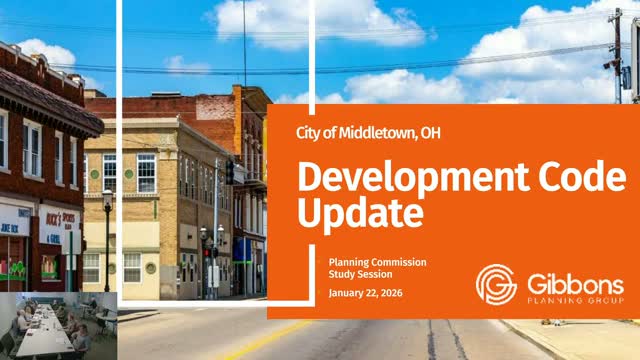
A consultant and city staff presented a second-phase draft of Middletown's development-code update to the Planning Commission, proposing changes to zoning districts, new land-use categories and a timetable for public review.
The update would reorganize chapter 12-04 (zoning districts and allowable land uses), add guidance in 12-06 for accessory and temporary uses, and revise definitions in 12-30. Lead presenter (staff) told the commission that the draft ties zone purpose statements directly to the city's comprehensive plan and adds uses such as vocational and trade schools, mobile food vendors and stand-alone pharmacies.
"We have more of these study sessions planned, but this is really phase 2," the lead presenter said, describing the package as three chapters that implement the comprehensive plan. Brent, a consultant on the project, said community outreach produced 284 survey responses that informed recommendations.
Why it matters: the changes would alter what land uses are allowed across the city and how new development is reviewed. The draft includes options that aim to increase housing variety and economic flexibility but also raises questions about neighborhood character and enforcement.
Key details: the draft proposes:
- Reworked purpose statements for every district and explicit links to comprehensive-plan designations.
- New land-use categories (for example, vocational/trade schools and clarified rules for food trucks and pharmacies).
- A zoning-verification process and associated fee so property owners can request official use and zoning confirmation.
Commissioners asked staff to produce tangible examples showing how codified overlay standards ("teeth") would affect specific parcels compared with a guideline-only approach. Staff agreed to prepare mock cases, noting that overlays could either simply reference the comprehensive plan or impose enforceable local requirements.
Next steps: staff said it will return with general development standards in April, issue a public-review draft ahead of a June workshop, bring public feedback to the commission in July, and begin hearings in the fall. Staff estimated an adoption timeline of roughly nine to 10 months from the present draft.
The update would reorganize chapter 12-04 (zoning districts and allowable land uses), add guidance in 12-06 for accessory and temporary uses, and revise definitions in 12-30. Lead presenter (staff) told the commission that the draft ties zone purpose statements directly to the city's comprehensive plan and adds uses such as vocational and trade schools, mobile food vendors and stand-alone pharmacies.
"We have more of these study sessions planned, but this is really phase 2," the lead presenter said, describing the package as three chapters that implement the comprehensive plan. Brent, a consultant on the project, said community outreach produced 284 survey responses that informed recommendations.
Why it matters: the changes would alter what land uses are allowed across the city and how new development is reviewed. The draft includes options that aim to increase housing variety and economic flexibility but also raises questions about neighborhood character and enforcement.
Key details: the draft proposes:
- Reworked purpose statements for every district and explicit links to comprehensive-plan designations.
- New land-use categories (for example, vocational/trade schools and clarified rules for food trucks and pharmacies).
- A zoning-verification process and associated fee so property owners can request official use and zoning confirmation.
Commissioners asked staff to produce tangible examples showing how codified overlay standards ("teeth") would affect specific parcels compared with a guideline-only approach. Staff agreed to prepare mock cases, noting that overlays could either simply reference the comprehensive plan or impose enforceable local requirements.
Next steps: staff said it will return with general development standards in April, issue a public-review draft ahead of a June workshop, bring public feedback to the commission in July, and begin hearings in the fall. Staff estimated an adoption timeline of roughly nine to 10 months from the present draft.
View the Full Meeting & All Its Details
This article offers just a summary. Unlock complete video, transcripts, and insights as a Founder Member.
✓
Watch full, unedited meeting videos
✓
Search every word spoken in unlimited transcripts
✓
AI summaries & real-time alerts (all government levels)
✓
Permanent access to expanding government content
30-day money-back guarantee
