Commission debates smaller single-family minimums and accessory dwelling units as tools for attainable housing
January 28, 2026 | Middletown City Council, Middletown, Butler County, Ohio
This article was created by AI summarizing key points discussed. AI makes mistakes, so for full details and context, please refer to the video of the full meeting. Please report any errors so we can fix them. Report an error »
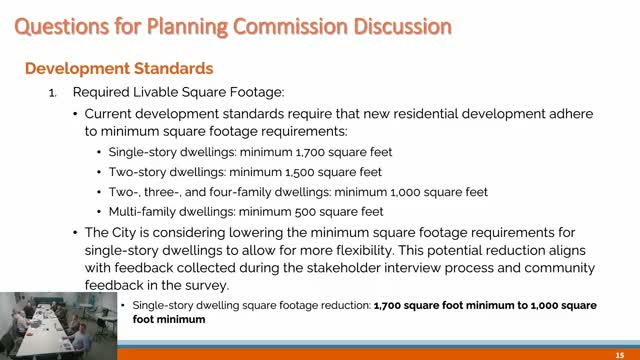
Lead presenter and consultants described proposed changes intended to broaden housing choices in Middletown, including a draft recommendation to lower the minimum size for single-story single-family (ranch) homes from 1,700 square feet to 1,000 square feet and to revise lot-size standards in R2 and R3 districts.
"We're proposing reducing the single-story ranch single-family typology from what is currently a 1,700 square-foot requirement, and lowering that to 1,000 square feet," the presenter said, framing the change as a tool to create lower price points for first-time homebuyers.
Commissioners voiced mixed reactions. Several said they'd support smaller minimums in principle but wanted guardrails: one commissioner suggested a practical floor of 1,200 sq ft to account for an expanded administrative waiver (20%), and others warned that overly small houses could worsen energy inefficiency and neighborhood fit. Staff noted planned design standards and permit controls would still apply to any smaller units.
On accessory dwelling units, commissioners discussed multiple implementation choices: allow ADUs by right in some zones, permit them conditionally in others, require owner-occupancy of the primary dwelling, mandate replacement parking when a garage is converted, and ensure plumbing/electrical/building-code inspections for habitability. A staff member said some jurisdictions pre-approve prefab ADU models to speed permitting; commissioners asked for local examples and staged rollouts limited initially to zones where soft density is appropriate.
Why it matters: lowering minimum home sizes and permitting ADUs are widely used to expand attainable owner-occupied housing options without large-scale new subdivisions, but they carry trade-offs for design, parking, infrastructure, and the character of single-family neighborhoods.
Clarifying details: staff cited a proposed administrative waiver increase (20%) that could interact with any new minimums; commissioners asked staff to consider raising a 1,000-sq-ft floor to 1,200 sq ft to prevent effective waiver-driven reductions below desirable standards.
Next step: staff will refine the draft language, analyze waiver interactions and provide example ADU standards and pre-approved models for the commission and the June public-review materials.
"We're proposing reducing the single-story ranch single-family typology from what is currently a 1,700 square-foot requirement, and lowering that to 1,000 square feet," the presenter said, framing the change as a tool to create lower price points for first-time homebuyers.
Commissioners voiced mixed reactions. Several said they'd support smaller minimums in principle but wanted guardrails: one commissioner suggested a practical floor of 1,200 sq ft to account for an expanded administrative waiver (20%), and others warned that overly small houses could worsen energy inefficiency and neighborhood fit. Staff noted planned design standards and permit controls would still apply to any smaller units.
On accessory dwelling units, commissioners discussed multiple implementation choices: allow ADUs by right in some zones, permit them conditionally in others, require owner-occupancy of the primary dwelling, mandate replacement parking when a garage is converted, and ensure plumbing/electrical/building-code inspections for habitability. A staff member said some jurisdictions pre-approve prefab ADU models to speed permitting; commissioners asked for local examples and staged rollouts limited initially to zones where soft density is appropriate.
Why it matters: lowering minimum home sizes and permitting ADUs are widely used to expand attainable owner-occupied housing options without large-scale new subdivisions, but they carry trade-offs for design, parking, infrastructure, and the character of single-family neighborhoods.
Clarifying details: staff cited a proposed administrative waiver increase (20%) that could interact with any new minimums; commissioners asked staff to consider raising a 1,000-sq-ft floor to 1,200 sq ft to prevent effective waiver-driven reductions below desirable standards.
Next step: staff will refine the draft language, analyze waiver interactions and provide example ADU standards and pre-approved models for the commission and the June public-review materials.
Don't Miss a Word: See the Full Meeting!
Go beyond summaries. Unlock every video, transcript, and key insight with a Founder Membership.
✓
Get instant access to full meeting videos
✓
Search and clip any phrase from complete transcripts
✓
Receive AI-powered summaries & custom alerts
✓
Enjoy lifetime, unrestricted access to government data
30-day money-back guarantee
