Commission weighs separation rules for nightlife and dispensaries, food-truck plazas and self-storage height
January 28, 2026 | Middletown City Council, Middletown, Butler County, Ohio
This article was created by AI summarizing key points discussed. AI makes mistakes, so for full details and context, please refer to the video of the full meeting. Please report any errors so we can fix them. Report an error »
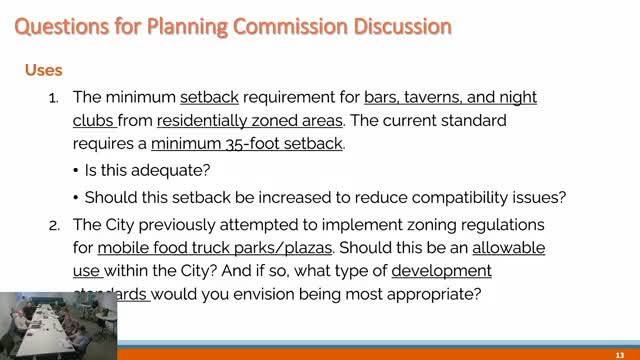
Commissioners and staff debated several nonresidential concerns raised while updating the development code: separation standards for liquor-oriented establishments, dispensary siting, mobile food-truck plazas, and the treatment of self-storage and outdoor vehicle storage.
Separation standards: staff asked whether the current 35-foot setback from residential zones for bars, taverns and nightclubs remains appropriate. Commissioners generally favored a zone-based approach that carves out mixed-use downtown areas while keeping stricter separations adjacent to low-density residential neighborhoods. They discussed performance standards (noise limits, operational hours) and enforcement by police for amplified sound.
Dispensaries: staff noted the Ohio Revised Code (ORC) already imposes setbacks (e.g., 500 feet from schools/parks/churches) and saturation rules that limit where dispensaries can open; commissioners suggested either referencing the ORC in the local code or codifying the same text for clarity.
Food trucks: staff resurfaced a prior proposal for designated "mobile food truck plazas" with infrastructure (electrical hookups, seating and an accountable operator). Commissioners recommended conditional-use review, caps on plaza numbers to protect downtown brick-and-mortar businesses, and accountability requirements for plaza operators.
Self-storage: the code currently limits self-storage building heights to 15 feet. Staff said that cap prevents multistory self-storage in infill settings and proposed letting those facilities comply with the base zoning district height instead; commissioners and economic-development staff warned of low economic return from self-storage versus other uses and suggested design/landscaping standards if taller storage facilities are allowed.
Why it matters: these choices affect where nightlife, dispensaries and logistics-related land uses locate in the city and how they interact with neighborhoods and municipal services.
Next step: staff will refine draft language on setbacks, propose zone carve-outs for true mixed-use areas, model a food-truck plaza conditional-use approach, and present options for self-storage heights and design features in the next draft.
Separation standards: staff asked whether the current 35-foot setback from residential zones for bars, taverns and nightclubs remains appropriate. Commissioners generally favored a zone-based approach that carves out mixed-use downtown areas while keeping stricter separations adjacent to low-density residential neighborhoods. They discussed performance standards (noise limits, operational hours) and enforcement by police for amplified sound.
Dispensaries: staff noted the Ohio Revised Code (ORC) already imposes setbacks (e.g., 500 feet from schools/parks/churches) and saturation rules that limit where dispensaries can open; commissioners suggested either referencing the ORC in the local code or codifying the same text for clarity.
Food trucks: staff resurfaced a prior proposal for designated "mobile food truck plazas" with infrastructure (electrical hookups, seating and an accountable operator). Commissioners recommended conditional-use review, caps on plaza numbers to protect downtown brick-and-mortar businesses, and accountability requirements for plaza operators.
Self-storage: the code currently limits self-storage building heights to 15 feet. Staff said that cap prevents multistory self-storage in infill settings and proposed letting those facilities comply with the base zoning district height instead; commissioners and economic-development staff warned of low economic return from self-storage versus other uses and suggested design/landscaping standards if taller storage facilities are allowed.
Why it matters: these choices affect where nightlife, dispensaries and logistics-related land uses locate in the city and how they interact with neighborhoods and municipal services.
Next step: staff will refine draft language on setbacks, propose zone carve-outs for true mixed-use areas, model a food-truck plaza conditional-use approach, and present options for self-storage heights and design features in the next draft.
Don't Miss a Word: See the Full Meeting!
Go beyond summaries. Unlock every video, transcript, and key insight with a Founder Membership.
✓
Get instant access to full meeting videos
✓
Search and clip any phrase from complete transcripts
✓
Receive AI-powered summaries & custom alerts
✓
Enjoy lifetime, unrestricted access to government data
30-day money-back guarantee
